
Today, millions of people continue to face terrifying realities as families are uprooted by conflict, children are weakened by hunger, and communities are shattered by disaster.
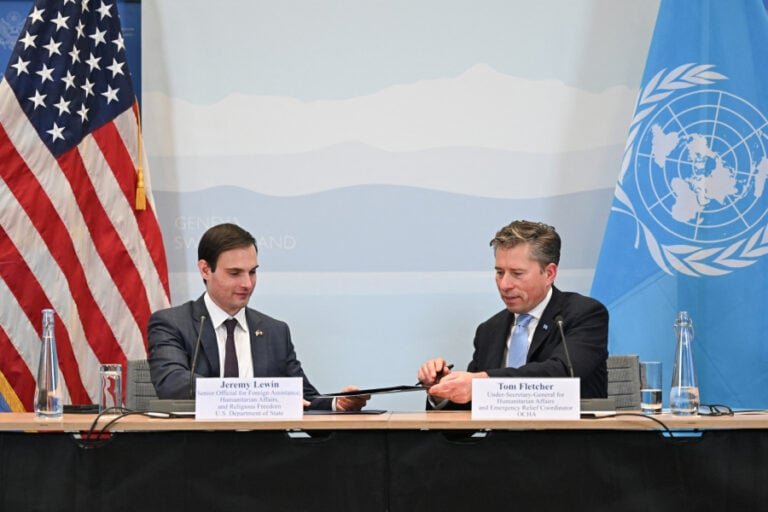
In response to this escalating global crisis, a landmark agreement between the United States and the United Nations seeks to provide aid as well as fundamentally transform its delivery. The landmark Sh257.80 billion ($2 billion) partnership between the U.S.
Department of State and the UN’s Office for the Coordination of Humanitarian Affairs (OCHA) is a critical step toward saving lives with greater speed, efficiency, and compassion. However, it dwarfs what the U.S. previously contributed in terms of aid.
For instance, in 2022, U.S. contribution to the UN’s humanitarian work was estimated at Sh2.19 trillion ($17 billion). The Memorandum of Understanding (MoU) signed between the two parties is the cornerstone of what the UN calls its “Humanitarian Reset.”
It is a direct response to a simple, urgent truth: as needs escalate globally, the old ways of working are no longer enough. It is an initiative designed to cut through bureaucracy and place aid closer to the front lines of emergencies.
- USAID closure sparks fears of global health crisis, millions at risk
- US funding freeze sparks crisis in Kenya’s refugee camps
According to Tom Fletcher, UN Under-Secretary-General for Humanitarian Affairs and Emergency Relief Coordinator, the expectation of this agreement is that it will save millions of lives.
“Hundreds of millions of people are alive today because of U.S. generosity, and many millions more will survive in 2026 because of this landmark investment in humanity,” said Tom Fletcher.
The staggering goal of the new agreement is to save 87 million lives in 2026, a mission that demands action that is faster, smarter, and crucially, closer to the people on the frontlines of emergencies.
This means eliminating duplication, prioritizing the hardest-hit communities, and ensuring aid reaches those who need it most, when they need it most.
To achieve this, the agreement establishes a bold new paradigm, replacing a fragmented system of individual project grants with consolidated, flexible funds at the country or crisis level, administered by OCHA.
This streamlined approach is governed by comprehensive country-level policy agreements, ensuring that every dollar is aligned with clear, life-saving priorities and U.S. oversight.
The intended result is a system that is more accountable to taxpayers and more efficient, aiming to nearly double the life-saving impact of each dollar spent through UN channels.
The agreement will cover 17 crisis-affected countries: Guatemala, Honduras, El Salvador, Ukraine, Haiti, Nigeria, Ethiopia, South Sudan, Mozambique, Myanmar, the Democratic Republic of the Congo (DRC), Sudan, Bangladesh, Syria, Uganda, Kenya, and Chad, as well as the UN Central Emergency Response Fund (CERF).
Nonetheless, the painful reality remains that this reduced funding, spread across 17 crisis-affected countries and a global emergency fund, will inevitably leave multitudes in need.
Email your news TIPS to Editor@nairobilawmonthly.com, and to advertise with us, call +254715061658 anytime of the day
