

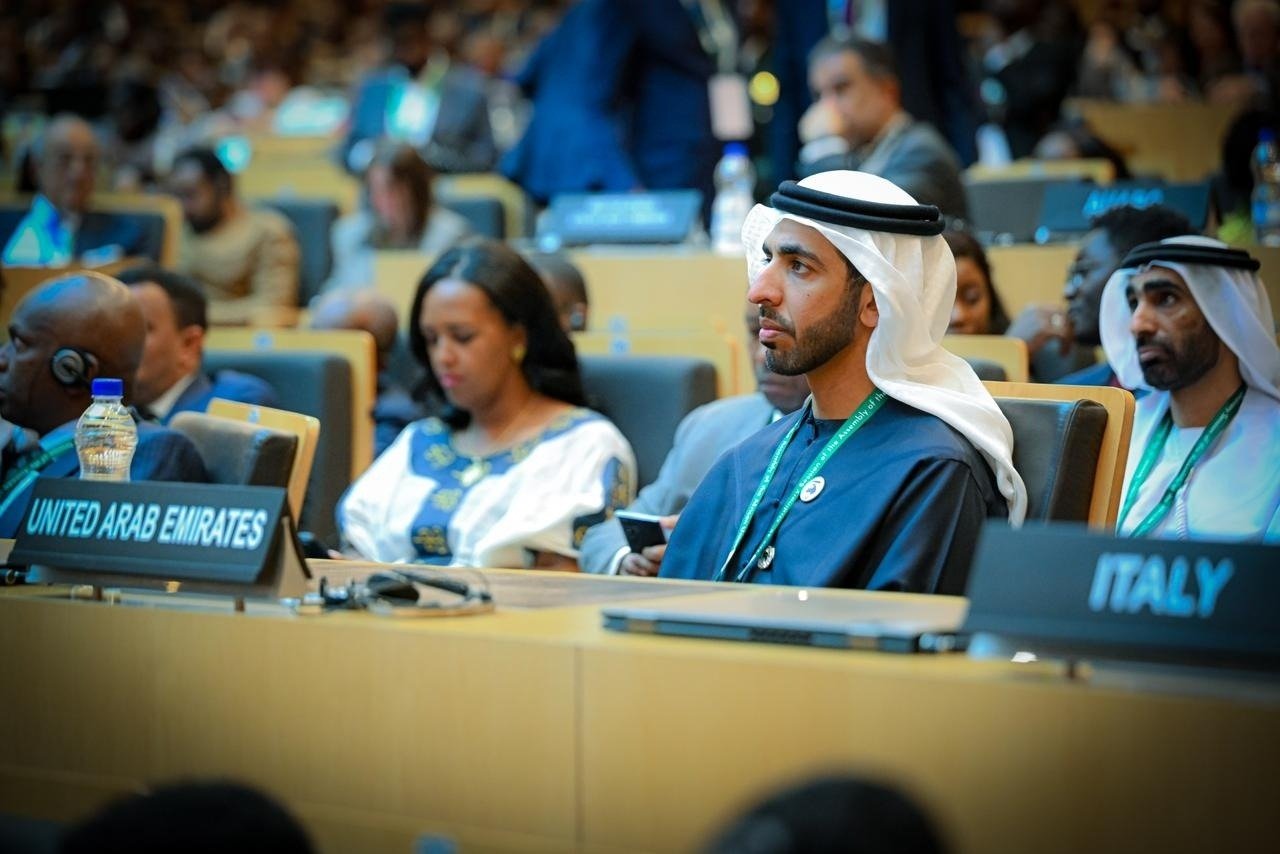
The United Arab Emirates (UAE) is signaling a long-term bet on Africa’s economic growth, committing more than $110 billion across the continent between 2019 and 2023, with over $70 billion directed to energy, green and renewable sectors.
As the 39th session of the Assembly of the African Union (AU) concluded on February 15, in Addis Ababa, it became clear that besides this scale of capital, the highest by any country in that period, momentum is building around clean energy financing.

Under the Africa Green Investment Initiative, $4.5 billion has been mobilised for more than 60 projects spanning solar, wind, geothermal, battery storage and green hydrogen.
Complementing this, Masdar renewable programme’s $10 billion Africa programme and the Etihad 7 initiative aim to help expand electricity access to up to 100 million people by 2035, targeting structural power deficits and new generation capacity.
Ethiopia’s Minister of State, Sheikh Shakhbout bin Nahyan Al Nahyan, speaking at the 39th AU summit, in Addis Ababa, said, due to deepening economic ties, leaders need to support the African Union’s Agenda 2063 and deeper cooperation with the African Union Commission to boost member states’ trade and investment, renewable energy, food security, digital transformation, and capacity building.
“Our engagement with Africa is rooted in decades of trade, maritime links, and people-to-people connections across the Red Sea and Indian Ocean corridors,” he said, noting that that historic connectivity is reflected in a growing diplomatic footprint (19 embassies in Sub-Saharan Africa) with further expansion underway.
“At the same time,” he added, “African diplomatic representation in the UAE continues to grow, reinforcing our country’s role as a hub for African trade, finance, and dialogue.”
In recent years, trade architecture between the UAE and African partners has been expanding. The UAE has concluded 9 Comprehensive Economic Partnership Agreements with African countries — Nigeria, DRC, Sierra Leone, Gabon, Angola, Kenya, Congo-Brazzaville, Mauritius and the Central African Republic.
These deals extend beyond tariff reductions to services, digital trade and investment protection, and are designed to complement the African Continental Free Trade Area by strengthening value chains and cross-border competitiveness.
Logistics investments are reinforcing these trade flows, with supply chain player DP World expanding its operations across African ports, including a $1 billion upgrade of Dar es Salaam Port in Tanzania.
Abu Dhabi-based trade and logistics firm, AD Ports has also broken ground on a new terminal in Luanda to significantly increase Angola’s container capacity — long-term assets aligned with regional integration ambitions.
All these developments show that stronger ties with Arab countries remain a key driver of economic development. Nearly 40 percent of the UAE’s total foreign assistance over the past decade — approximately $20.9 billion — for example, has been directed to African countries in the form of development, humanitarian and charitable support.
Looking ahead, water and climate resilience are rising on the joint agenda. The UAE will co-host the 2026 UN Water Conference with Senegal from 2–4 December 2026 — the first time two Global South countries will jointly lead this global process — underscoring a shared commitment to accelerating progress on water security and sanitation, a central development challenge across Africa.
Email your news TIPS to Editor@nairobilawmonthly.com, and to advertise with us, call +254715061658 anytime of the day
