

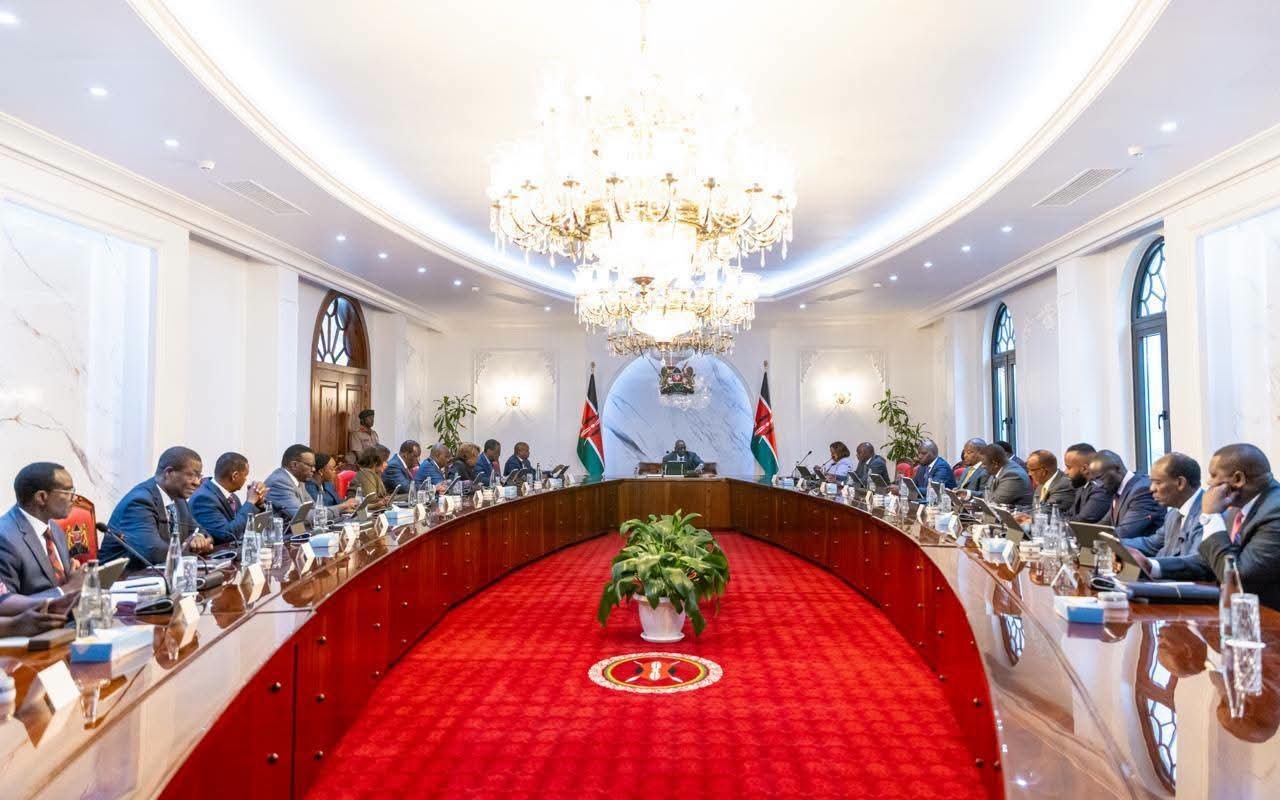
President William Ruto has been ordered to reconstitute his Cabinet within 120 days after the High Court ruled that its current composition breaches the Constitution’s two-thirds gender principle.
In a majority decision delivered on Wednesday, Justices Fred Ogola and Stephen Githinji found that the Cabinet does not meet the constitutional requirement for gender representation, while Justice Jairus Ngaah issued a dissenting opinion challenging both the reappointment of dismissed Cabinet Secretaries and the inclusion of opposition politicians in government.
The court found that the 25-member Cabinet comprises 18 men and seven women, giving women approximately 28 per cent representation—below the constitutional threshold of at least one-third.
The judges further held that the Secretary to the Cabinet could not be included in the gender calculation, noting that Article 152(1) of the Constitution recognises only the President, Deputy President, Attorney General, and Cabinet Secretaries as members of the Cabinet.
“The current Cabinet does not comply with the two-thirds gender principle,” the judges ruled, directing the President to comply with Article 27 of the Constitution within 120 days.
The petitions were filed following President Ruto’s decision to dissolve his Cabinet in July 2024 after Gen Z-led protests, before reappointing several former Cabinet Secretaries and bringing a number of Orange Democratic Movement (ODM) politicians into what the government described as a broad-based administration.
On the issue of reappointing ministers who had previously been dismissed, the majority held that the President acted within his constitutional mandate under Article 152(5)(b). The judges ruled that the President’s authority to appoint and dismiss Cabinet Secretaries does not automatically raise integrity concerns under Chapter Six of the Constitution.
The court also upheld the National Assembly’s approval process for the nominees, finding that the constitutional requirement for public participation had been met. It further dismissed claims that the appointment of the Attorney General was unconstitutional, ruling that the office is not subject to the same competitive recruitment process applicable to the Director of Public Prosecutions.
However, Justice Ngaah strongly disagreed with the majority’s findings.
“Why would the President renominate people he had found to be ineffective and dismissed them to the same positions?” Justice Ngaah asked, arguing that Article 259(10) only permits the reappointment of a dismissed State Officer if they remain qualified to hold office.
He maintained that the President’s reasons for dissolving the Cabinet weakened the justification for returning many of the same individuals to office.
Justice Ngaah also faulted the appointment of ODM politicians to the Cabinet, arguing that bringing opposition Members of Parliament into government without a formal coalition agreement contravenes the Political Parties Act.
“Opposition MPs can only be co-opted into government through the framework of Sections 10 and 11 of the Political Parties Act,” he ruled.
“The only means by which a ruling party can partner with the opposition is through the framework of a coalition.”
In his dissent, Justice Ngaah further underscored the judiciary’s constitutional responsibility to check executive action.
“When the President frustrates the Constitution, it is the duty of the Court to rise up and safeguard the Constitution,” he said, citing Article 131(2)(a), which requires the Head of State to respect, uphold, and safeguard the Constitution.
While the majority upheld the legality of the Cabinet reappointments and the parliamentary vetting process, its order requiring the President to comply with the constitutional gender rule within 120 days presents the administration with a fresh legal and political test.
Email your news TIPS to Editor@nairobilawmonthly.com, and to advertise with us, call +254715061658 anytime of the day
