

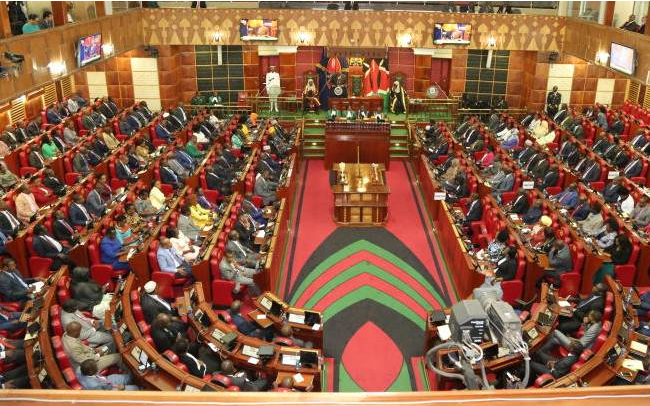
Parliament plans to summon principals of large secondary schools to explain the management of institutional funds, even as the Ministry of Education blamed chronic underfunding and delayed release of Exchequer funds for the financial challenges facing schools, TVET institutions and universities.
The revelations were made during a parliamentary committee sitting where Education Cabinet Secretary Julius Ogamba appeared before lawmakers.

Committee Chairperson Dick Maungu said the committee had already begun receiving reports on the management of funds in secondary schools and would soon begin summoning principals.
“We have since begun receiving reports of high schools and very soon we shall be summoning principals of high schools. We’ve discovered that a lot of these schools oversee huge amounts of funds, yet they have not been able to appear before us,” Maungu said.
He said the committee was preparing a framework that would require principals of large secondary schools, especially national schools, to personally explain how their institutions manage taxpayers’ money.
“We shall be beginning very soon with C1 schools and thereafter move to C2 schools and any other institution the committee may find necessary to summon,” he said.
Maungu noted that some institutions with only about 120 students account for their finances before Parliament, while larger schools handling much bigger budgets have not faced similar scrutiny.
The committee’s move comes as more than 1.1 million secondary school students await capitation funds amid rising enrolment and budget allocations that have failed to match the growing cost of education.
Appearing before the committee, Education Cabinet Secretary Julius Ogamba denied claims that the ministry was withholding funds, saying the real problem was inadequate allocations and delayed disbursement by the National Treasury.
“Our challenge is not that the Ministry sits on money. The problem is that the resources released by the National Treasury fall far below the actual funding requirements, and when the Exchequer is delayed, institutions inevitably experience cash flow challenges,” Ogamba said.
He told MPs that TVET institutions have continued receiving an annual capitation allocation of Sh5.2 billion despite increasing student enrolment.
According to the ministry, Sh7.9 billion has already been disbursed under the student-centred funding model to nearly 200,000 trainees, but the programme is still facing a funding deficit of about Sh14.9 billion.
Ogamba also said public universities required Sh29.9 billion during the 2025/26 financial year but received only Sh18 billion, leaving a funding gap of nearly Sh11.5 billion.
He added that continuing students under the previous Differentiated Unit Cost model required Sh40.4 billion, but only Sh23 billion was allocated, creating a further Sh17.4 billion shortfall.
– By Esther Keshe
Email your news TIPS to Editor@nairobilawmonthly.com, and to advertise with us, call +254715061658 anytime of the day
