

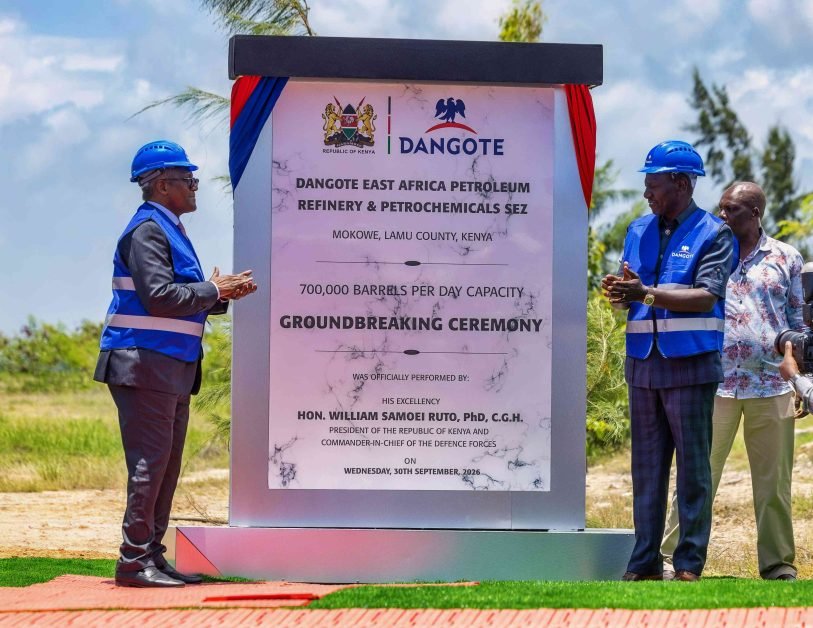
Construction of the Sh2.2 trillion Dangote East Africa Refinery in Lamu can go ahead after a court in Malindi declined to issue fresh interim orders to maintain the status quo while a land and environmental dispute is resolved.
In a preliminary ruling on Wednesday, October 14, 2026, Justice Jane Onyango declined to issue fresh interim orders to maintain the status quo. This clears the way for the government and Nigerian billionaire Aliko Dangote to continue developing the 700,000-barrel-a-day facility, set to be one of the largest oil refineries in the world.

The judge found that the petitioners, 133 Lamu residents, had not served Dangote and the state agencies named in their case, as the court had directed earlier. “You did not serve the respondents as per the October 1, 2026, directions. Serve him and all parties within 14 days before the hearing. Leave is granted to amend the petition within seven days,” Justice Onyango said.
“Serve Dangote properly before we can proceed to a hearing,” she added. The court also noted that the petition referred to the wrong parcel of land, which is located in Watamu rather than Lamu, and allowed the residents to amend their papers to show the correct property and village names.
The respondents argued that the earlier orders could not stand. “Service is mandatory. I have not been served and was not aware of this matter,” said Gitonga, the lawyer for Southern Engineering Company Limited (SECO).
Waswa, representing the Attorney General, told the court: “Interim orders were to be extended upon serving us. The land in Lamu has no orders as it stands.” Khaoya, for the National Land Commission (NLC), asked the court to vacate the orders, arguing that they related to “a different parcel of land in Watamu.”
For the residents, petitioner Wakahiu raised concerns about activity at the site, where soil-testing works have begun. “I am worried about what is happening on the ground,” he said.
In their petition, the residents claim that the refinery threatens their property rights and that the developers have not shown compliance with environmental laws. The project is expected to cover between 7,000 and 10,000 acres, including the contested Magogoni area.
On September 25, the Malindi Environment and Land Court had ordered the status quo to be maintained on the disputed parcel pending a hearing, but it did not stop the groundbreaking ceremony. The case will be mentioned again on November 24, 2026.
The government maintains that the site is public land. Lands Cabinet Secretary Alice Wahome has said that most of the roughly 7,000-acre site is owned by the State. She has explained that people living on parts of the land do not, by that fact alone, make it private property, and has described those she accused of settling squatters on the site as “enemies of development.”
President William Ruto and Dangote formally launched construction on September 30, 2026. The President promised residents that “Land matters will be handled lawfully and fairly,” and said the State would compensate owners of any land needed beyond the government-owned site. Dangote committed to an ambitious timeline.
“I want to promise you that we will come back and commission this refinery 40 months from today,” he said. He also pledged to train local people: “We will set up a training school in Lamu which will train 1,000 of your people.”
The refinery, which will include a 1,000-megawatt power plant, forms part of the Lamu Port-South Sudan-Ethiopia Transport (LAPSSET) Corridor and is expected to be commissioned by 2030. The President has said it will create more than 60,000 direct and indirect jobs.
“At peak, the construction wages could reach Ksh. 2 billion,” he said. The government has also announced Sh7.5 billion for 3,000 housing units in Lamu to support the development.
Email your news TIPS to Editor@nairobilawmonthly.com, and to advertise with us, call +254715061658 anytime of the day
