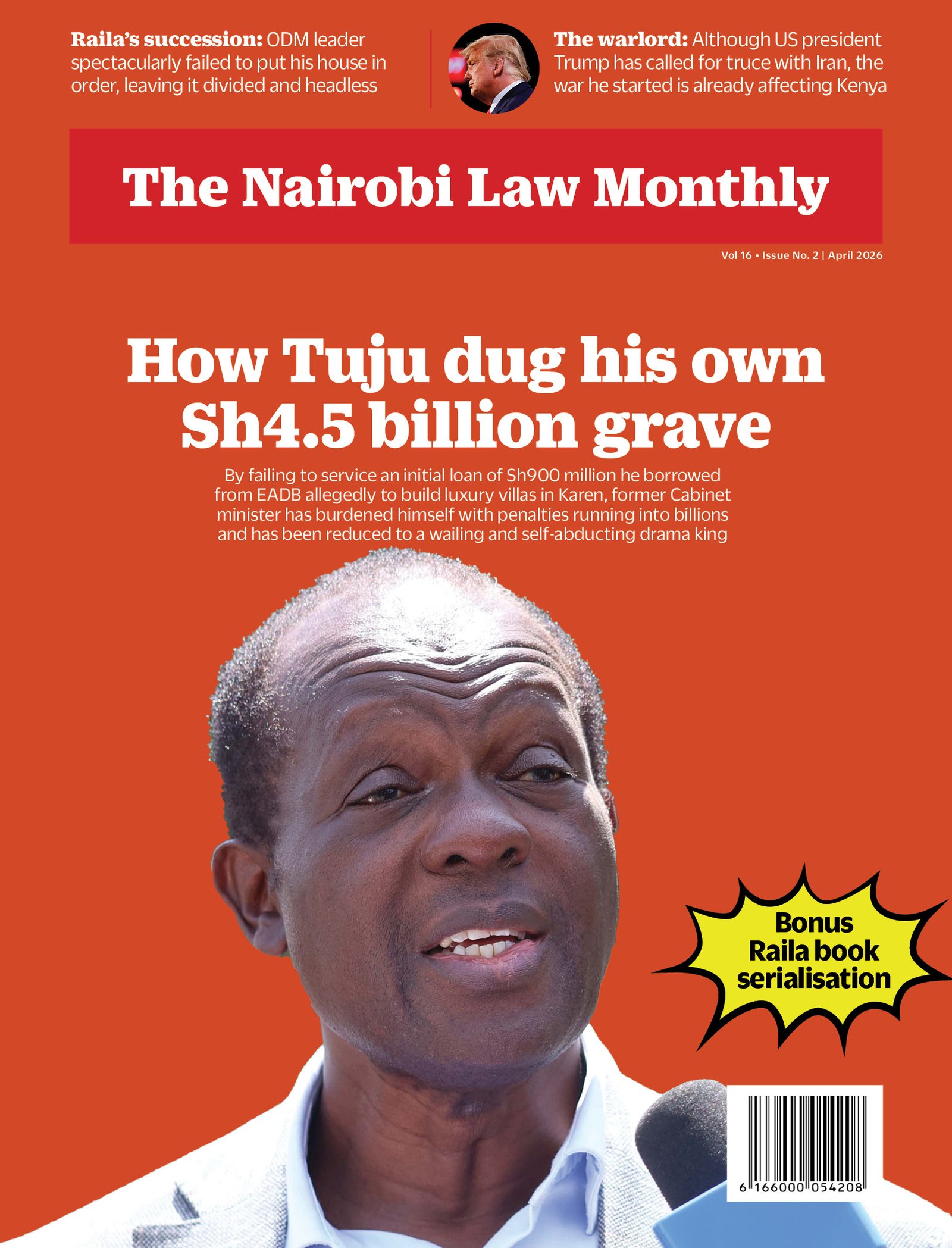
The current governor of Kisumu county, Prof. Peter Anyang’ Nyong’o studied at Alliance High School and Makerere University, where he earned a Bachelor’s degree in Political Science & Philosophy; he graduated with a first class. He was also a student leader at university. He went on to join the University of Chicago for a degree in Political Science, and a Master’s in Political Economy from the same university. When he returned to Kenya, he taught at the University of Nairobi between 1977 and 1981. In 1982, he took up the role of a Visiting Research Officer at the El Colegio…
Author: NLM Correspondent

NLM Correspondent
📢 Got a Story That Needs Coverage? Let Nairobi Law Monthly be your platform! Whether it's breaking news or an in-depth feature, we're here to amplify your voice. 📧 Email Us: editor@nairobilawmonthly.com ✨ Advertising Opportunities Available! Promote your brand to our engaged audience. Contact us today to discuss advertising options. 📞 Call Anytime: +254715061658 Don't miss out on the chance to reach a wider audience and make an impact. Get in touch with Nairobi Law Monthly now!
Ethiopian athlete who protested at Rio is back home Exiled Ethiopian marathoner Feyisa Lilesa has returned home. Lilesa landed in the capital Addis Ababa after more than two years in exile. The 28-year-old came into the limelight in 2016 after he crossed the Olympic marathon finish line in Rio by holding his crossed wrists over his head—a gesture of solidarity with the anti-government protests that had been taking place in the Horn of Africa nation. The Oromo, Ethiopia’s largest ethnic group, along with the Amharas, were demonstrating to demand equal economic opportunities, political reform, and an end to the police…
By Alfred Mosoti When driving, particularly in two way traffic, darting between lanes is not just idiotic; it is also dangerous. It confuses and irks other road users, more so oncoming traffic, and can cause head-on collisions. The same principle applies – or ought to apply – in on the political highway. The trend by politician(s) to indoctrinate their fans into certain ethno-political axes before unceremoniously shifting to opposing ones is equally catastrophic! In both scenarios, erratic behaviour is not only detrimental to particular actor(s), but also to the ‘innocent’ followers for, to quote the sages, the hyena split in…
By Edwin Musonye One great wrong in modern Kenya is the sustenance of the permanent and pensionable employment contracts in public service. This practice undermines the principles of equity and equality, given that some citizens are favoured to earn from taxes whilst the rest are only destined to pay those taxes. In the early times following independence, the allocation of the jobs was based on attainment of formal education. And because only few people had such a qualification, most citizens were recruited directly from school under the Africanisation programme, to fill positions left vacant by the colonialists returning home. Unfortunately,…
By Kevin Motaroki The United Nations projects that Africa will have some 1.7 billion people by 2030, and 2.6 billion by 2050. This projected growth poses a real socio-economic challenge because, with its current 1.2 billion people, the continent has perennially fallen short of its food production targets, creating worrying shortages and contributing to the global food crisis. To plug the deficit and forestall future food shortages, the continent needs to produce at least 80 percent more food than it currently does – to both guarantee its food needs and to avoid its overreliance on imports, or aid in dire…
UN High Commissioner for Human Rights Michelle Bachelet last month warned the mass deportation of Congolese nationals from Angola has already resulted in serious human rights violations by security forces on both sides of the border, and left at least 330,000 returnees in an extremely precarious situation. Since the beginning of October, some 330,000 people have reportedly crossed from Angola, mostly into the Kasai, Kasai Central and Kwango provinces of the Democratic Republic of Congo, following an expulsion order by the Government of Angola targeting irregular migrants. In interviews with people in the border town of Kamako in Kasai, the…
By Oscar Okwaro Our political landscape has undergone immense metamorphosis – from an overwhelming sense of patriotic citizenship imbued with nationalism and the commitment to curb illiteracy, poverty and diseases, to a country of systemic ethnic divisions that only find amity at election time. Whereas the patriotism of yesteryears is embedded in the likes of Musalia, they miss out big when critical discourses of national significance are shaped, often on ethnic considerations. The puzzle remains: must leaders convert to ethnic politics to ascend to the presidency? Kenya needs a unifier to usher this nation into a “new dawn”. But who…
By NLM Writer The year was 2005. As one of Equity Bank’s major shareholders, Africap Fund, was leaving, a decision was made that instead of floating the shares at the Nairobi Securities Exchange, employees would be given the chance to own a part of one of the most profitable banks in the country. “I am pleased to inform you that we successfully concluded the purchase of shares from Africap Fund at the modest price of Sh136 per share. The total purchase price was paid to Africap Fund who have transferred the shares to the trust. Equity Bank Employee Share Ownership…
By ANTONY MUTUNGA The World Youth Organisation places the youth – those aged between 10 and 24 years – at 1.8 billion, or 25 percent of the global population. Sadly, this formidability has not translated into robust policy and practice for their welfare. Africa, which accounts for the largest segment of this figure, has one of the largest rates of youth unemployment in the world. World Bank studies say the youth in Africa account for 60 percent of the jobless. In fact, according to the African Development Bank (AfDB), in most African countries youth unemployment occurs at a rate that…
By Joel Okwemba The very nature of soft power in the 21st Century seems to imply a disassociation with real effects of violence and critical security. However, the intricate nature of the utilisation of “soft power” to achieve the benefits of “hard power” demands a compound approach for long lasting stability in view of the changing International Order. It is evident that what is classified as “soft power” is among the first targets for terrorist groups – for instance religious and cultural heritage sites and Educational institutions in the case of Boko Haram in Nigeria and the Taliban in Pakistan.…