

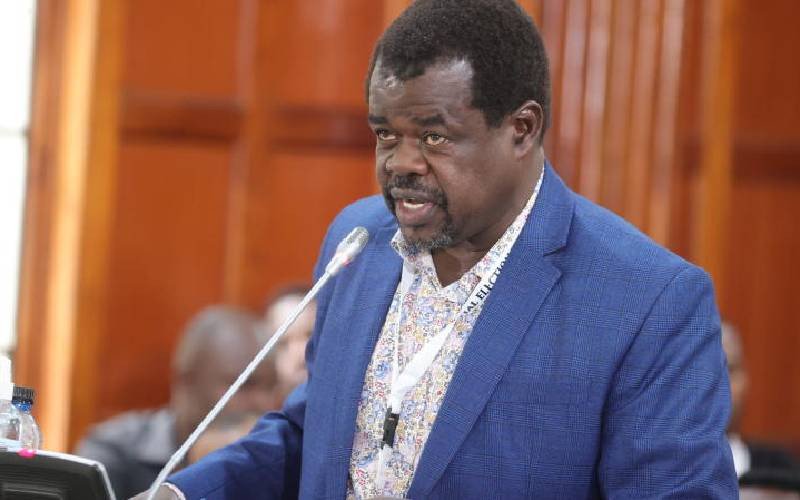
Busia Senator Okiya Omtatah has vowed to challenge in court three of the eight laws President William Ruto assented to on October 15, 2025, arguing that they contain unconstitutional provisions that threaten rights, justice, and transparency in public affairs.
“For that reason, I am heading to the High Court to have the offending laws declared unconstitutional and, therefore, invalid, null, and void ab initio,” said Omtatah.

In a detailed statement dated October 22, 2025, Omtatah clarified that the eight Acts signed into law by the President were passed by the National Assembly after several amendments, and should not be confused with the original Bills that were tabled earlier.
“At the very onset, I wish to clarify that the eight Acts of Parliament are not the same as their source Bills, which were published and tabled in the National Assembly,” he added.
The laws include the Air Passenger Service Charge (Amendment) Act, National Police Service Commission (Amendment) Act, Virtual Asset Service Providers Act, Wildlife Conservation and Management (Amendment) Act, Computer Misuse and Cybercrime (Amendment) Act, Land (Amendment) Act, National Land Commission (Amendment) Act, and the Privatisation Act.
Omtatah said he had no objection to five of the laws, which he described as beneficial to governance and national development. These include the Air Passenger Service Charge (Amendment) Act, which directs tourism revenues to the Tourism Fund; the National Police Service Commission (Amendment) Act, which establishes counselling and wellness centres for police officers; the Wildlife Conservation and Management (Amendment) Act, which enhances compensation for marine wildlife-related losses; the Virtual Asset Service Providers Act, which regulates digital assets; and the Land (Amendment) Act, which improves transparency in the registration of public land.
However, the senator said he would move to the High Court to have the remaining three Acts — the Computer Misuse and Cybercrime (Amendment) Act, the National Land Commission (Amendment) Act, and the Privatisation Act — declared unconstitutional.
- Maraga blasts divisive bills signed on Raila’s death day
- Govt defends cybercrime law as rights groups cry foul
Omtatah argued that the Computer Misuse and Cybercrime (Amendment) Act introduces vague and overly broad definitions that could be used to stifle freedom of expression and media freedom. He claimed that the law allows authorities to block websites and social media applications such as TikTok and X (formerly Twitter) without judicial oversight, while creating contradictions about who has the authority to regulate online content.
On the National Land Commission (Amendment) Act, Omtatah said Parliament acted unconstitutionally by imposing a five-year limit on the Commission’s mandate to review public land grants and address historical injustices. He noted that the Constitution provides no such limitation, adding that the amendment sought to preempt a ruling in his ongoing High Court Petition No. E349 of 2021, which challenges similar restrictions.
The senator also described the Privatisation Act, 2025, as unconstitutional, arguing that it violates Article 68 of the Constitution by allowing the privatisation of public land. He said the National Assembly passed the law without involving the Senate, despite the Bill touching on land and county interests. According to him, the Act excludes government-linked corporations and county-held shares from oversight, opening the door to unregulated sales of public assets.
Omtatah further stated that the Privatisation Act violates constitutional principles on public finance, fair hearing, and access to information, and unlawfully attempts to revive a 2009 privatisation notice that expired in 2014.
“The Act is unconstitutional, invalid, null, and void ab initio,” said the senator.
He said he intends to file fresh suits and amend existing petitions to have the contested provisions struck out.
– Timon Otieno
Email your news TIPS to Editor@nairobilawmonthly.com, and to advertise with us, call +254715061658 anytime of the day
