

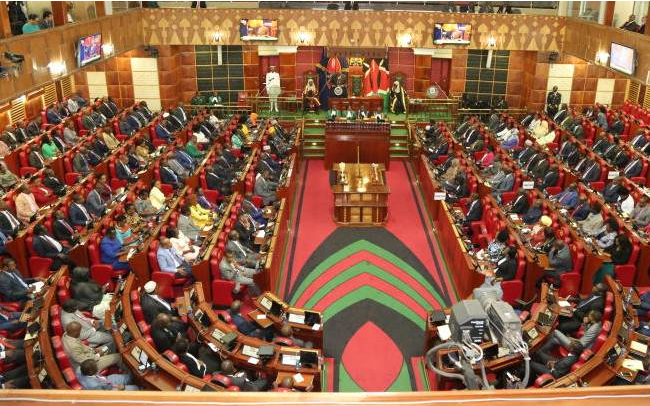
Members of the National Assembly have endorsed seven nominees to the Independent Electoral and Boundaries Commission (IEBC), despite mounting objections and concerns over impartiality and alleged political affiliations.
On Thursday, 5 June 2025, Parliament approved all seven IEBC nominees—including Erastus Ethekon as chairperson—after a brief 20-minute debate in the House. The approval came amid strong claims of political bias and ties to powerful figures, notably those close to President William Ruto and his ruling party.

The nominees, vetted by the Justice and Legal Affairs Committee (JLAC), include Anne Nderitu, Mary Sorobit, Mohamed Hassan Noor, Paul Siror, and commissioners Prof. Francis Aduol and Fahim Abdalla.
Despite the controversy, JLAC, chaired by Tharaka MP George Murugara, defended its vetting process and dismissed claims of favouritism. “We were satisfied that all the objections raised were sufficiently addressed,” Murugara stated.
The vetting and subsequent endorsement took place in Parliament, with earlier JLAC hearings held at County Halls, Mini Chambers. The committee finalised its report last weekend, and Parliament voted on 5 June 2025.
The IEBC appointments come at a pivotal moment, as Kenya prepares for the 2027 general elections. The new commissioners are expected to lead the electoral body through a politically charged period, following the contested 2022 elections.
The urgency to appoint new commissioners follows the exit of the previous IEBC team and aims to restore public trust in the electoral system. However, critics argue that the process has been marred by political interference.
While defending the nominees, Kimani Ichung’wah acknowledged political tensions but emphasised the need for stability and credibility. “We must shame them today by approving these names, having a commission in place, and ensuring credible elections in 2027,” he said.
“It’s saddening that, because of politics, some began demonising these nominees based largely on their origins.”
Concerns about conflicts of interest and political loyalty were particularly focused on Erastus Ethekon, who was accused of close ties with Josphat Nanok. Ethekon denied the allegations, stating: “Our work together was about service delivery for the people of Turkana, and nothing more.”
Anne Nderitu also faced objections from three petitioners who alleged she favoured President Ruto’s UDA party in 2022. She rejected the claims, stating: “Whatever past professional associations I may have had, the IEBC is an independent institution, and I am committed to upholding that independence.”
Rarieda MP Otiende Amollo defended the vetting process, noting: “It is important that Kenyans understand the context… We conducted a very robust vetting exercise and posed to the nominees all the relevant questions.”
However, the approval has not ended the controversy. A court order issued earlier had barred the swearing-in of the new commissioners, pending judicial review—adding a legal twist to the political storm.
Though Parliament has approved the IEBC nominees, the process remains under intense scrutiny. Allegations of bias, political patronage, and regional favouritism continue to cast a shadow over the appointments. As the 2027 elections approach, the commission’s integrity and independence will remain under the national spotlight—and may yet face further legal challenges.
Email your news TIPS to Editor@nairobilawmonthly.com, and to advertise with us, call +254715061658 anytime of the day
