

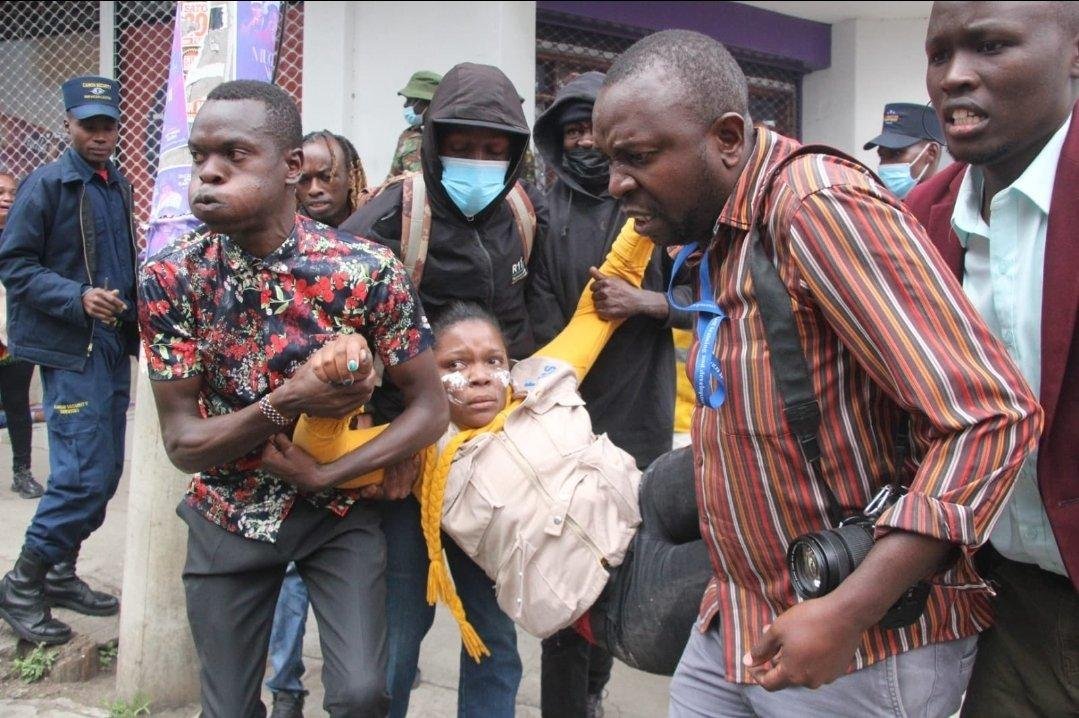
Although police spokesman Muchiri Nyaga has argued that police officers did not target journalists who were injured on Madaraka Day, it is worrying that the police — and by extension the Kenya Kwanza administration — appear to be reversing the freedom of press gains that Kenya had made. The result is that the country’s ranking on the global press freedom scale has been on a downward spiral.
According to Mr Nyaga, the journalists were injured as police tried to prevent a group of rowdy youth from accessing the Raila Odinga Stadium, where the President was scheduled to be the chief guest during the national day celebrations.

Whether this is what actually happened should be the subject of an investigation. Going forward, however, there is need to build bridges between the police and pressmen to ensure that the freedom of media workers to carry out their duties is upheld and protected.
That is why the police service should be chastised to know that whereas Kenya was ranked 69th in the Global Press Freedom Index under the previous administration in 2022, it dropped 47 places in 2023 to stand at 116th out of 180 countries ranked globally. With the record worsening by the day, it will not come as a surprise if Kenya drops further down in the 2024 survey.
In my view, it was as shocking as it was flabbergasting that government officials and the police did not see the contradiction that they were throwing the country into by blocking the media from covering a national day event.
This was unprecedented, but that is not what should worry right-thinking Kenyans. Rather, it is the fact that it was the second time, in as many days, that the media was being barred from covering a presidential function, an aberration made worse by the fact that some journalists were physically assaulted.
A day earlier, journalists from KTN had been barred from State House, Nairobi, where President William Ruto was hosting a joint press conference with the President of Slovenia, Natasa Pirc Musar.
Earlier, an officer attached to the President’s security detail was recorded, on several occasions, harassing photographers and blocking them from taking pictures at a public event, a clear signal, if one was needed, that the systematic harassment of journalists in the line of duty is State-sanctioned.
As the Media Council of Kenya — the industry regulator — rightly observed in its condemnation of the attacks, “the incidents highlight a concerning trend of deliberate targeting of media professionals, undermining their vital role. Such actions violate Article 34 of the Kenyan Constitution, which guarantees press freedom.”
For avoidance of doubt, Article 34 provides that the State shall not interfere with any person engaged in broadcasting, the production or circulation of any publication or the dissemination of information by any medium.
Whereas it is the responsibility of the State to guarantee this right, the growing intolerance towards media professionals by State agencies, especially those under the Executive, poses a threat to both democracy and public interest. It also sends the message that there is something that the government is hiding from the public or it is uncomfortable with scrutiny.
In its statement, the Kenya Editors Guild (KEG) rightly reminded government agencies that their regressive actions not only undermine democratic ideals but also the country’s international obligations on press freedom. KEG also reminded State actors of the mechanisms available to those who feel aggrieved by journalists or media houses and the need to use them to avoid conflicts.
Public and State officers who have been perpetrating the attacks must be reminded that they are obligated to uphold the Constitution and avoid actions that roll back the gains that Kenya has made after many years of struggle and to honour the spirit of “internal self-rule” that is encapsulated in Madaraka Day celebrations.
In addition, the leadership of the police office, the management of media houses and representatives of journalists’ organisations ought to explore ways of finding a formula that will ensure that police officers do not assault journalists while on duty.
The safety of journalists must never be compromised if Kenya is to live up to the ideals of the Constitution and democratic tenets, which government officials routinely vow allegiance to.
Email your news TIPS to Editor@nairobilawmonthly.com, and to advertise with us, call +254715061658 anytime of the day
