
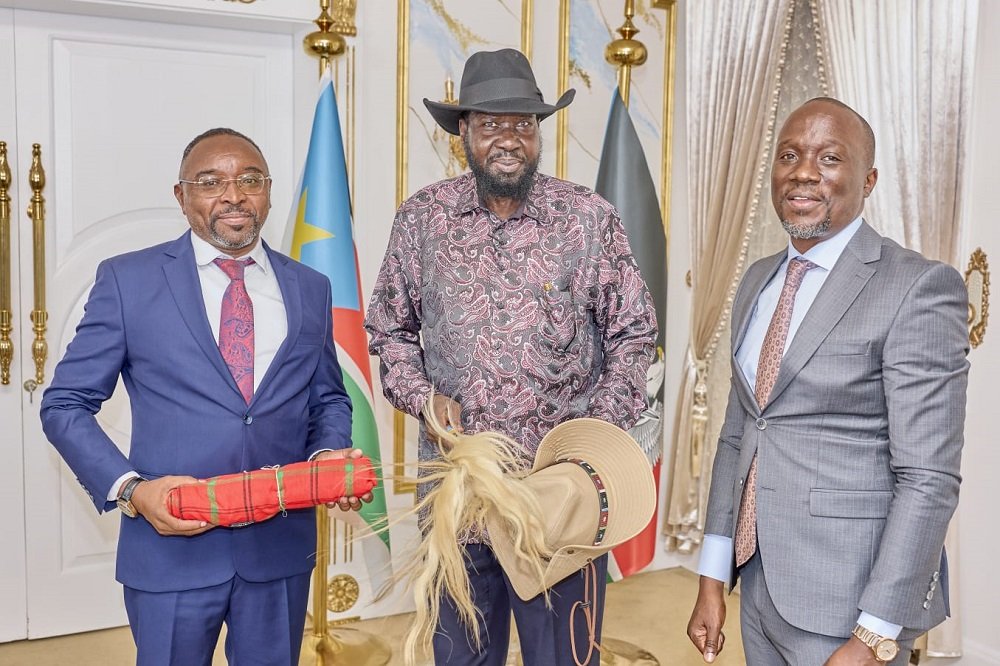
The innermost sanctum of the Juba State House is layered in gold and white from floor to ceiling, with a Persian carpet muffling footsteps as one walks into the gilded room that oozes the aura of power.
A bespoke chandelier radiates warm-white rays in all directions. The portrait of President Salva Kiir Mayardit, in his signature black cowboy hat — a gift from former US president George Bush — dominates part of the wall. Next to it, and equally prominent, is that of the founding father of South Sudan, John Garang, in his unmistakable cloud-grey moustache.
Were this not in Juba, the capital of the world’s youngest country, one would have been forgiven for thinking they had stumbled right into the guest room of the Summer Palace of Russian royalty. However, this is the holding room right outside the office of the President of South Sudan, who is hosting a team of Kenyan journalists for an exclusive interview on the day he will be signing an amendment to the 2018 Revitalised Agreement on the Resolution of the conflict in the Republic of South Sudan (R-ARCSS).
This is the law that ended the internal conflict that had, for three years after South Sudan gained independence, wracked the country. However, it also created a large and complex transitional government bureaucracy that has saddled President Kiir with five vice-presidents and Juba with 650 MPs. This is in addition to the even larger number of regional legislators, majority of who are not elected but hand-picked by the parties that signed the peace deal.
In the guest room, the six seats reserved for the media team invited by the Presidency are layered in soft, flowered sky-blue livery, with white and gold finishing all round. President Kiir’s court of arms stands authoritatively to the left of the chocolate-brown leather seat from where he will grant the rare interview. To its right is the national flag, its yellow star shining dominantly against the light blue background. The setting is regal, almost to a fault.
“Mzee has not been speaking much of late,” a resident of Juba who works for the United Nations had said in an earlier conversation. “So, it has become difficult for us to figure out the direction of his thinking.”
A lot has changed in South Sudan over the last 15 years. What once looked like a dusty outpost in the middle of nowhere is now a bustling city with new buildings coming up, some funded by the government, some by private investors in real estate. Among the new landmarks are the newly inaugurated Juba International Airport terminal three and swanky headquarters of the Bank of South Sudan at the Jebel Check point.
The government is also exploring new ways to earn export dollars, with focus being on developing the tourism industry as well as agriculture. Whereas the infrastructure is visible, the government philosophy can be elucidated better.
That is why, today, the UN worker will have his question answered. For, no sooner is the President ready to face the cameras than the milk-white double door leading from his office opens, and he makes his way into the room, dressed in a royal purple Mandela shirt, a black pair of trousers that compliments his cowboy hat, and matching shoes.
He oozes power, shuffling softly with a walking stick in hand. Power, clearly, is sweet, and President Kiir is here to announce that he will be seeking to validate his mandate when South Sudan goes to the polls in December.
“The transition is not good for the people,” he says, referring to the R-ARCSS agreement that has been in force for the last eight years. Arising from it, a deal to share government was cobbled up through compromises that circumvented an election but guaranteed a much-needed ceasefire that has held to date.
“South Sudan is ready for elections because the people want to elect their leaders and get out of this transition.”
In his view, one which is shared by senior members of his administration, the transition has come at a high cost to the citizenry.
“The government is heavy,” says the Minister for Presidential Affairs, Africano Gedima. “The transitional government has outlived its purpose.”
Like the President, he, too, acknowledges that the transition government was necessary for the restoration of peace and for ensuring that South Sudan made the necessary but painful steps it needed to take to get where it is today.
“The people who wanted positions were given positions,” he says. “Otherwise, the country would have taken a different direction.”
Though a fragile peace has held the country together — in part policed by blue-helmeted UN-backed peace mission — the war in Sudan, through which crude oil from South Sudan is piped, has taken a toll on the economy, with inflation still rising.
A US dollar has been exchanging for about 7,500 South Sudan Pounds (SSP) in recent days and the Bank of South Sudan Governor, Johnny Ohisa Damian, has been urging South Sudanese to prefer trading in SSPs rather than the greenback as has become all too common in the streets of Juba.
In the 15 years president Kiir acknowledges that keeping South Sudan on track has been a daunting task.
“We have moved step by step,” he says of the journey that his country has travelled since signing the peace deal.
Now, he feels, it is time for a change, and the surest way would be to hold an election.
“There would be no need for elections if they will not lead to change,” says President Kiir, who is keen to trim his large government to free up resources for development projects, some of which have started coming up, such as the Juba International Airport, which was inaugurated on July 17 to coincide with the independence celebrations.
“They will have to be reduced so that there can be a window for development,” he says.
In his view, the citizens have endured the transitional arrangement for far too long and the only way they can take that corner is to come out and register as voters and, in December, make their votes count by casting their ballots.
According to Gedima, the elections will guarantee stability and give investors more incentives to do business in South Sudan.
“Investments will create more jobs and reduce conflicts,” he says, emphasizing that South Sudan is open to both “high and low level” investors, such as the 50,000 Kenyans who do business in that country.
“Elections will remove us from muddy waters,” he says.
This is a standpoint that broadly mirrors President Kiir’s.
“I want them (South Sudanese) to register in big numbers, then pick their leaders,” says. “This will not be dictated to them.”
His final message is a clarion call for peace and national unity.
“I ask the South Sudanese living in South Sudan and its Diaspora to remain united. If they remain united, we will have no problem.”
With those words, he is ready to take his leave and retire into the inner chamber of his office, where he operates from every day, reporting as early as 6.30am and clocking out just before sundown. The State House is not his residence, just his place of work.
As he rises to his feet, the white double door opens. President Salva Kiir walks back from whence he came. The journey to interview him, which started with a phone call from the Loresho office of FELT Africa has come to an end.
At last, the people of South Sudan have gotten to hear from their reclusive leader. The door closes softly behind him. The interview is over.
Email your news TIPS to Editor@nairobilawmonthly.com, and to advertise with us, call +254715061658 anytime of the day
