

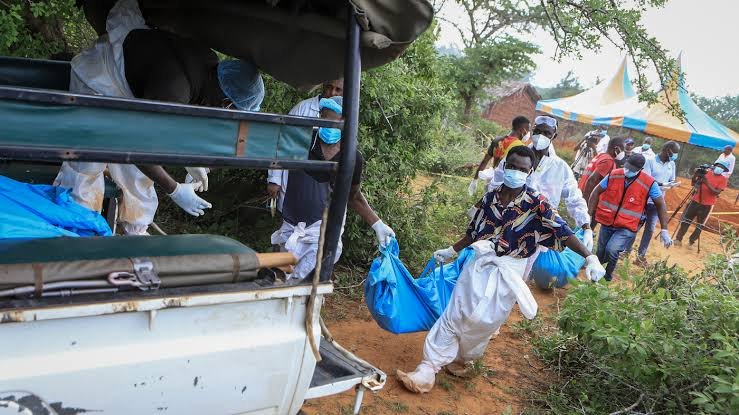
Kilifi County has given families of Shakahola massacre victims 21 days to come forward and claim their relatives’ remains, ahead of a planned mass interment of unclaimed bodies expected to be completed by December.
Kilifi County Executive Committee Member for Health Services Peter Mwarogo briefed senators on Monday, September 21, during a joint sitting of the Senate Committees on County Public Investments and Special Funds and on Health, held as part of the Senate Mashinani tour at Malindi Sub-County Hospital.

He said 443 bodies and body parts recovered from the Shakahola mass graves are currently being preserved in a container at the facility, and that the Directorate of Criminal Investigations (DCI) has now concluded its forensic investigations and cleared the county to proceed with their interment.
“They have given us the go-ahead for the interment of the bodies. They have to be disposed of in a way that they can be identified,” Mwarogo said, adding that all 443 remains have already been embalmed at the county’s temporary morgue. “We have full bodies and other body parts embalmed.”
Of the 443 remains held at the facility, only 14 have so far been identified by families through the DNA matching process. Under the plan outlined to senators, a gazette notice will be published, giving relatives 21 days from that publication to come forward and identify or claim their loved ones’ remains.
Any bodies that remain unclaimed once that window lapses will be disposed of through a court-approved process, with the county set to seek a court order authorising the burial of the remains in a manner that still allows for future identification, should relatives come forward later. The county has already identified land near Shakahola forest for the burials, and expects the entire exercise to be completed by December 2026.
- DPP seeks 11-year hybrid sentence for Shakahola convict
- Shakahola: How Paul Mackenzie runs deadly cult from prison
Mwarogo told senators that identifying the remains had proved difficult in ways that went beyond forensic limitations. He said some families had, in fact, successfully traced relatives among the dead through the identification process but had then declined to come forward and collect the bodies, citing the stigma associated with the wider Shakahola tragedy.
“Some people were able to trace their relatives, but they refused to come and take the body because of the stigma that is associated with it,” he said.
The Shakahola investigation began in 2023, after reports of deaths and missing persons connected to the Good News International Church, led by Pastor Paul Nthenge Mackenzie, prompted authorities to begin exhuming bodies from mass graves in the forest. More than 450 bodies were ultimately recovered in what investigators determined was a mass starvation cult case.
Subsequent investigations have since extended beyond the original forest site, with prosecutors also pursuing separate cases linked to additional deaths at Kwa Binzaro in Kilifi, with court proceedings in 2026 hearing evidence of further graves and alleged deaths connected to Mackenzie’s followers.
The prolonged storage of the remains has weighed heavily on the county government in the years since the exhumations began.
In August, Kilifi Governor Gideon Mung’aro had publicly raised concerns over the continued cost and burden of preserving hundreds of bodies at Malindi Sub-County Hospital, whose permanent morgue has a capacity of just 25 bodies, far short of what the Shakahola exercise has required.
Senators visiting the facility on Monday similarly raised concerns over how long the remains had remained in storage and questioned the effectiveness of efforts made so far to trace surviving family members.
With the DCI’s investigations now complete and the county cleared to proceed, the coming weeks will determine how many more families come forward before Kilifi moves ahead with burying those who remain unclaimed.
Email your news TIPS to Editor@nairobilawmonthly.com, and to advertise with us, call +254715061658 anytime of the day
