

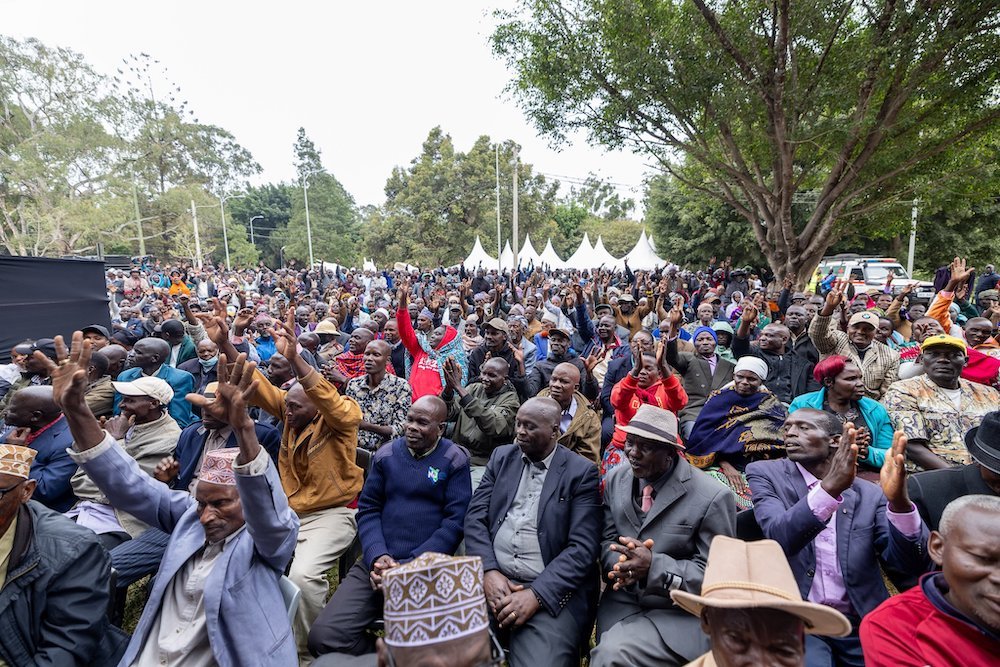
At least 106,000 village elders across Kenya will now receive a monthly government stipend, alongside free smartphones, training and health insurance cover, in a support package President William Ruto unveiled at State House, Nairobi, on Tuesday.
Ruto announced the package during an engagement forum attended by more than 10,000 village elders representing their counterparts from across the country. He said the elders would receive a Sh3,000 monthly stipend, cementing their formal recognition within the National Government Administration system.

“Today, we formally recognise that historic role. The onboarding of more than 106,000 village elders across the 47 counties into the National Administration system is a major milestone in bringing the government closer to the people,” he said.
President Ruto said the payment was recognition of their work rather than compensation. “Every village elder will receive a government stipend. This is not the price of your patriotism or your service. Patriotism cannot be compensated; it is priceless. This is simply recognition of the work you perform every day in serving your communities,” he added.
Tuesday’s rollout was the culmination of a process that began months earlier. Ruto first floated the stipend back in December 2025, when he pledged to place the country’s more than 106,000 village elders on a Sh3,000 monthly payment, initially targeting a start date of July 1, 2026.
Treasury Cabinet Secretary John Mbadi subsequently confirmed to Parliament that Sh3.9 billion had been set aside for the initiative in the 2026/27 budget, which was signed into law in June.
Ruto said the initiative was designed to acknowledge the elders’ contribution to grassroots leadership, community mobilisation and the implementation of government programmes.
He listed a range of duties the elders already carry out, including mobilising communities for vaccination drives, the census and voter registration; supporting school enrolment; assisting with drought relief and disaster response; advancing community policing and identifying vulnerable households in their areas.
To strengthen their capacity further, the President announced that elders will undergo training aimed at improving their administrative skills and the quality of service they provide to residents.
On the smartphones promised as part of the package, he directed the National Treasury to allocate funds for their purchase, while separately instructing Mbadi to set aside budgetary provisions to enrol all village elders, together with their spouses and children, under the Social Health Authority (SHA) programme.
Beyond the immediate benefits, Ruto directed the Ministry of Interior to prepare a Sessional Paper for presentation to Cabinet and Parliament before December, intended to create a formal legal framework anchoring the new measures.
Tuesday’s engagement also brought changes for elders’ immediate superiors. Chiefs and their assistants were elevated to the status of accounting officers within their jurisdictions, granting them authority to incur expenditure.
That shift builds on earlier budgetary changes flagged by Interior Cabinet Secretary Kipchumba Murkomen, who has previously indicated the Authority to Incur Expenditure allocation for assistant chiefs had already been raised from Sh15,000 to Sh30,000, and for chiefs from Sh30,000 to Sh50,000, as part of a broader push to strengthen the administrative structure at the grassroots.
Email your news TIPS to Editor@nairobilawmonthly.com, and to advertise with us, call +254715061658 anytime of the day
