
The Kenya Editors Guild (KEG) has urged newsrooms to take a harder look at government borrowing and complex financing deals, warning that poor disclosure is leaving the public with little sense of the risks tied to public money.
The guild took up the issue in Nairobi on Thursday during a peer-to-peer engagement focused on the information gaps surrounding public debt and government financing.
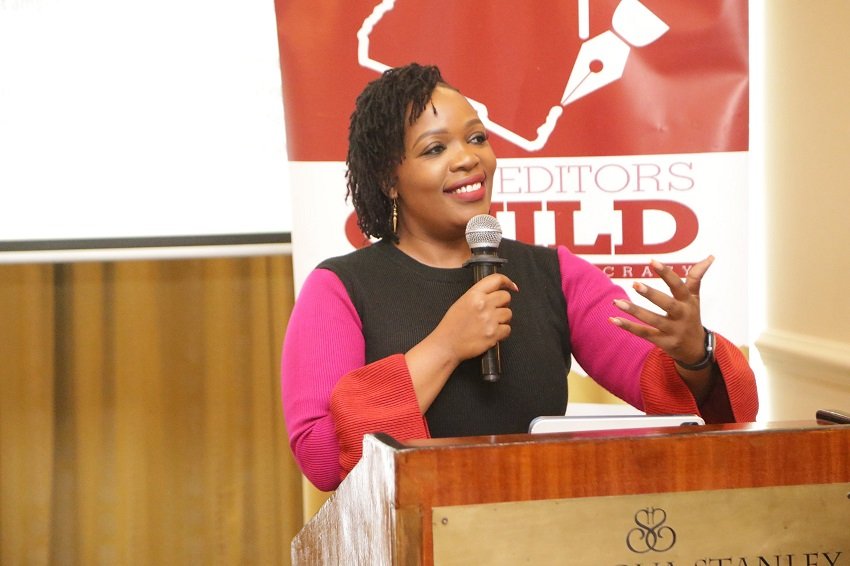
KEG president Zubeida Kananu said journalists should not simply repeat official explanations but should press institutions for details about the commitments being made on behalf of taxpayers.
“Our responsibility as editors and journalists is not simply to report what institutions tell us. We have a responsibility to ask the difficult questions,” Kananu said.
Journalists at the meeting pointed to several obstacles, including limited access to reliable information, the technical language used in financing agreements, poor disclosure of loan terms and government guarantees, and inconsistent responses from public institutions.
The stakes, however, extend beyond the technical details of individual agreements. Government financing can carry guarantees, procurement requirements, repayment obligations and contingent liabilities that may not be obvious when a deal is first announced.
Kananu said journalists need to establish who ultimately bears the risk in such arrangements, what guarantees have been issued, how contracts were awarded and how much taxpayers could eventually be required to repay.
“These are not merely technical questions. They are questions of public interest, accountability and democratic oversight,” she said.
The engagement was held in partnership with the International Republican Institute (IRI) and follows a June Media and CSOs Roundtable on Public Debt Accountability and Fiscal Justice.
KEG will use issues raised during the meeting to prepare a Media Issues Paper highlighting evidence and information gaps, as well as specific questions that journalists want public institutions to answer.
The paper will feed into an institutional dialogue scheduled for September 17. Kananu said the media should go into the meeting with questions based on evidence and the experiences of journalists covering public finance.
“We want the media to arrive at that dialogue with clearly articulated questions, supported by evidence and grounded in the experiences of journalists working in newsrooms,” she said.
The Nairobi meeting was the first of five engagements planned by KEG and IRI to strengthen media scrutiny of complex and high-risk public financing.
Email your news TIPS to Editor@nairobilawmonthly.com, and to advertise with us, call +254715061658 anytime of the day
