

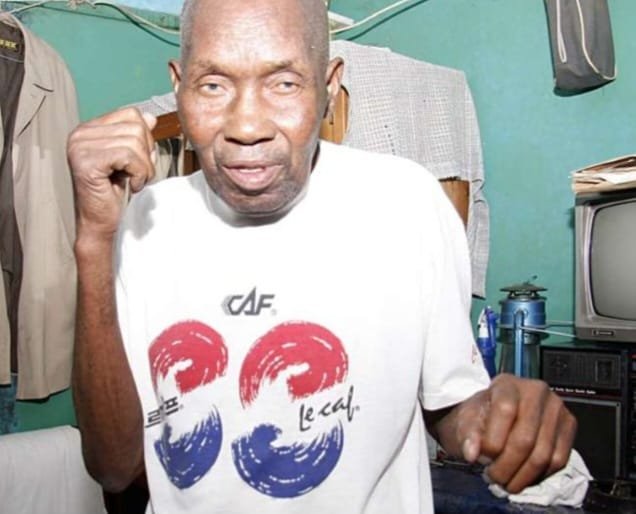
Eddie “Papa” Musi was a South African-born boxing coach who found a home in Kenya. Born in Soweto in 1940, he entered Kenya in 1967 via the Namanga border in a group of young South Africans who had fled the brutal Apartheid regime.
Kenya welcomed him, and he gave back immensely including being a part of the Kenya “hit squad” to the Commonwealth Games in Brisbane in 1982. Eddie settled in Nairobi and built a stable of champions and stars in Kariobangi, shaping generations of Kenyan elite boxers.
Kariobangi with Eddie, Madison Square Garden in Nakuru under the Nakuru Amateur Boxing Club, and Dallas Muthurwa under the late Coach Patrick “Madd” Okoth, remain Kenya’s most successful boxing stables in Olympic, Commonwealth and World Championship history.
Eddie also served as a Mathematics and Science teacher at Guru Nanak Secondary School in Pangani. He made Kenya his permanent home until his passing in September 2011 at the age of 71.
That spirit of exchange between Kenya and South Africa has continued across generations!
Today, South African football legend Benni McCarthy is the Head Coach of the Kenya National Football Team, the Harambee Stars.
On the other side, former Kenya Captain Musa Otieno, aka Otero, became a legend in South Africa playing for Santos FC for 14 years. At Santos, Musa played alongside former Bafana Bafana goalkeeper Andre Arendse, who was in goal during the AFCON triumph in 1996.
Lucas Radebe and Mark Fish played a major role for South Africa, forming the core central defensive partnership as Bafana Bafana won the 1996 Africa Cup of Nations on home soil — a tournament Kenya had been slated to host. Musa was then rated as one of the best defenders in Africa alongside Fish and Radebe, who also captained Leeds United in the English Premier League.
Kenyan defender Brian Onyango Mandela has also played extensively in South Africa’s top-tier PSL for many years for clubs like Maritzburg United and Mamelodi Sundowns.
Even our very own Olympian and rugby GOAT, Collins Injera, underwent trials with Western Province, gaining exposure in South Africa’s highly competitive rugby 15s system.
The top-ranked and best rugby sevens teams in Africa are South Africa, the Blitzboks, and Kenya, the Shujaa, followed closely by competitive rising sides like Uganda and Zimbabwe. Only two African countries — South Africa and Kenya — have ever had teams play in rugby sevens at the Olympic Games.
We even co-hosted the world together. In 2003, Kenya, Zimbabwe and South Africa jointly hosted the ICC Cricket World Cup. The tournament was full of upsets — hosts South Africa, Pakistan, West Indies and England were all eliminated at the group stage, with South Africa missing out by 1 run after misreading the Duckworth-Lewis rules.
England forfeited their match with Zimbabwe due to political unrest, which helped Zimbabwe reach the Super Sixes. New Zealand forfeited their match with Kenya due to security concerns — which helped Kenya make history by reaching the semi-finals, the only non-Test playing nation to ever do so.
In 1998, South Africa’s Banyana Banyana made a stopover in Nairobi and lost 1-0 to Kenya in an international friendly.
Recently, Kenya’s U17 team beat South Africa ( home and away) to qualify for the FIFA U-17 Women’s World Cup.
In boxing, Kenyan light-flyweight Peter Mungai earned his qualification slot for the 2016 Rio Olympics after South African Sibusiso Bandla was dropped when the South African Sports Confederation and Olympic Committee (SASCOC) did not recognize his qualification.
From boxing gyms in Kariobangi to football pitches in the PSL, to rugby fields and cricket stadiums in a shared World Cup — Kenya and South Africa have always built each other. A true sporting connection.
Email your news TIPS to Editor@nairobilawmonthly.com, and to advertise with us, call +254715061658 anytime of the day
