

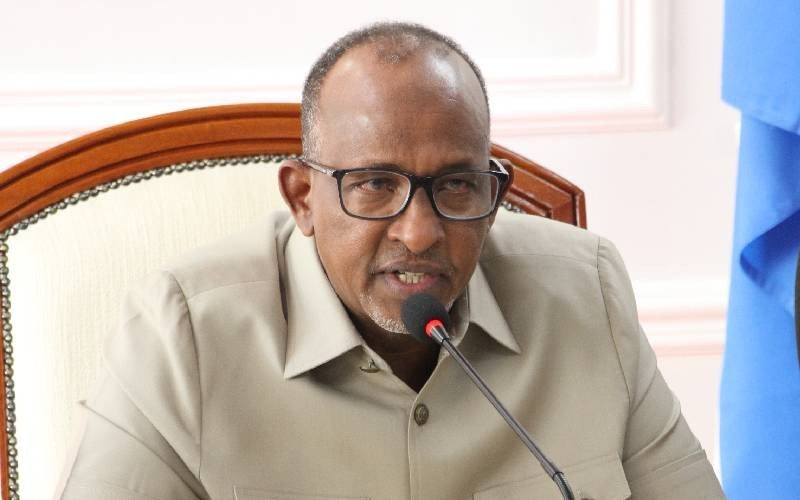
Kenya could be declared free of Bundibugyo virus disease, a form of Ebola, after meeting the World Health Organization’s requirements for ending an outbreak, Health Cabinet Secretary Aden Duale has said.
Speaking on Citizen TV’s Sunday Live on October 25, Duale said the country’s response had contained the outbreak within a cluster linked to an imported case, with no evidence of wider community transmission.
“We have contained it. The next time Kenya will be Ebola-free will be when we reach 42 days. It is not our timeline; it is a global timeline set by the WHO,” said Duale.
Kenya has had nine confirmed cases and two deaths from Bundibugyo virus disease, which is caused by Bundibugyo virus. The index case, who travelled from the Democratic Republic of the Congo via Uganda, died on October 5. The second death was confirmed on October 23 and involved a 65-year-old woman who was a close contact of the first case.
The other patients are stable and receiving treatment in isolation facilities. All subsequent cases have been epidemiologically linked to the original patient and involve family members and healthcare workers. However, Kenya must complete the 42-day period without new cases and meet international guidelines before it can be declared Ebola-free.
The countdown to Kenya being declared Ebola-free does not follow a simple timeline. Generally, the 42 days begin the day after the last confirmed patient tests negative twice and is discharged. However, there are exceptions to this rule, as outlined in WHO guidelines.
There are discrepancies over the exact date of the last confirmed case. Some statements from the Ministry of Health and Duale indicate that the last case was identified on October 19. However, the European Centre for Disease Prevention and Control states that the last case was identified on October 20. In both cases, the patient was a known contact and was already in quarantine.
Duale stated that all known contacts had been traced and that those who had been exposed to confirmed cases were still being monitored. The WHO and the Ministry of Health have stated that 135 contacts were identified and traced. Those who complete the 21-day mandatory monitoring period without showing any symptoms will be assessed by health officials.
Duale also stated that, in the 48 hours before his television interview, nearly 551 people had been tested and all had tested negative. The Cabinet Secretary said Kenya had enhanced its preparedness to ensure that healthcare workers are protected, suspected cases can be identified, and the risk of further infections can be reduced.
More than 26 high-risk counties have been provided with personal protective equipment. More than 4,900 trained healthcare workers, 342 first responders and five laboratories, including mobile laboratories, are supporting testing.
He stressed the need to protect healthcare workers. “The first people we must protect are our healthcare workers,” he said. The CS also thanked the WHO and the United States government, including the US Centers for Disease Control and Prevention, the US Embassy and the US State Department.
Kenya’s outbreak began with an imported case. The patient died on October 5, and the Ministry of Health announced the laboratory confirmation of the case the following day. All subsequent cases have been identified within the known contact group, with no evidence of wider community transmission.
However, until the monitoring period is complete and the relevant WHO criteria are met, Kenya cannot be officially declared Ebola-free. Health workers will need to continue monitoring, investigating suspected cases and tracing contacts.
– By John Murunga
Email your news TIPS to Editor@nairobilawmonthly.com, and to advertise with us, call +254715061658 anytime of the day
