

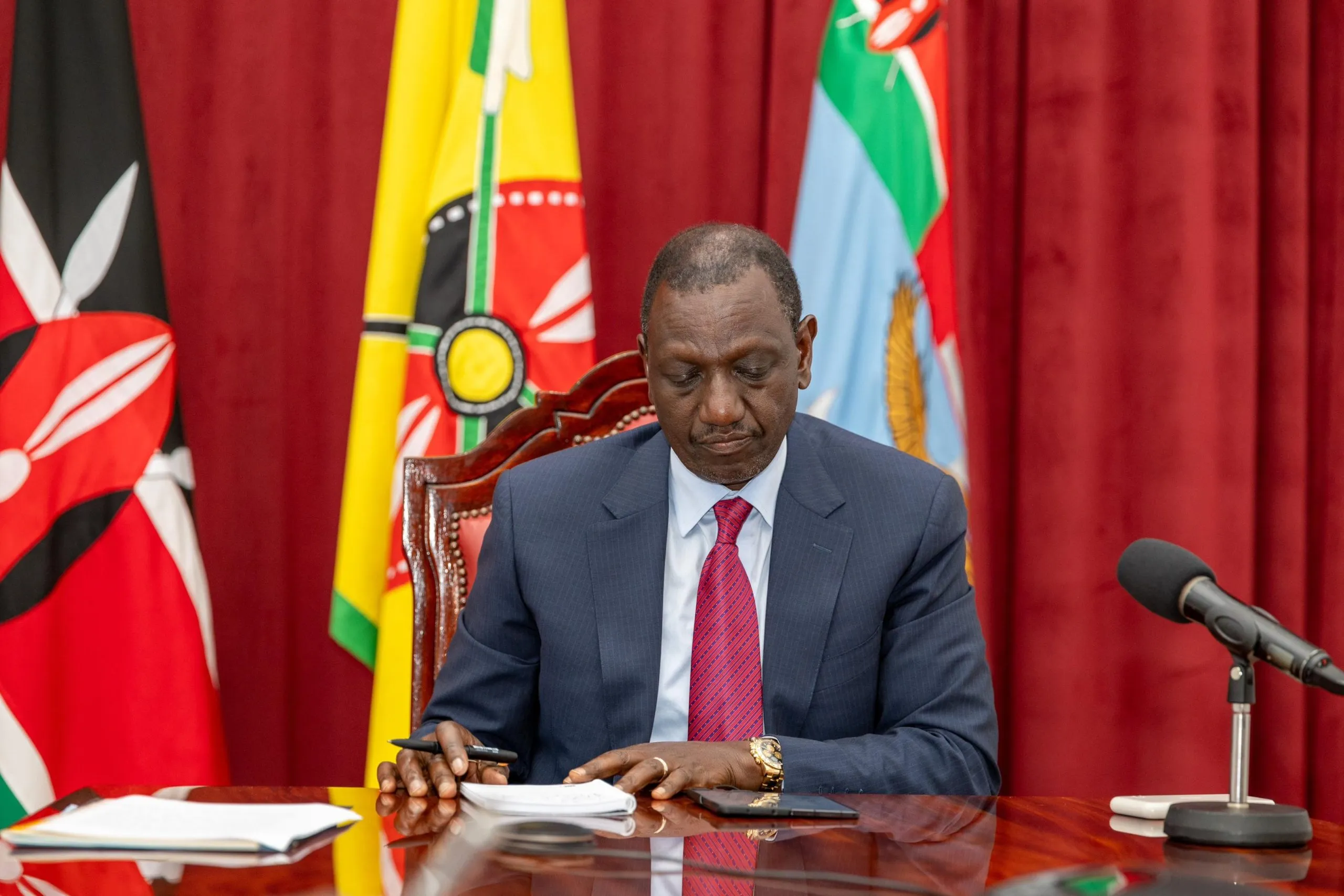
President William Ruto has signed four Bills into law, introducing new rules covering public finance management, population planning, air passenger charges and trust administration, marking a significant legislative package aimed at strengthening governance and service delivery across the country.
Ruto assented to the Bills on Tuesday, September 8, at State House, Nairobi, in a ceremony announced via his official X account. The four pieces of legislation are the National Council for Population and Development Bill, the Air Passenger Service Charge (Amendment) Bill, the Public Finance Management (Amendment) Bill, 2025, and the Trust Administration Bill, all of which had already completed the full parliamentary process before being forwarded to him for final approval.

“The new pieces of legislation mark a major step forward in strengthening governance, accountability and service delivery in our country,” Ruto said.
The Public Finance Management (Amendment) Act introduces some of the most consequential changes, strengthening oversight and accountability over how public resources are managed at both national and county levels.
Notably, the new law introduces penalties for public entities that disregard audit findings, specifically targeting officials who fail to implement recommendations made by the Auditor-General or the Controller of Budget, including those already adopted by Parliament or county assemblies.
The law also sets out clearer rules on how counties access and manage public funds, aimed at improving transparency in county-level financial reporting.
The National Council for Population and Development Bill re-establishes the National Council for Population and Development as a fully-fledged statutory body through an Act of Parliament, rather than the administrative arrangement under which it previously operated.
The council will continue functioning under the Ministry of Finance’s State Department for National Planning, though its name is set to change.
Giving the council statutory footing allows it to meet international obligations more effectively and operate on comparable legal standing with similar institutions in other countries.
The Bill originated from Cabinet, was sponsored by the Leader of the Majority Party, and passed the National Assembly in 2024 before the Senate introduced its own amendments, with both Houses eventually agreeing on a joint version that was forwarded to the President for assent in August.
The Air Passenger Service Charge (Amendment) Act changes how revenue collected from air travellers is administered, rather than introducing any new charge on passengers. Under the current statutory rates, domestic departures attract a charge of Sh600 and international departures Sh6,500, figures that took effect following an increase in October 2025 and remain unchanged under the new law.
The Kenya Revenue Authority will now remit proceeds collected directly to four designated beneficiaries, the Kenya Airports Authority, the Kenya Civil Aviation Authority, the Kenya Meteorological Services Authority and the Tourism Fund, a move intended to strengthen funding certainty for Kenya’s aviation and tourism sectors.
National Assembly Clerk Samuel Njoroge, speaking during the ceremony, explained the practical effect of the change: “The Bill makes it easier for the Commissioner General to remit the resources collected from the Air Passenger Service Charge directly to the four entities without cumbersome processes.”
The Trust Administration Act, meanwhile, modernises the legal framework governing how trusts are managed in Kenya, setting out clearer rules for trustees and beneficiaries alike.
With all four Bills now signed into law, attention turns to implementation, particularly for the Public Finance Management changes, which will require public entities nationwide to start taking audit recommendations more seriously or risk facing the new penalties, and the aviation charge reforms, which should give the Kenya Airports Authority, KCAA, the Meteorological Services Authority and the Tourism Fund more predictable access to the funding they are owed.
Email your news TIPS to Editor@nairobilawmonthly.com, and to advertise with us, call +254715061658 anytime of the day
