

President William Ruto has signed into law two Bills that keep value-added tax (VAT) on fuel at 8 per cent for another three months, cut taxes on building materials and change how the Kenya Revenue Authority (KRA) is governed and funded.
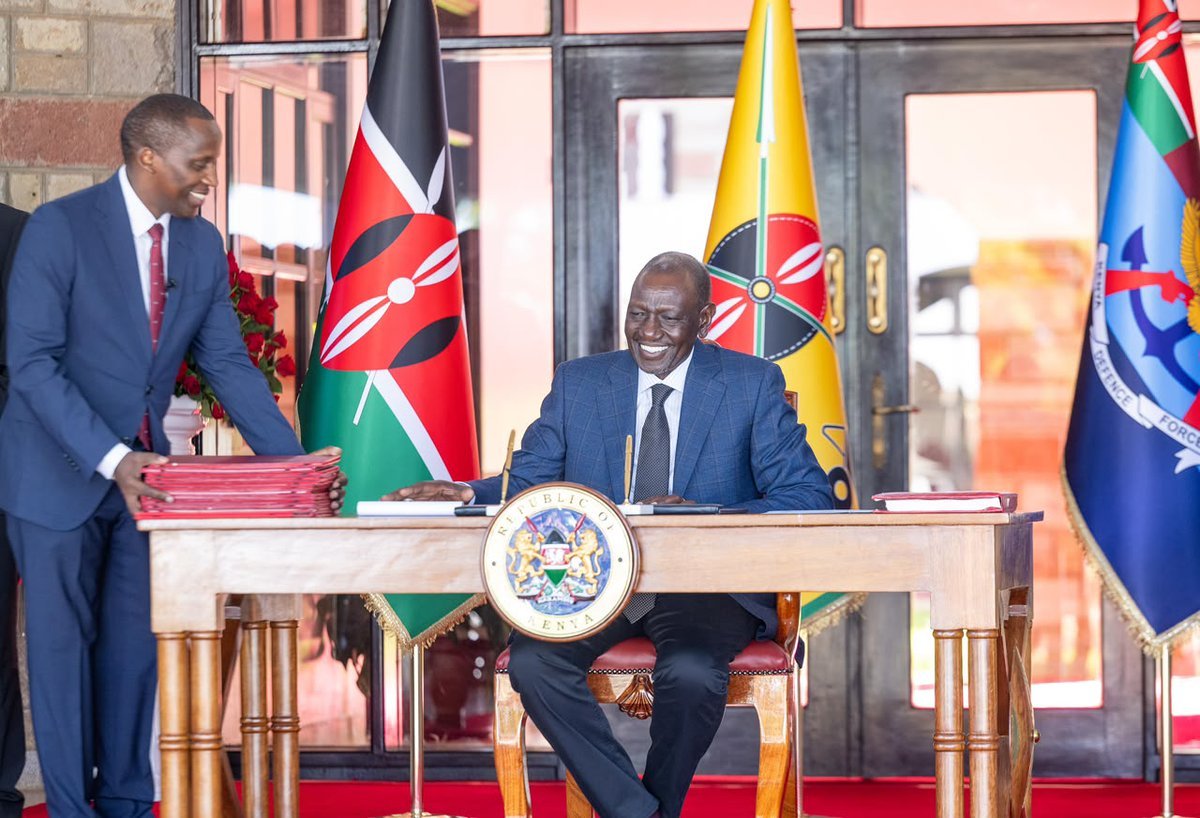
The President assented to the Tax Laws (Amendment) Bill, 2026, and the Kenya Revenue Authority (Amendment) Bill, 2026, at Eldoret State Lodge, Uasin Gishu County, on Friday, October 16, 2026, two days after the National Assembly passed them.
Under the new tax law, petrol, diesel and kerosene will continue to attract VAT at 8 per cent instead of the standard 16 per cent for an initial 90 days from October 14, 2026. The Cabinet Secretary for the National Treasury can extend the relief by a further 90 days through a Gazette notice if global oil markets remain unsettled by the crisis in the Middle East.
The Government said the measure will protect families and businesses from rising costs.
“This will ease the burden on households by protecting against increased costs of transport, essential goods and services across the economy,” it said.
Deputy Chief of Staff Josephat Nanok, who briefed the President before the signing, explained that the reduced rate had already been factored into the pump prices announced by the Energy and Petroleum Regulatory Authority (EPRA) on October 14, following consultations with the regulator and the Ministry of Energy.
“Had that 8 per cent not been factored in, the price of fuel announced by EPRA was going to be higher than the price announced,” he said.
The VAT cut was first introduced in April 2026 and extended in July to cushion consumers from high global oil prices.
The tax law also brings relief to the construction sector. Excise duty on tiles will now be charged at a flat Sh400 per square metre instead of by weight, while duty on ceramic sanitary ware such as sinks drops from Sh50 to Sh30 per kilogramme. Flat glass imported from East African Community partner states will be treated in line with regional trade protocols.
“Further, the amendments will support the construction and housing sectors, which the Government considers a major driver of economic growth and job creation,” the Government said.
The second law, the Kenya Revenue Authority (Amendment) Act, 2026, changes the composition of the taxman’s board by removing the ex officio designation for specified government officials and adding the Managing Director of the Kenya Ports Authority (KPA) to the board.
The change is meant to improve coordination between revenue collection and port operations.
“It therefore brings the managing director of KPA into the board,” Nanok said.
The law also guarantees KRA funding equal to at least 2 per cent of its estimated annual revenue collections and gives the authority an incentive of 3 per cent of any revenue it collects above its quarterly target. It further updates the list of laws KRA administers.
According to the Government, the reforms are meant to raise collections without adding new burdens on taxpayers.
“The Bill was enacted to enhance efficiency at the Kenya Revenue Authority. It is expected that enhanced efficiency will lead to better revenue collection, hence no need for an increase in taxes,” it said.
During the debate on the tax Bill, Finance and National Planning Committee Chairperson Kimani Kuria told the National Assembly that the Government had given up about Sh54 billion in revenue over the past six months to keep fuel affordable.
With the President’s assent, motorists, transporters and households can expect pump prices to remain below the levels they would have reached had VAT reverted to 16 per cent, which would have added about Sh17 to a litre of super petrol in Nairobi.
Email your news TIPS to Editor@nairobilawmonthly.com, and to advertise with us, call +254715061658 anytime of the day
