

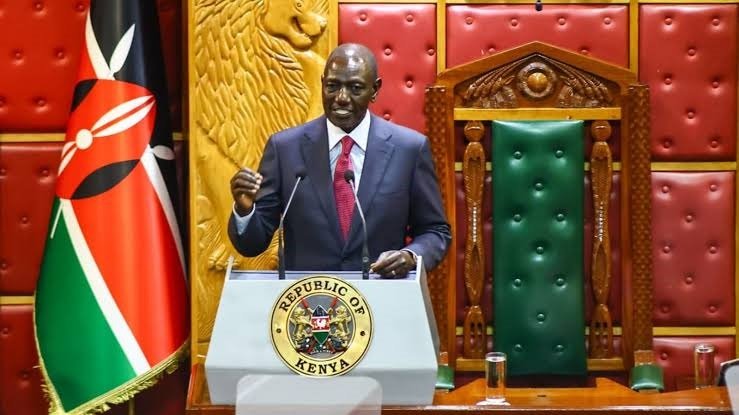
President William Ruto has announced that the government will pay Sh27.8 billion owed to suppliers and contractors, as well as billions of shillings owed to universities, hospitals and sugarcane farmers, during his fourth State of the Nation Address.
Speaking to a joint sitting of Parliament on Wednesday, November 18, 2026, the President said the government had approved payment of 28,726 verified pending bills dating back to 2005, each worth Sh50 million or less.

He also announced that the State would release Sh18 billion owed to public universities and about Sh16 billion to public and private hospitals with outstanding claims under the former National Health Insurance Fund (NHIF).
Sugarcane farmers will receive a Sh1.2 billion bonus, with payments set to begin next week.
“Our nation is making a remarkable comeback,” Ruto said, as lawmakers greeted him with chants of “Tutam” and “Usawa ni sawa” at Parliament Buildings in Nairobi.
The President also unveiled plans to build 600 modern markets across the country at a cost of Sh57 billion and issue 1.8 million title deeds.
He said 20,000 more teachers would be hired next year, while Sh16.8 billion had been set aside this year for marginalised areas under the Equalisation Fund.
He repeated the tax relief proposals he first announced on Mashujaa Day, which include exempting workers earning Sh32,333 or less a month from Pay As You Earn (PAYE) tax, removing stamp duty on land transactions worth Sh1 million or less, and scrapping the 25 per cent import duty on mobile phones.
The speech was his last State of the Nation Address before the August 2027 General Election.
Ruto said the reforms his government introduced after taking office in 2022 had restored stability to the economy.
“Our first responsibility was to restore economic stability,” he said. “We confronted those challenges through extensive but necessary reforms.”
He said the shilling had stabilised at about Sh129 to the US dollar, from Sh162 in 2022, while inflation averaged 4.1 per cent in 2025, down from 9.6 per cent in 2022.
Foreign exchange reserves rose from $7.37 billion in 2022 to a peak of $15.3 billion this year.
“Despite global uncertainty and disruptions to international trade, our economy has been expanding,” he said.
In agriculture, maize production reached 71 million bags last year, up from 44.3 million in 2022, while the price of a 2kg packet of maize flour fell from Sh230 in September 2022 to Sh152 in September this year.
A bag of fertiliser now costs Sh2,000, down from Sh7,500.
Sugarcane deliveries to factories rose by 57 per cent, while sugar production grew by 60 per cent between January and October. Output is expected to exceed 900,000 tonnes this year.
On health, Ruto said 33.7 million Kenyans had registered with the Social Health Authority (SHA), compared with eight million NHIF members in 2022.
The scheme is funding treatment for 53,465 cancer patients and 24,468 people on dialysis, and has paid for 89 kidney transplants.
“These are among the most expensive forms of medical care, often beyond the financial reach of ordinary households,” he said.
In education, the government has hired 100,000 teachers in four years, built 23,000 classrooms and has 1,600 laboratories under construction, while the education budget has grown from Sh521 billion to Sh784 billion.
This year’s national examinations were printed in Kenya for the first time since independence, saving about Sh1 billion, while a record 3,634,846 candidates sat the examinations.
“Examinations are a normal part of learning, not a security operation or a matter of life and death,” Ruto said.
He added that more than 313,000 affordable housing units were under construction, more than 707,000 Kenyans had found jobs abroad and 350,000 were working in the digital economy. Meanwhile, about 7,000 kilometres of roads were under construction.
Counties have received Sh1.55 trillion over four years, with a further Sh428 billion allocated for this financial year.
“What many of us take for granted has remained a distant hope for other citizens. That is the inequality we are correcting,” he said.
Email your news TIPS to Editor@nairobilawmonthly.com, and to advertise with us, call +254715061658 anytime of the day
