
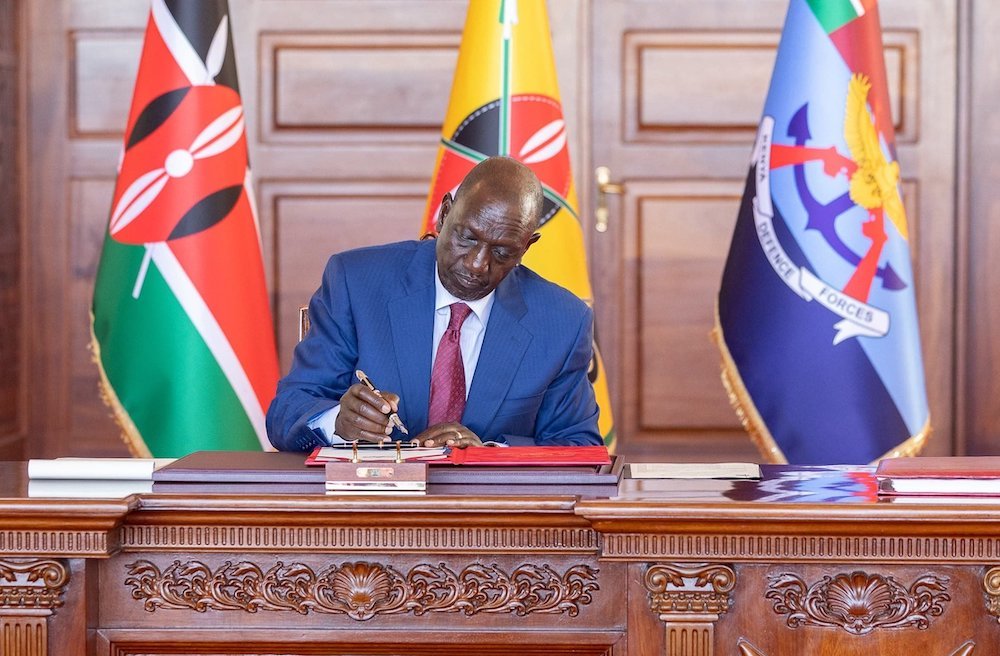
President William Ruto has signed six bills into law, giving breastfeeding mothers new workplace rights, imposing tougher rules on the handling of sexual offence cases and expanding pension benefits for public servants.
The President signed the bills at State House, Nairobi, on Thursday, November 26, 2026. They are the Breastfeeding Mothers Bill, 2024, two Sexual Offences (Amendment) Bills, the Public Service Superannuation Scheme (Amendment) Bill, 2025, the Environmental Professionals Institute of Kenya Bill, 2024, and the East African Development Bank (Amendment) Bill, 2026.

The Breastfeeding Mothers Act, sponsored by Nominated MP Sabina Chege, requires employers to provide clean, private and fully equipped facilities where mothers can breastfeed or express breast milk.
Employers must also allow breastfeeding breaks and offer flexible working arrangements to mothers returning from maternity leave. Public buildings with a capacity of at least 50 people must provide similar facilities. The law also bars employers from discriminating against women because of pregnancy, childbirth or breastfeeding.
Ruto directed the State House to lead by example. “I direct State House to take the lead in implementing this law by providing safe, private and comfortable spaces,” he said.
Two amendments to the Sexual Offences Act will strengthen how sexual offence cases are prevented, reported and prosecuted.
The first, National Assembly Bill No. 78 of 2023, requires the government to run nationwide awareness campaigns on sexual offences and the legal remedies available to victims. It also requires the Education Cabinet Secretary to establish programmes that protect victims’ right to education, including girls affected by teenage pregnancy.
The second, National Assembly Bill No. 50 of 2025, was sponsored by Garissa County Woman Representative Udgoon Siyad. It requires all sexual offence cases to go through the formal courts and be concluded within six months of plea.
A case cannot be withdrawn simply because the parties have settled out of court, and judges must hear the Director of Public Prosecutions’ reasons before allowing a withdrawal. Intimidating, threatening or offering inducements to a complainant to drop a case is now an offence. The law also outlaws traditional mediation, such as Maslaha, in sexual offence cases.
The Public Service Superannuation Scheme (Amendment) Act renames the scheme the Public Service Superannuation Fund and opens membership to public servants on fixed-term contracts. Employers must now pay gratuity into members’ retirement accounts every month, instead of paying it as a lump sum at the end of their contracts.
Members will be able to use their savings as collateral for mortgages and to secure post-retirement medical cover. The fund’s board will gain two independent directors appointed by the Treasury Cabinet Secretary.
The changes come days after the fund declared an interest rate of 17.99 per cent for members for the 2025/26 financial year, with assets of Sh343.8 billion.
The Environmental Professionals Institute of Kenya Act, sponsored by Ndaragwa MP George Gachagua, creates an institute to register, license and regulate people working in the environment sector, in collaboration with the National Environment Management Authority (NEMA). It will promote professionalism and enforce practice standards. The institute will be funded by its members, not taxpayers.
The East African Development Bank (Amendment) Act brings the law into line with the Constitution. It follows a March 2025 High Court ruling that struck down earlier amendments. Public money can now go to the bank only after the National Assembly approves the allocation and the Controller of Budget authorises its release, strengthening oversight of public expenditure.
Email your news TIPS to Editor@nairobilawmonthly.com, and to advertise with us, call +254715061658 anytime of the day
