

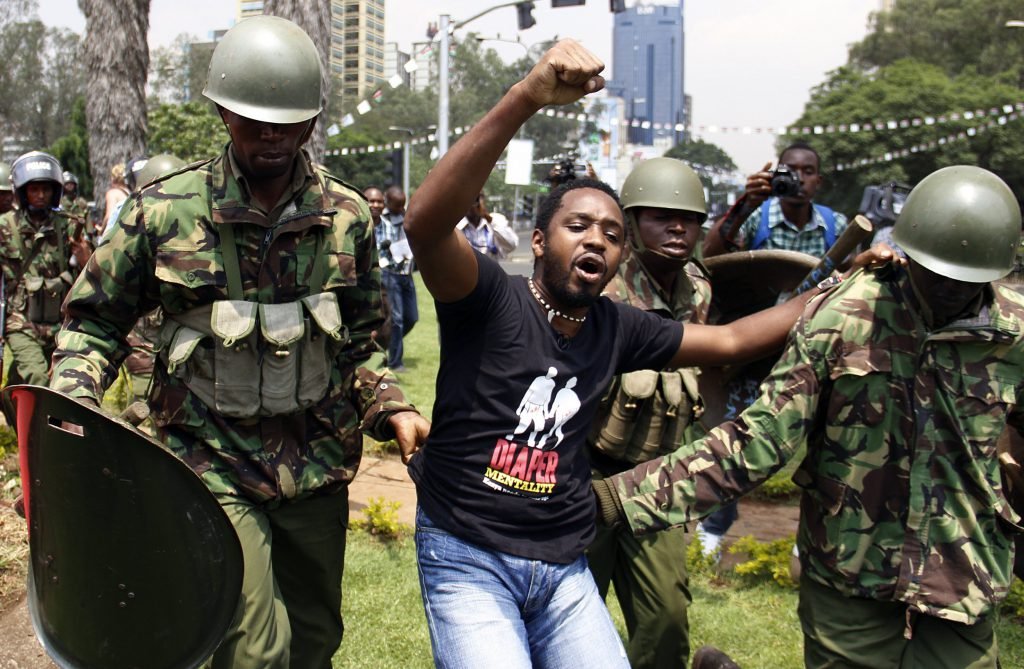
It came as a surprise when police arrested activist Boniface Mwangi and went ahead to slap terrorism charges against him. Even more perplexing was that the office of the Director of Public Prosecution allowed such an outrageous charge to stand in the first place and only substituted it after a public outcry.
The reaction of security agencies to the youth protests has, to say the least, been very curious, if not disturbing. It started with extra-legal abductions, then shooting of protesters and innocent bystanders to now accusing them of terrorism. In my view, the actions of the police have been sliding from the farcical to the absurd. And from the look of things, we are headed even further south.

It is a sad day when police have to be reminded of the self-evident truth that human rights and political activism are not crimes. Unlawful assembly? May be. Terrorism? That is pushing the envelope too far and it does great harm to the security agencies’ reputation. It is a sign that police are either running out of options or are being directed by an unseen hand that is desperate to silence dissent.
Criticism of the government of the day has been a constant in Kenya’s public engagement between governors and the governed. To assume, therefore, that this is a phenomenon that started two years ago is to wish away an integral part of how citizens have perennially engaged with their elected representatives. It is also disingenuous to claim that the last two administrations were not besieged by violent protests at various points in time.
What the police need, more than anything else, is to disabuse themselves of this notion and re-evaluate their strategies and stop moving from bad behaviour to worse. First, they should acknowledge that citizens have a right to take to the streets, costly as this may be to the economy.
They should also acknowledge that there will always be rogues who take advantage of such civil action to commit criminal offenses. And once they do this, they should deploy the tools that will help them separate the wheat from the chaff and take the right legal actions against criminal elements.
Whereas the cloak of collective responsibility may appear appealing to law enforcers in the short term, each officer ought to be warned that when the dagger of justice strikes, it is individual wrongdoers who will find themselves in the dock in a system that, they must not forget, is efficient at sacrificing pawns to achieve bigger political objectives. Only knaves will allow themselves to be caught in that system.
The leadership of security agencies should also be challenged to stop using yesteryear’s strategies to deal with modern-day challenges. The protesting youth have access to technology. Do the police have what it takes to track them in that space?
Does the intelligence-gathering bureaucracy have the wherewithal to collect and analyse digital ‘signals’ shared by the youth or are they caught in a time-warp like old school parents who do not understand even one word of the lingua the children backbiting them under their own roofs speak?
Do they share the intelligence with the right people at the right time? And if they do, is there a system of accountability that should punish those who receive the intelligence and fail to take preventive measures?
The days when police would trump up charges and spirit political suspects to court at night are long gone. Such underhand tactics have no place in a society that has a large population of tech-savvy and politically aware youth.
The police must also be alive to the fact that the government is under constant watch by digital warriors at home and abroad, and it is not possible to wage a successful war against them unless they deploy the right tools. Thorax simply won’t do, and the sooner security agencies realise this, the easier their job of addressing protests and social media activism will be.
mbugua@nairobilawmonthly.com
Email your news TIPS to Editor@nairobilawmonthly.com, and to advertise with us, call +254715061658 anytime of the day
