

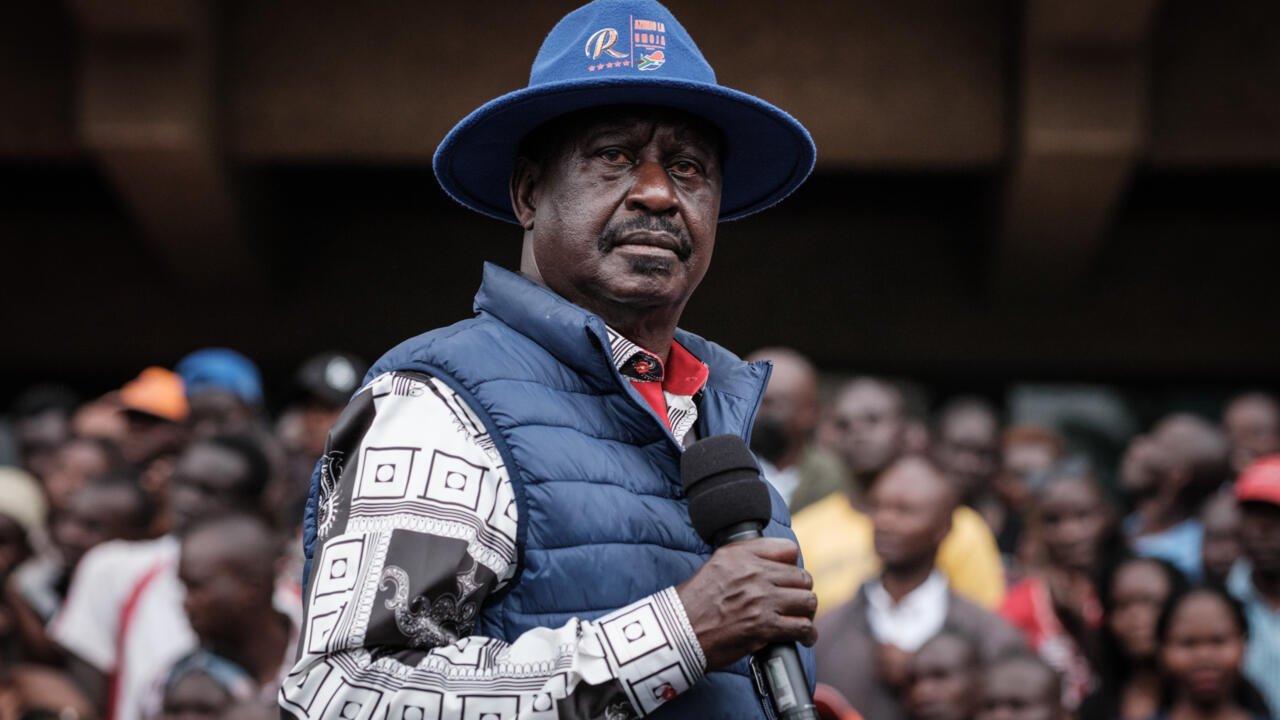
Kenya today, Thursday, 15 October 2026, marks the first anniversary of the passing of former Prime Minister Raila Amolo Odinga, one of Kenya’s most influential politicians.
Odinga passed away on 15 October 2025 in Kerala, India, at the age of 80, while receiving medical treatment. His death triggered shockwaves across Kenya and around the world, as world and local leaders, political allies and opponents, and ordinary citizens expressed their condolences over the loss of a man who had been at the centre of Kenya’s political scene for several decades.
The main commemorations in honour of the former Prime Minister will take place at Migwena Cultural Grounds in Bondo, Siaya County, with family members, politicians, spiritual leaders, citizens and well-wishers expected to attend and pay tribute to him.
The respect accorded to Odinga was also reflected in the national honours extended to him after his death. His body was returned to Kenya for a state funeral, allowing citizens from across the country to pay their final respects.
His mausoleum has since become a place of remembrance, drawing family members, political leaders and ordinary Kenyans who continue to honour Baba and reflect on his contribution to the country’s democratic journey.
President William Ruto has described Odinga as “a once-in-a-generation leader whose vision transcended politics, whose courage shaped Kenya’s democratic journey, and whose life and service became inseparably woven into the history of our Republic.”
At the dedication of the mausoleum, Ruto said the Republic had built it “in his honour as the father and guardian of our democracy,” adding that “a building cannot contain Baba’s legacy. Stone can keep his memory, but only a nation can keep his promises.” He summarised Odinga’s lifelong mission in two words: “equitable transformation.”
Ida Odinga, the former Prime Minister’s widow, has urged Kenyans to remember her husband for the values he championed. “Baba stood for peace, Baba stood for unity, and let’s remember him as that,” she said.
She emphasised that “Baba belongs to many people, belongs to many denominations, belongs to people, many parties,” and called on the nation to uphold peace: “We need peace in our homes and in our nation. Let us not rise in anger, but in understanding, for peace cannot survive in bitterness.” She also recalled that he “taught us to live humbly, to forgive and to love our country deeply.”
Siaya Governor James Orengo, who shared a more than 50-year friendship with Odinga, reflected in an exclusive interview with the Daily Nation on the personal and political loss.
“I was not ready for it [Raila’s death], I was shocked and lost for words and feelings. One of the things that kept on coming to my mind was that Raila should be able to give the presidency one more last time and he didn’t rule out the idea,” Orengo said.
- Raila Amolo Odinga: A life lived in defiance of silence
- Raila Odinga: The patriot who put Kenya before himself
He added that many had come to believe that “Raila would never die… he looked like he would be there forever.” Orengo further stated that “Raila’s spirit is undoubtedly in Linda Mwananchi. There is no doubt about that.”
Odinga’s death left a huge vacuum in Kenya’s politics, as he had been a central figure in the country’s political affairs for over 40 years.
Throughout his political journey, Odinga was a key player in almost all major political events that shook the nation and forced it to rethink its governance, including the fight for multiparty democracy and the promulgation of the 2010 Constitution.
He is best known for leading the charge for the reintroduction of multiparty democracy in Kenya and challenging the one-party state system.
Odinga was one of the key figures detained during the dark days of authoritarian rule and went to jail twice for defying the government and speaking up for the oppressed.
He mounted five unsuccessful bids for the presidency, in 1997, 2007, 2013, 2017 and 2022. Following the disputed 2007 presidential election, he served as Prime Minister from 2008 to 2013.
The post-election violence that shook the nation resulted in more than 1,000 deaths and the displacement of more than 600,000 people. The power-sharing agreement between President Kibaki and Odinga opened a new chapter in Kenya’s history and helped set the stage for the 2010 constitutional reforms. Odinga was also at the forefront of the fight during the 2005 constitutional referendum, when he led the opposition to a historic victory.
In 2017, the Supreme Court annulled the presidential election results following a petition by the opposition, marking a significant chapter in Kenya’s history.
Odinga’s death left the political scene in Kenya in disarray as the country’s opposition struggles to chart its way forward. Since the veteran politician’s death, ODM has been at loggerheads with itself over the way forward regarding its relationship with the government of President Ruto. Some members of the movement support the government, while others have taken the lead in opposing it.
The split has manifested itself through an internal wrangle between the factions of Linda Ground and Linda Mwananchi. The dispute saw Edwin Sifuna removed from the position of party secretary-general, which he had held for nine years. The fallout did not end there: Sifuna, the sitting senator for Nairobi County, was also stripped of his Senate leadership position as deputy minority whip.
The two camps disagree on a range of issues, including the participation of ODM members in the broad-based government. One faction supports President Ruto’s re-election, while the other opposes it.
The rift is also set to be a major factor in the upcoming 2027 General Election, as the Linda Ground camp, headed by Dr Oburu Oginga, the late Raila’s elder brother, favours the continuation of the broad-based government. Meanwhile, the Linda Mwananchi faction, associated with Edwin Sifuna, Babu Owino and James Orengo, wants ODM to move into direct opposition to the Ruto administration.
Both factions claim to uphold their leader’s legacy, even as their divisions threaten to become a major distraction in the country’s politics.
For years to come, any internal wrangles within ODM are likely to invite comparisons with the legacy of Raila Odinga and the ideals he championed.
The first anniversary offers Kenyans an opportunity to reflect on their memories of Odinga and the mixed emotions surrounding his passing, as his impact on the country’s politics is likely to be felt for generations to come.
For Kenyans, and particularly the younger generations, Odinga will always be Baba: a man whose name will forever be remembered for his central role in shaping the events that transformed Kenya’s political landscape.
– By John Murunga
Email your news TIPS to Editor@nairobilawmonthly.com, and to advertise with us, call +254715061658 anytime of the day
