

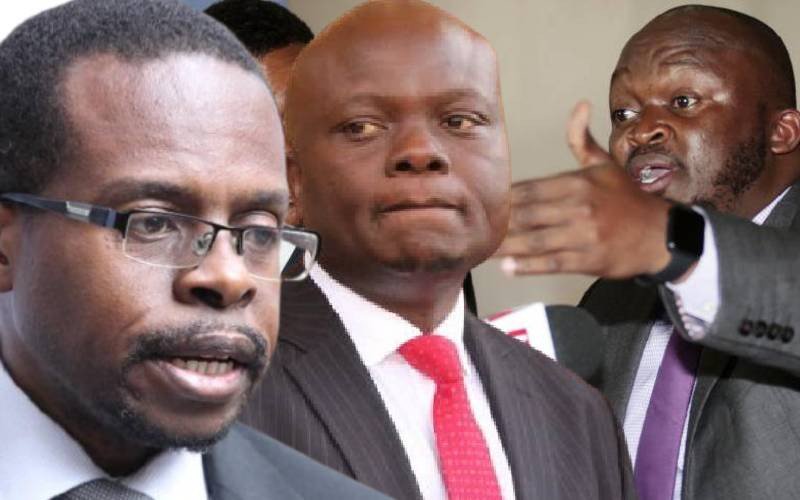
As lawyers prepare to elect the successor of Law Society of Kenya (LSK) President, Faith Odhiambo, they will need to cross-examine their consciences to identify the important issues that they will need to address as a fraternity.
This introspection will be important for several reasons: First, the person who will take over the mantle will still be at the helm in 2027 when Kenya will go to the polls.

As such, a strong leader will be needed in the event that there will be a dispute with regards to the outcome of the presidential election, as there is likely to be.
Second, lawyers will need to interrogate their relationship with judges with a view to improving access to justice. Too many long-suffering ordinary litigants feel that the wheels of justice grind too slowly and too often steamroll the innocent, the weak and the downtrodden.
Senior lawyers, led by Ahmednasir Abdullahi and Nelson Havi, have been at the forefront in demanding a cleaning up of the Judiciary to improve the administration of justice.
While their efforts have not borne much fruit, they have succeeded in raising public awareness about corruption in the Judiciary. They have also routinely pinpointed its institutional unwillingness to respond to feedback from court users, including members of the Bar.
For instance, the High Court last month ruled that the Judicial Service Commission (JSC) cannot entertain complaints against judges unless and until rules of procedure are set and gazetted. The ruling flew in the face of the spirit of the law and elevates procedure over and above justice.

The intransigence evident in that ruling only went to cement the view that the Judiciary is unwilling and incapable of removing the log in its eye, yet it is always too quick to point out the specks in the eye of other institutions, such as the Executive.
Indeed, there was a point at which Kenya was experiencing what I would call ‘governance by the Bench’. At the time, judges had abrogated unto themselves the role of deciding what other arms of government and related institutions could or could not do.
The next phase of the leadership of the LSK is also critical because of the changes expected at the Supreme Court, the highest court in the land and the one mandated to hear presidential election petitions.
For one, last month’s death of Justice Mohamed Ibrahim and the impending retirement of Deputy Chief Justice Philomena Mwilu are set to dramatically reshape the thinking — not to mention the workings — of the Supreme Court.
In the recent past, all the judges have been writing one ruling. By so doing, they departed from a long tradition of each judge writing their own before collating their collective wisdom to establish the majority. This new trend has raised questions among senior counsel who have challenged the wisdom of the uniform thinking that is emerging from the apex court.
A strong leader for LSK will be critical in shaping debate about who qualifies — or does not — for appointment to these two roles. This is important bearing in mind that Ibrahim represented the apex court in the Judicial Service Commission (JSC) and a Deputy Chief Justice is only a heartbeat away from the presidency of the Judiciary.
Who will hold these critical positions as Kenya heads to the polls and what ideologies and legal philosophies will they bring to the top court? This is a question that LSK must grapple with so that it can give Kenyans an informed opinion on who would be best suited to ascend to these two critical offices.
Finally, the LSK membership is faced with a dilemma as to whether they want change or continuity. The current Vice-President, Mwaura Kabata, is among the three candidates eyeing the top seat.
In as much as he is his own man, he represents continuity to the extent that he is part of the existing leadership establishment. The question that members will want to ask him is whether he has what it takes to transform the association or will continue with the broad goals of his predecessor.
The other two candidates – Charles Kanjama and Peter Wanyama — are yet to make their way into LSK elective positions though they ran and lost in past races. Will one of them make it to the helm this time or will the jinx of the past return to haunt them?
All three candidates have pledged to mainstream member welfare. Kanjama and Mwaura have both pledged to strengthen the rule of law, a key plank of the future of LSK. The jury is out there. Lawyers must play their cards right to give the country a man — there is no woman this time — for all seasons.
mbugua@nairobilawmonthly.com
Email your news TIPS to Editor@nairobilawmonthly.com, and to advertise with us, call +254715061658 anytime of the day
