

 By Gabriel Gervais
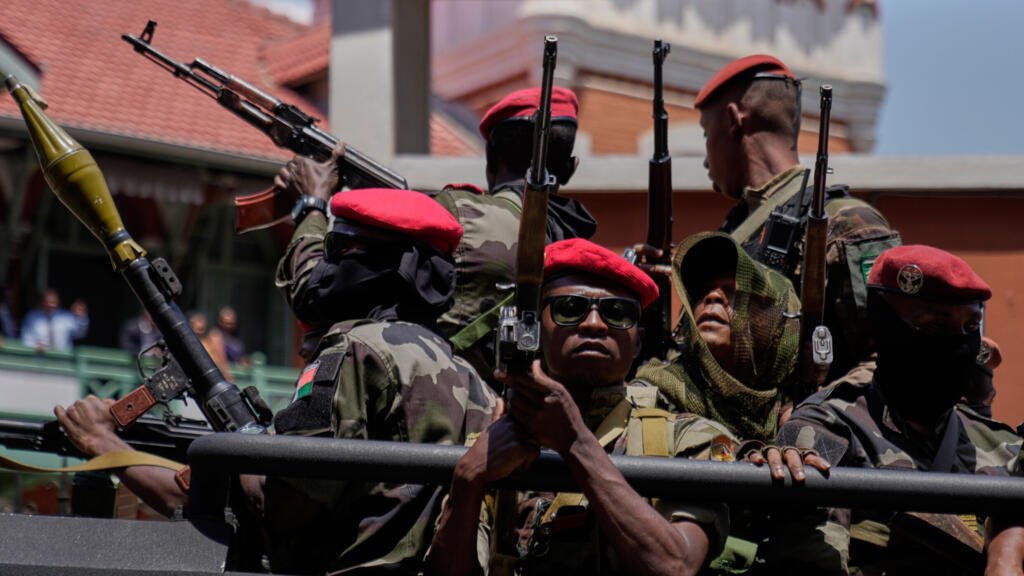
In mid-October 2025, as the political crisis in Antananarivo dragged on, videos posted on Facebook and TikTok preceded the first official statements by several hours. They cheered the army, invoked ‘regained sovereignty’ and compared Madagascar to Mali or Burkina Faso.

By the time the armed forces announced their intervention, the narrative framework was already in place. The coup no longer appeared to be a rupture, but a solution.
A standardised pattern
This is not an isolated incident. Since 2020, Africa has been hit by a veritable epidemic of coups and attempted coups, from the Sahel to the Gulf of Guinea. Mali, Burkina Faso, Niger, Guinea, Gabon, Guinea-Bissau, Madagascar: the list is growing, as military operations are carried out according to now well-established procedures.
An elite unit, concentrating most of the national army’s operational capabilities, seizes power without encountering major resistance, exploiting very real popular grievances: insecurity, corruption, poverty, and distrust of the civilian elite.
The pattern is almost always the same. The seizure of power is presented as a ‘transition’, a necessary interlude before a return to constitutional order. In reality, power is never returned to civilians. In the Sahel, military transitions drag on indefinitely, while elections, when they do take place, systematically confirm the former coup leader in power.
Guinea provided a recent illustration of this, with the overwhelming election of General Mamadi Doumbouya, the result of an electoral process that was rigged from the outset. Far from pacifying political life, these transitions often lead to new ‘coups within the coup’, as in Burkina Faso in 2022 and again in 2025.
Madagascar: 100 days of decline
The latest country to fall, Madagascar is now following this worrying trajectory. The Madagascan junta’s record, 100 days after coming to power, is mixed to say the least. Water and electricity problems, which were at the heart of Gen Z’s protests and anger, remain unresolved.
At the same time, nepotism continues. Businessman Daya Koufali is already seeking to establish himself as the new Mamy Ravatomanga, perpetuating the logic of predation.
Finally, although the junta has promised presidential elections in 2027, previous examples in Africa suggest that extreme caution is warranted. In Antananarivo, this commitment is even less likely to be honoured given that the military authorities already fear a violent takeover by rivals in the coming months, a sign that the coup has not ended the political crisis but merely displaced it.
Transition… towards authoritarianism and foreign interference
This phenomenon is not limited to a democratic crisis. It opens the door to periods of lasting authoritarianism, as seen in the Alliance of Sahel States (AES), where juntas organise themselves into a bloc, marginalise civil institutions and suspend any credible alternation of power.
It also causes chronic institutional instability, which is incompatible with any long-term development strategy. Foreign investors quickly become wary, projects are put on hold and capital flows dry up. The economic impact is direct and profound.
In this context, coups d’état create fertile ground for intervention by predatory international actors. Russia, through its security and information channels, has rushed into the breach in the Sahel. China is advancing its economic pawns in fragile political environments.
The United States, too, is adjusting its strategy according to the military balance of power. Everywhere, proclaimed sovereignty serves as a smokescreen for renewed dependence, often even more opaque than before.
Another factor exacerbates this dynamic: the massive disinformation that now accompanies every coup. Social media plays a central role in legitimising juntas. Videos of jubilation, viral messages, pan-Africanist influencers: the narrative of ‘national salvation’ spreads faster than the facts.
During the foiled coup attempt in Benin at the end of 2025, rumours announcing the fall of the government were relayed from Burkina Faso and Niger, proof of the transnational circulation of these narratives. Benin resisted thanks to the strength of its institutions. But this episode shows that even the best-administered states are no longer immune.
International institutions struggling
Faced with this wave of unrest, regional organisations appear to be struggling. ECOWAS sanctions, designed to deter coups, have backfired in online discourse, where the organisation is described as a mouthpiece for Western interests.
The African Union, while suspending the states concerned, is struggling to impose an audible counter-narrative. Messages calling for respect for constitutional order are met with public opinion that is increasingly sceptical of democratic institutions.
Further south, the SADC is trying to make its voice heard. But there is no guarantee that Michaël Randrianirina, the transitional president, will be impressed by the regional organisation’s warnings. In fact, it cannot be ruled out that he will fail to meet the SADC’s expectations, which would be a definite setback for South African diplomacy and for the stature of President Cyril Ramaphosa, the current chair of the SADC.
Everywhere, pro-junta disinformation acts as an accelerator of democratic fatigue. By glorifying the seizure of power by force, it contributes to eroding the very idea of electoral change. Africa is thus facing a systemic risk. By trivialising coups, the very idea of political change is being eroded.
Coups are becoming just another option on the political horizon. Madagascar, returning to the chronic instability of its political changes, is now bitterly experiencing this.
It is urgent to break with this complacency. Coups d’état are neither solutions nor transitions. They are a symptom of military adventurism that permanently compromises the stability, real sovereignty and development of African countries. To continue to tolerate them is to accept that Africa will remain trapped in a cycle of instability for which it will pay the price for a long time to come.
Email your news TIPS to Editor@nairobilawmonthly.com, and to advertise with us, call +254715061658 anytime of the day
