

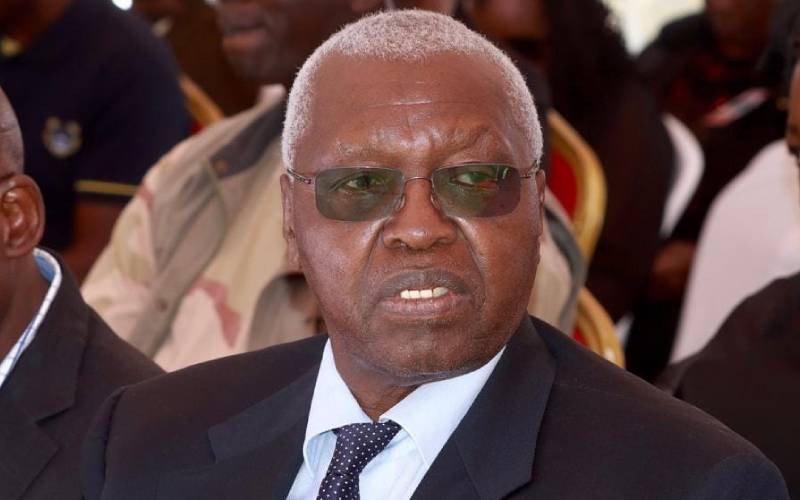
Kenya is mourning the loss of one of its most influential academic architects, Professor Raphael Munavu.
His life traces the evolution of the country’s higher education system from post-independence aspiration to modern day reform.

The distinguished scholar, passed away at the Aga Khan Teaching and University Hospital on Friday, April 24 aged 80, while undergoing cancer treatment.
He leaves behind a legacy deeply etched in lecture halls, policy frameworks, and generations of students and leaders shaped under his stewardship.
Born in 1946 in Mbilini Village, Kangundo, Machakos County, Munavu’s educational journey began in Tala Boys HGM school in rural Eastern Kenya before stretching across continents.
He then went to Mang’u High School and in 1967, flew to the United States, studying at Kalamazoo College, Wayne State University, and later earning a PhD from the University of Detroit.
His specialization in organic, environmental, and industrial chemistry would later intersect with a broader national mission: aligning science and education with Kenya’s development goals.
In a career spanning nearly five decades, Prof. Munavu became a central figure in the governance of Kenya’s universities.
At the University of Nairobi, he rose through the ranks to serve as Dean of the Faculty of Science and later Deputy Vice-Chancellor.
His administrative influence expanded nationally during his tenures as Vice-Chancellor of Egerton University and Moi University, where he spearheaded institutional reforms, including the introduction of privately sponsored student programmes that reshaped university financing and access.His imprint extended beyond academia into national policy.
Munavu chaired the Kenya National Examinations Council for a decade, influencing the structure and integrity of Kenya’s examination systems.
He later served as Commissioner at the Commission on Revenue Allocation and chaired the Kenya National Academy of Sciences for nearly two decades, positioning science and innovation at the center of national discourse.
- Final call for Jambojet founding CEO Willem Alexandar
- Njambi Koikai dead after battle with endometriosis
- High Court Judge David Majanja dies suddenly in Nairobi
At the time of his passing, he was chairing the Presidential Working Party on Education Reforms, a taskforce established under President William Ruto to reimagine Kenya’s education system. He was also serving as Chairman of the Board of Konza Technopolis.
His role reflected a lifetime commitment to aligning education with economic transformation, technology, and indigenous knowledge systems.
\Yet beyond the formal titles, Munavu’s life was woven with personal and often quietly told stories.
Among the anecdotes that have circulated in academic and political circles is a claim—never formally documented but widely whispered—that he once assisted in drafting a doctoral thesis for a young scholar who would later rise to become President William Ruto.
Whether apocryphal or factual, the story speaks to Munavu’s reputation as a mentor whose intellectual influence extended into the highest levels of leadership.
His personal life was marked by partnership and loss. His wife, Salome Munavu, a respected University Librarian at the University of Nairobi, passed away in June 2021 from cardiac arrest.
Her funeral in Mbilini village, Kangundo Constituency, brought together national leaders, including Mr. Ruto, then Deputy President and former Machakos Senator Mr.Johnson Muthama, in a show of solidarity with the Munavu family.
In death, as in life, the couple remained symbols of service within Kenya’s intellectual community. The couple had three sons, one of whom died two years ago in the United States.
Prof. Munavu’s contributions were widely recognized.
He was awarded the Elder of the Burning Spear (EBS) and the Order of the Grand Warrior (OGW), and received honorary doctorates from both Kalamazoo College and Laikipia University.
But beyond medals and citations, his enduring legacy lies in the architecture of opportunity—institutions strengthened, policies shaped, and minds inspired.
As Kenya reflects on his passing, it confronts a quieter question: who carries forward the intellectual discipline, institutional courage, and long-view thinking that defined Munavu’s era?
In lecture halls, policy rooms, and reform committees, his absence will be felt—not just as a loss of a scholar, but as the fading of a generation that built the scaffolding upon which Kenya’s future still stands.
– Anchor Media
Email your news TIPS to Editor@nairobilawmonthly.com, and to advertise with us, call +254715061658 anytime of the day
