

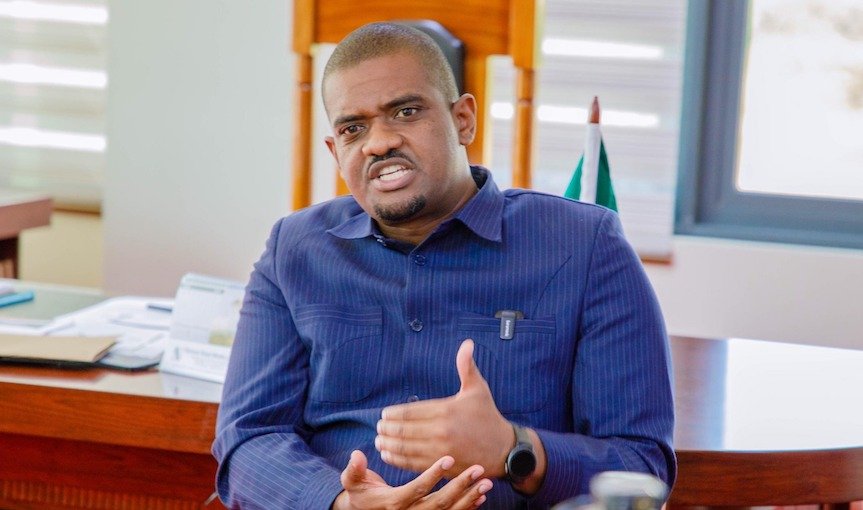
Tanzania’s ruling Chama Cha Mapinduzi (CCM) party has appointed Energy Minister Deogratius Ndejembi, 43, as the country’s new Vice President, filling the vacancy left by Emmanuel Nchimbi’s sudden resignation earlier this week.
CCM Secretary-General Dr Asha-Rose Migiro announced the decision on Wednesday, August 26, speaking to journalists at the party’s Lumumba headquarters in Dar es Salaam. She said Ndejembi’s elevation followed the party’s internal selection process, triggered once the vice presidency fell vacant after Nchimbi stepped down.

His appointment must still pass through the constitutional and legal procedures required before he can formally take up the office, including confirmation by the National Assembly.
Ndejembi takes on the role after serving as Energy Minister since a cabinet reshuffle in November 2025, having previously held the docket for Lands, Housing and Human Settlements Development.
On the other hand, Nchimbi leaves office after less than a year in the role, having been sworn in on November 3, 2025, following his selection as President Samia Suluhu Hassan’s running mate for the 2025 election.
In the same announcement, Migiro confirmed that CCM had gone further than simply accepting Nchimbi’s resignation; the party had formally expelled him from its membership altogether.
She said the decision was taken by CCM’s internal organs, including its Central Committee, as part of what she described as disciplinary and ethical measures against certain party members, framing the move as necessary to uphold the party’s principles and standards.
The expulsion adds weight to speculation that Nchimbi’s resignation was not the clean, voluntary exit his own letter suggested. Tanzania’s Constitution ties eligibility for the vice presidency directly to party membership. Article 47 requires a sitting Vice President to belong to a political party, meaning expulsion from that party automatically vacates the office.
Political analyst and lawyer William Maduhu explained the mechanism, saying: “If you read Article 47 of our Constitution, it talks about the qualifications for a person to become Vice President. One of the qualifications is that the person must be a member of a political party. Therefore, if the party that sponsored him for that position expels him from membership through its lawful party organs, automatically, the position of Vice President becomes vacant. That is a political route.”
Some analysts have suggested Nchimbi’s resignation may have been a pre-emptive move to face what was coming on his own terms, rather than being pushed out through expulsion.
Tension between Nchimbi and the party leadership appears to trace back to his public remarks on constitutional reform. At a public event on July 24, Nchimbi said Tanzania had “a genuine opportunity to secure a new Constitution before 2030,” and argued that President Hassan had the political will to advance that agenda.
Although Hassan herself did not respond publicly, the comments drew sharp criticism from senior CCM figures, who argued the party already had an established internal process for handling constitutional reform, and that the matter was already accounted for in its election manifesto.
CCM National Parents’ Wing chairman Fadhili Maganya went further, publicly questioning why Nchimbi appeared to be stirring conflict. Nchimbi pushed back against the idea that disagreement equated to disloyalty, telling the same event: “For gentlemen, there is agreeing to disagree. We can reach a point where we do not agree.”
Much of the wider speculation around the fallout links it to positioning ahead of the 2030 election, with critics reportedly accusing Nchimbi of using the constitutional reform debate to build his own political profile ahead of a future presidential run.
Nchimbi’s expulsion brings an unusually abrupt end to a rapid political rise, from CCM Secretary-General to presidential running mate to Vice President, all within roughly a year.
Under Tanzania’s Constitution, once the vice presidency becomes vacant, the President is required to appoint a replacement within 14 days, subject to confirmation by a majority vote in the National Assembly. Ndejembi’s appointment must still complete that process before he can be formally sworn in.
Email your news TIPS to Editor@nairobilawmonthly.com, and to advertise with us, call +254715061658 anytime of the day
