

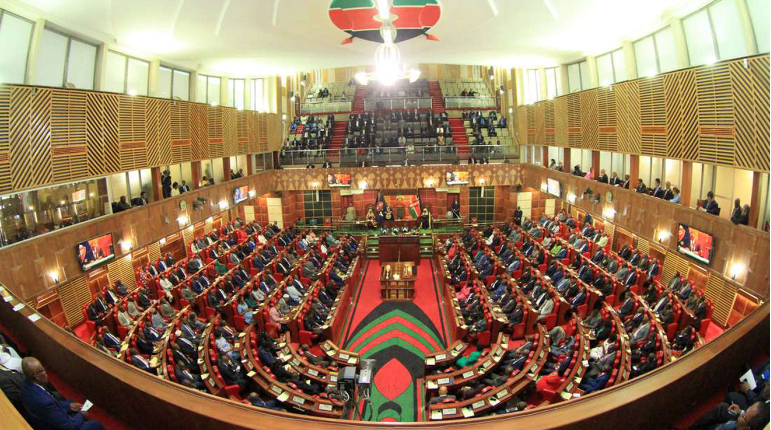
The National Assembly has passed a Bill that removes the legal requirement for the Independent Electoral and Boundaries Commission (IEBC) to livestream election results, changing how results will be handled in the 2027 General Election.
MPs approved the Elections (Amendment) Bill on Thursday, October 22, 2026. Clause 22 of the Bill deletes Section 39 of the Elections Act, the provision that governs how results are determined, transmitted and declared. The Bill had already been passed by the Senate.

Under the new law, the IEBC will still be required to determine, declare and publish results immediately after polls close, and results declared at the polling station will continue to be treated as final. However, the commission will no longer be legally bound to stream the results live as they are announced. The media and election observers will remain free to broadcast results independently.
Deputy Speaker Gladys Boss Shollei dismissed concerns that the change would weaken transparency, saying the law already has strong safeguards for resolving disputes.
“If there is a query, the ballot box will be brought back,” she said. “And that’s why last time, the Supreme Court, when they decided they want to recount the votes, the one from Tiaty was brought to the Supreme Court, the one from, it was Mombasa, Jicho Pevu’s constituency, and so on. So that is how it’s done. So there is nothing wrong.”
During the debate, MPs rejected a separate amendment by Suba South MP Caroli Omondi that sought to change how presidential results are tallied, verified and communicated.
National Assembly Majority Leader Kimani Ichung’wah opposed the amendment, warning against changing electoral laws so close to the polls.
“If we start tinkering with electoral laws, substantive issues of touching on our electoral processes, and also in the transmission of results and all those other things, shenanigans around the electoral period, the elections, we stand accused,” he said.
The IEBC has previously said that changes to election laws are meant to strengthen, not weaken, the transmission of results.
In July 2026, responding to reports on a related Bill, the Election Laws (Amendment) Bill, 2026, the commission described claims that livestreaming would be scrapped as “erroneous.” It said the Bill did not seek to amend Section 44 of the Elections Act, which governs the electronic system used for voter registration, identification and transmission of results.
Instead, the commission said the Bill would introduce a backup method for areas without adequate mobile network coverage.
“It proposes a complementary mechanism for result transmission,” the commission said, explaining that electronic transmission is impossible in some areas because of a “lack of 3G network, which is the minimum standard required for transmission of result Forms.”
The IEBC added that the reforms align the law with the Supreme Court’s 2017 ruling that Form 34A, filled in at the polling station, is the primary and final record of results.
The change reverses a position Parliament took in 2022, when the National Assembly’s justice committee rejected a similar IEBC proposal to end the livestreaming of results.
Email your news TIPS to Editor@nairobilawmonthly.com, and to advertise with us, call +254715061658 anytime of the day
