

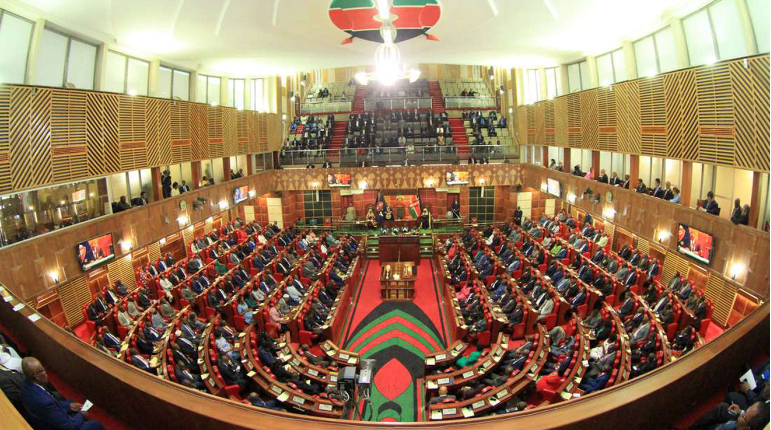
The National Assembly has removed proposed provisions from the Elections (Amendment) Bill, 2024, that would have given the Independent Electoral and Boundaries Commission (IEBC) ownership of the intellectual property rights to its election technology and required suppliers to host election servers in Kenya.
The changes reopen the debate over who controls the systems used to manage and transmit results ahead of the 2027 General Election.

MPs adopted the amendments, moved by Homa Bay Town MP Peter Kaluma, without opposition as the House considered the Bill last week. The Bill, which originated in the Senate, now returns to the Senate, where senators will decide whether to accept the National Assembly’s changes.
Kaluma argued that the requirements did not belong in law, saying that ownership of technology should ordinarily follow from the way it is procured and that information stored on the internet could not always be kept within national borders. “When you procure something, it becomes yours. These are not things to put in law,” he said.
The original Bill proposed amending Section 44 of the Elections Act to require the IEBC to secure the intellectual property rights to any election technology it purchases from suppliers. It also sought to guarantee that candidates, the courts and other authorised parties could access the technology and election information for scrutiny, with no charge for information supplied electronically.
A proposed new Section 82A would have required the commission to provide requested information within three days in a presidential election and within seven days for other elective seats. The IEBC would have been allowed to charge for hard copies, but only up to the actual cost of copying and supplying them.
Kaluma also amended a clause that would have barred technology suppliers, or anyone associated with them, from supplying election systems if they had been found guilty of procurement violations, convicted of a crime, breached professional standards or been barred from public procurement in any country. He said such conditions were better placed in tender documents than in the law.
The provisions were among the reforms proposed by the National Dialogue Committee (NADCO) to strengthen the commission’s independence, improve transparency and prevent technology suppliers from using their proprietary rights to limit scrutiny of election systems.
Control of election servers has been a recurring issue in Kenya’s recent elections. In 2017, the Supreme Court nullified the August 8 presidential election, citing, among other issues, the IEBC’s failure to open its servers for scrutiny, and ordered a fresh poll, which was held on October 26 that year.
Similar concerns arose after the 2022 election, when Smartmatic International Holding BV, the firm that supplied the Kenya Integrated Elections Management System (KIEMS), reportedly denied the IEBC access to servers holding election results despite a court order, citing its intellectual property rights.
Former National Assembly Speaker Justin Muturi has argued that ownership of the technology is key to the commission’s independence. “The IEBC must ensure that whoever provides the KIEMS kits gives the commission ownership of the intellectual property rights to avoid situations similar to those witnessed in previous elections,” he said, urging Parliament to pass the reforms and the commission to comply with them.
The amendments come days after MPs passed changes to the same Bill that deleted Section 39 of the Elections Act, removing the legal requirement for the IEBC to livestream election results. Under that change, the commission must still declare and publish results immediately after polls close, and results declared at the polling station remain final.
With the Bill now headed back to the Senate, the question of how much control the IEBC will have over its election technology remains unresolved ahead of the 2027 polls.
Email your news TIPS to Editor@nairobilawmonthly.com, and to advertise with us, call +254715061658 anytime of the day
