

By Dr Samuel Ndogo
In this article, I offer a comparative analysis of two towering figures in Kenya’s intellectual and political history: Ngũgĩ wa Thiong’o and Raila Amolo Odinga. My reflections are shaped by years of engagement with Ngũgĩ’s works as a literary scholar and teacher, as well as my research interests in good governance and democratic movements across Africa. Ngũgĩ, the novelist and cultural theorist, and Raila, the politician and activist, stand as parallel embodiments of resistance—each confronting authoritarianism in their own sphere, one through the pen and the other through the podium.
This exploration is not merely biographical; it is an inquiry into how literature and politics intersect to shape the destiny of nations. Ngũgĩ’s prison memoirs and linguistic defiance reveal the power of words to liberate, while Raila’s detentions, exiles, and party leadership illuminate the arduous path toward multiparty democracy. By placing these two figures side by side, I seek to underscore how public intellectuals—whether literary voices or political actors—become builders of freedom, crafting legacies that transcend borders and generations.
…………………………..
The month of October, when Kenyans celebrate Mashujaa Day, provides an opportunity to pause and reflect on the achievements of those who have shaped our unending—and oftentimes elusive—project of nation-building. Yet in 2025, this ritual of remembrance was tinged with grief. It was during this month that Kenyans woke up to the sad news of the passing on of Raila Amolo Odinga. The flowers had not even dried on the grave of the doyen of African literature from Limuru, Ngũgĩ wa Thiong’o, who had passed on five months earlier.
In this article, I pay homage to the two iconic sons of the soil: Ngũgĩ wa Thiong’o, the literary revolutionary whose pen unsettled the empire by moving the centre through literature, and Raila Amolo Odinga, the political trailblazer and doyen of multiparty democracy whose voice stirred the status quo in post-independence Kenya.
Although they walked different paths—Ngũgĩ through the corridors of decolonial thought, Raila through the trenches of oppositional politics—their lives converge in a shared commitment to justice, truth, democracy, good governance, and the dignity of the Kenyan people. I want to invite you as I explore their distinct journeys as well as the common thread that unites them: a relentless pursuit of a freer, more humane republic.
Both men shared striking historical parallels. They were born in colonial Kenya in the same month—January—and died in the same year. Ngũgĩ was born on 5 January 1938 in Kamĩrĩĩthũ, Limuru, and died on 28 May 2025 at the age of 87 in Buford, Georgia, USA. Raila, on the other hand, was born on 7 January 1945 in Maseno and died on 15 October 2025 at the age of 80 in Kerala, India.
As a literary scholar specializing in autobiographical and prison writings, I have spent years engaging with both Ngũgĩ wa Thiong’o and Raila Odinga—not merely as public figures, but as subjects of deep intellectual and cultural inquiry.
I have taught Ngũgĩ’s works at both undergraduate and postgraduate levels, and I had the privilege of meeting him on several occasions in Kenya, Germany, and the United States. Each encounter revealed a man of profound conviction, quiet humility, and incandescent brilliance.
Although I never met Raila in person, I encountered him through his autobiographical and biographical writings, which pulse with defiance, vulnerability, and a populist eloquence that, in many ways, mirrors Ngũgĩ’s literary passion.
Their lives diverged in form—one wielding fiction, the other forging political coalitions. However, they converged in spirit: both were prisoners of conscience, architects of resistance, and tireless advocates for the dignity of the Kenyan people.
Clearly, Ngũgĩ and Raila join a constellation of authors and political thinkers whose works I teach in the university course Kenyan Fiction and History. Here, we explore the intersection of literature and political struggle through the writings of Jomo Kenyatta, Meja Mwangi, Sam Kahiga, Marjorie Oludhe Macgoye, Bethwell Allan Ogot, E. S. Atieno Odhiambo, David Anderson, David Cohen, and John Lonsdale. My reading list also includes Jaramogi Oginga Odinga, whose autobiography Not Yet Uhuru remains foundational in understanding Kenya’s post-independence trajectory.
Ngũgĩ’s commitment to writing in his Gĩkũyũ mother tongue was not merely a linguistic choice—it was a revolutionary act. He believed that language is the soul of a people, and through it, he advanced a vision of cultural liberation, most powerfully articulated in his seminal collection of essays Decolonising the Mind: The Politics of Language in African Literature, published in 1986. It is in this book that he makes his famous declaration, announcing his commitment to write his creative works in Gĩkũyũ, a vow he tried to fulfill until the time of his demise
Ngũgĩ’s prison memoir, Detained: A Writer’s Prison Diary, remains one of the most powerful texts I teach. This one is not merely a chronicle of incarceration; it is a testament to the resilience of the human spirit and the enduring power of the written word. Indeed, Ngũgĩ’s one year in Kamiti Maximum Prison was enough to sharpen his critique of authoritarianism and to affirm the role of literature as a weapon of resistance.
Yet when set alongside the nine long years of detention endured by Raila Odinga the contrast becomes striking. This is because, Ngũgĩ’s confinement birthed a literary classic that continues to inspire generations, while Raila’s prolonged ordeal forged a political legacy rooted in sacrifice, endurance, and the struggle for democratic space.
As such, both men, though operating in different spheres, reveal how detention in post-independent Kenya became not only a personal crucible but also a national symbol: for Ngũgĩ, the pen became his defiance; for Raila, the sheer longevity of his detention became a rallying cry for freedom. Together, their experiences remind us that the walls of prison can paradoxically become the womb of liberation, producing voices that refuse to be silenced.
Moreover, Ngũgĩ’s novels, essays, and plays—such as Petals of Blood, Moving the Centre, Barrel of a Pen, and I Will Marry When I Want (co-authored with Ngũgĩ wa Mĩriĩ)—have continued to shape generations of thinkers, writers, and activists across Africa and beyond.
In December 1977, Ngũgĩ was detained without trial for a year following the staging of Ngaahika Ndeenda in his home village Kamĩrĩĩthũ, Limuru. Performed by local villagers, the play offered a searing critique of social injustice and political corruption. In effect, through this community theatre project, Ngũgĩ was trying to move the centre by taking the university to the village—a profoundly subversive act that unsettled the political establishment.
For sure, the Kamĩrĩĩthũ Community Education and Cultural Centre stands as one of his most radical contributions to grassroots empowerment. Though it was destroyed by the state in 1982, its legacy endures as a symbol of the transformative power of community-based cultural production.
Significantly, Ngũgĩ’s imprisonment at Kamiti Maximum Security Prison marked a turning point. This is because, it is under the harsh conditions of prison that he wrote his first novel in Gĩkũyũ, Caitaani Mũtharaba-inĩ (Devil on the Cross) on prison-issued toilet paper—an act of defiant literary resistance that underscored his commitment to indigenous language and storytelling.
Following his release, increasing surveillance and threats forced him into exile in the 1980s. Yet exile was not retreat; it was repositioning. From abroad—particularly in the United States—Ngũgĩ amplified his critique of authoritarianism and cultural imperialism, remaining deeply tethered to Kenya’s struggles.
One striking feature of Ngũgĩ’s works is that his fictional and autobiographical writings are deeply interconnected. For instance, his novels—Weep Not, Child, A Grain of Wheat, Petals of Blood, and Matigari—are rooted in lived experience, historical memory, and political critique. On the other hand, his autobiographical works that he penned towards the end of his writing career—Dreams in a Time of War, In the House of the Interpreter, and Birth of a Dream Weaver—provide the intellectual scaffolding behind his fiction.
At this juncture, let me mention an emotive matter: The coveted Nobel Prize. Despite his towering stature as a doyen of African literature, Ngũgĩ was never awarded the Nobel Prize for Literature. During his lifetime, this omission continued to puzzle literary pundits, since his oeuvre embodies the very qualities the Nobel often seeks to honour: originality, courage, and a profound engagement with the human condition.
From A Grain of Wheat to Petals of Blood, Ngugi consistently interrogated the intersections of colonialism, class, and culture, while simultaneously pioneering the use of African languages in literary production.
As I have already indicated, his refusal to write exclusively in English was not merely a stylistic choice but a radical act of cultural reclamation, positioning him as a global voice of resistance. Yet, paradoxically, it is this very commitment to linguistic decolonization that may have contributed to his exclusion from the Nobel canon, which has historically privileged works accessible to Eurocentric readerships.
Nonetheless, the absence of a Nobel Prize does not diminish Ngũgĩ’s influence; rather, it underscores the limitations of global literary recognition. In contrast to laureates whose works are often celebrated within Western frameworks, Ngũgĩ’s legacy is rooted in the lived struggles of African communities and the insistence that literature must serve as a tool of liberation.
As a matter of fact, his global stature is evident in the countless universities that teach his texts, the movements that draw inspiration from his ideas, and the generations of writers who see in him a model of intellectual courage.
Thus, to speak of Ngũgĩ without the Nobel (or even the Nobel without Ngũgĩ) is to remind ourselves that prizes, however prestigious, are not the ultimate arbiters of literary greatness. For sure, Ngũgĩ’s enduring relevance lies not in the accolades withheld but in the transformative power of his words, which continue to shape conversations about identity, justice, and freedom across continents.
Let us now turn to Raila Amolo Odinga, one of the most consequential figures in Kenya’s political history.
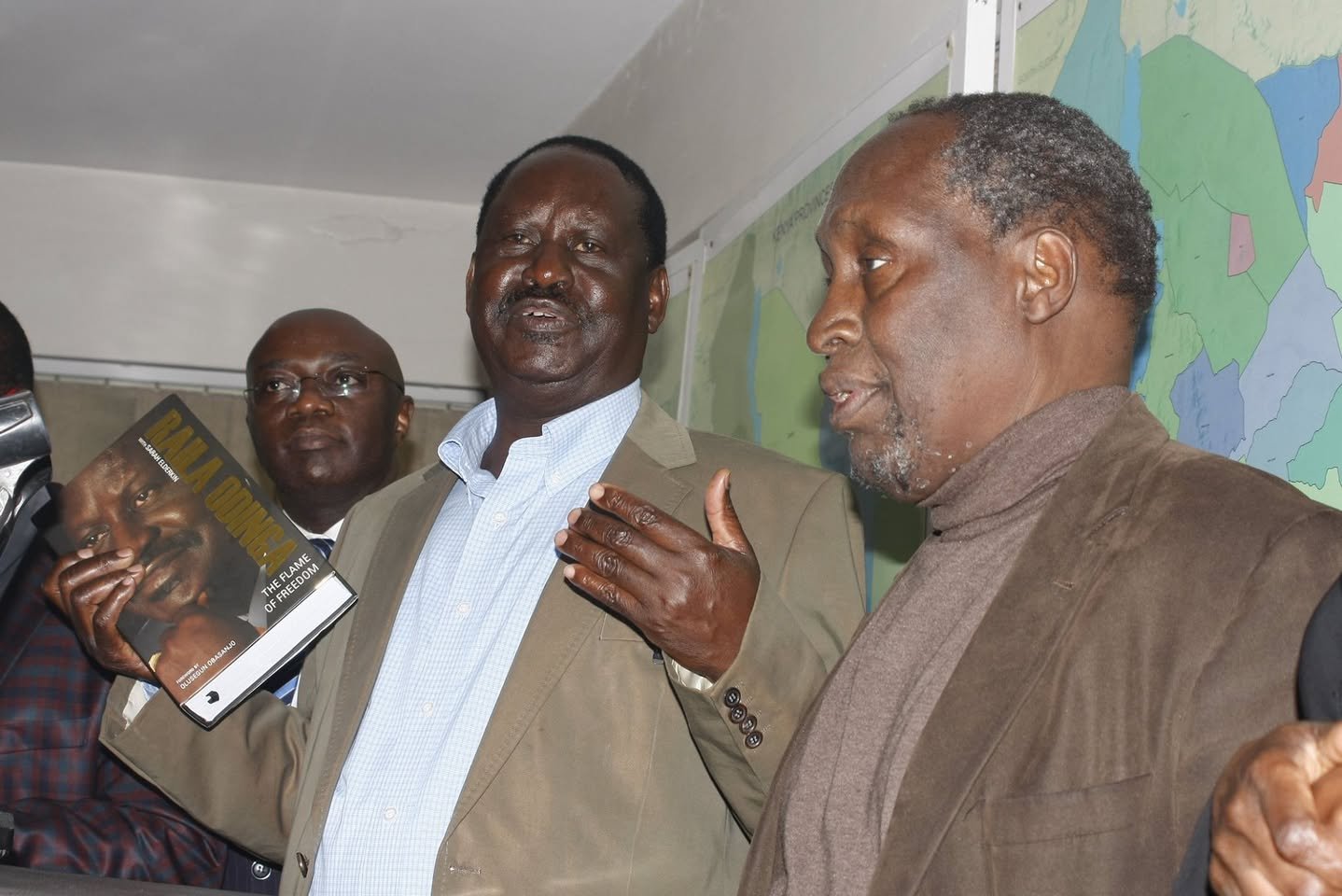
Raila Amolo Odinga’s name will remain etched into Kenya’s political history. A son of Jaramogi Oginga Odinga, Raila inherited a legacy of resistance from his father, but he carved his own path and niche as a champion of Kenya’s Second Liberation. His autobiography, The Flame of Freedom, offers rich insight into the personal cost of engagement in political struggle with striking candour.
Like Ngũgĩ, Raila endured detention, exile, and relentless opposition. Yet he remained steadfast in his pursuit of democracy, justice, and national unity. His ability to mobilize across ethnic lines and speak truth to power made him a unifying figure in Kenya’s fractured political terrain. His political activism was never confined to rhetoric; it was embodied in action, protest, and sacrifice. Raila became the face of resistance against one‑party authoritarianism, and his voice carried the aspirations of millions who longed for a freer Kenya.
In 1982, following the failed coup against President Daniel arap Moi, Raila was accused of involvement and detained without trial for six years. His time in prison was brutal, yet transformative. It solidified his resolve to fight for democratic reform and gave him firsthand experience of the repression faced by political dissidents.
In The Flame of Freedom, Raila recounts these years of adversity with raw honesty, offering insight into the cost of resistance and the resilience required to endure it. His imprisonment became a crucible in which his political philosophy was refined—anchored in the belief that democracy must be won through struggle, and that freedom is never handed down but wrested from the grip of tyranny.
After his release, Raila continued to face political persecution, leading to periods of exile in Norway and other countries. Even from abroad, he remained a vocal critic of the Kenyan regime and a symbol of the struggle for multiparty democracy. His return to Kenya was met with renewed activism, culminating in his central role in the push for constitutional reform and electoral justice.
Raila’s exile, like Ngũgĩ’s, did not silence him—it instead amplified his voice and broadened his influence, making him a continental figure in the fight for democratic governance. His political journey, marked by resilience and sacrifice, demonstrates that activism is not a passing flame but a sustained fire, capable of illuminating the path toward freedom even in the darkest of times
As such, through exile, Raila discovered that distance from home does not silence dissent; instead, it sharpened his critique and expanded his political reach. Exile paradoxically gave him both refuge and a platform, allowing him to speak to international audiences about Kenya’s democratic deficit and to build solidarity networks that transcended national boundaries.
Historically, exile has functioned as both punishment and empowerment for African intellectuals and activists. South African writers and leaders such as Es’kia Mphahlele and Oliver Tambo found in exile the space to articulate visions of freedom that were impossible under apartheid’s surveillance. Similarly, Raila’s years abroad became a school of political maturity, exposing him to global democratic movements and strengthening his conviction that Kenya’s struggle was part of a wider continental quest for liberation.
Upon his return, Raila carried with him not only the scars of detention but also the broadened horizons of exile, which informed his central role in the push for multiparty democracy and constitutional reform. Thus, exile, though adversarial, became paradoxically generative—fuelling activism, sharpening vision, and transforming personal suffering into collective hope.
Exile, then, becomes not simply a form of geographical displacement but a crucible of creativity and activism. For Raila, exile expanded his political reach, enabling him to connect Kenya’s democratic struggle with global movements for justice. For Ngũgĩ, exile was equally formative, though expressed through the pen rather than the podium. His decision to write in Gĩkũyũ while abroad was itself a radical act of resistance, challenging the dominance of colonial languages and asserting the legitimacy of African voices in world literature. In both cases, exile paradoxically amplified their influence: Raila’s political activism gained international resonance, while Ngũgĩ’s literary exile produced texts that continue to shape debates on culture, identity, and liberation.
Placed side by side, the narratives of these two Kenyan icons reveal exile as a paradoxical gift—an adversarial context that fuels vision, deepens resolve, and transforms personal suffering into collective empowerment. Raila’s political exile broadened his horizons and strengthened his democratic mission; Ngũgĩ’s literary exile sharpened his cultural critique and fortified his commitment to linguistic decolonization.
Together, they remind us that exile, though intended to silence, often becomes the very condition for enduring voices of resistance. In their journeys, the prison cell and the foreign land converge as sites of transformation, producing leaders and writers whose legacies transcend borders and continue to inspire the struggle for freedom and dignity.
One defining moment came in March 2018 with the now‑famous “handshake” with President Uhuru Kenyatta—a gesture that prioritized national cohesion over political antagonism. It marked Raila’s evolution from opposition figure to statesman. In that single act, Raila reframed the grammar of Kenyan politics: reconciliation replaced confrontation, dialogue supplanted division, and the pursuit of unity took precedence over the calculus of power.
Clearly, the handshake was not merely symbolic; it was a deliberate re‑imagining of politics as a space for healing, where adversaries could become partners in the unfinished project of nation‑building.
This reconciliatory approach elevated Raila’s stature beyond the realm of partisan struggle. He became a statesman whose legacy was defined not only by resistance but also by the courage to embrace peace. In the years that followed, his role in constitutional reform, electoral justice, and national dialogue was seen through the lens of this transformative gesture.
Therefore, when the state posthumously awarded him Kenya’s highest honour, the Chief of the Order of the Golden Heart (C.G.H.), it was a recognition that his sacrifices, detentions, exiles, and reconciliatory politics had together shaped the nation’s democratic trajectory. Raila’s journey thus stands as a testament to the paradox of struggle: that the flame of freedom, once kindled in prison and exile, can culminate in the embrace of reconciliation and the honour of a grateful nation.
To speak of Raila Amolo Odinga is to speak of the architecture of Kenya’s multiparty democracy. Clearly, his political career cannot be disentangled from the parties he founded, led, or revitalized—each one a vessel for the aspirations of a restless nation. From the National Development Party (NDP) to the Orange Democratic Movement (ODM), Raila consistently positioned himself at the centre of Kenya’s democratic ferment, embodying the resilience and adaptability required in a shifting political landscape.
The National Rainbow Coalition (NARC) marked a turning point in Kenya’s history, ushering in the end of one‑party dominance and symbolizing the triumph of coalition politics. Later, through Coalition for Reform and Democracy (CORD) and National Super Alliance (NASA), Raila became the rallying figure for opposition forces, articulating the frustrations of citizens who demanded electoral justice and constitutional reform.
Raila’s last bid for Kenya’s presidency under Azimio la Umoja—though unsuccessful against William Ruto—underscored his enduring relevance and his refusal to retreat from the democratic stage. Each of these affiliations was more than a political manoeuvre; they were chapters in the unfolding story of Kenya’s Second Liberation.
Taken together, these political parties form Raila’s indelible legacy: he was not merely a participant in Kenya’s democratic struggle but its chief architect, the undisputed doyen of multiparty democracy. His leadership across these platforms demonstrates a rare ability to reinvent, to mobilize, and to keep alive the flame of freedom in the face of repeated setbacks. In this sense, Raila’s legacy is not just confined to electoral contests, but it is woven into the very fabric of Kenya’s democratic imagination.
In the end, the stories of Ngũgĩ wa Thiong’o and Raila Amolo Odinga converge as parallel testaments to the power of public intellectuals. Ngũgĩ, through the written word, constructed a literary architecture of resistance—his novels, essays, and prison memoirs becoming scaffolding for cultural liberation and linguistic decolonization. Raila, through political activism, built the architecture of multiparty democracy—his leadership across NDP, NARC, ODM, CORD, NASA, and Azimio la Umoja shaping Kenya’s democratic imagination and keeping alive the flame of freedom.
Together, they embody the paradox of struggle: that prison cells and exile, meant to silence, became wombs of transformation; that the pen and the podium, though different instruments, can both carve pathways toward liberation. Ngũgĩ’s literary exile and Raila’s political exile mirror each other, revealing how adversity fuels vision and how resistance matures into reconciliation.
For sure, the 2018 handshake crowned Raila’s journey with statesmanship, just as Ngũgĩ’s enduring global stature crowned his literary defiance. And when the state posthumously awarded Raila Kenya’s highest honour, it was a recognition that his sacrifices had become part of the nation’s democratic DNA.
Thus, Ngũgĩ and Raila stand as architects of freedom—voices that refused to be silenced, builders of cultural and political emancipation, and enduring symbols of Kenya’s struggle for democracy. Their legacies remind us that true greatness lies not just in prizes or titles, but in the courage to speak truth to power, to act, and to build a future where freedom is both lived and imagined.
Together, they remind us that both the pen and the podium, when wielded with courage, can catalyse transformation. Upon their demise, Ngũgĩ laid down his pen; Raila dropped the mic. Yet, their voices endure—in classrooms, in political discourse, in collective memory. Although Kenya has lost two giants, we have inherited two enduring flames.
May their legacies illuminate our path toward a freer, wiser, and more united Kenyan nation.
……………..
Dr. Samuel Ndogo is a Senior Lecturer in the Department of Literature, Linguistics, Foreign Languages and Film Studies at Moi University, Eldoret. He teaches literature, performance, and cultural studies, with a research focus on literatures in African languages, autobiographical and prison writings. His work explores memory, resistance, and the role of narrative in shaping postcolonial identity.
Email your news TIPS to Editor@nairobilawmonthly.com, and to advertise with us, call +254715061658 anytime of the day
