

By Samuel Ndogo
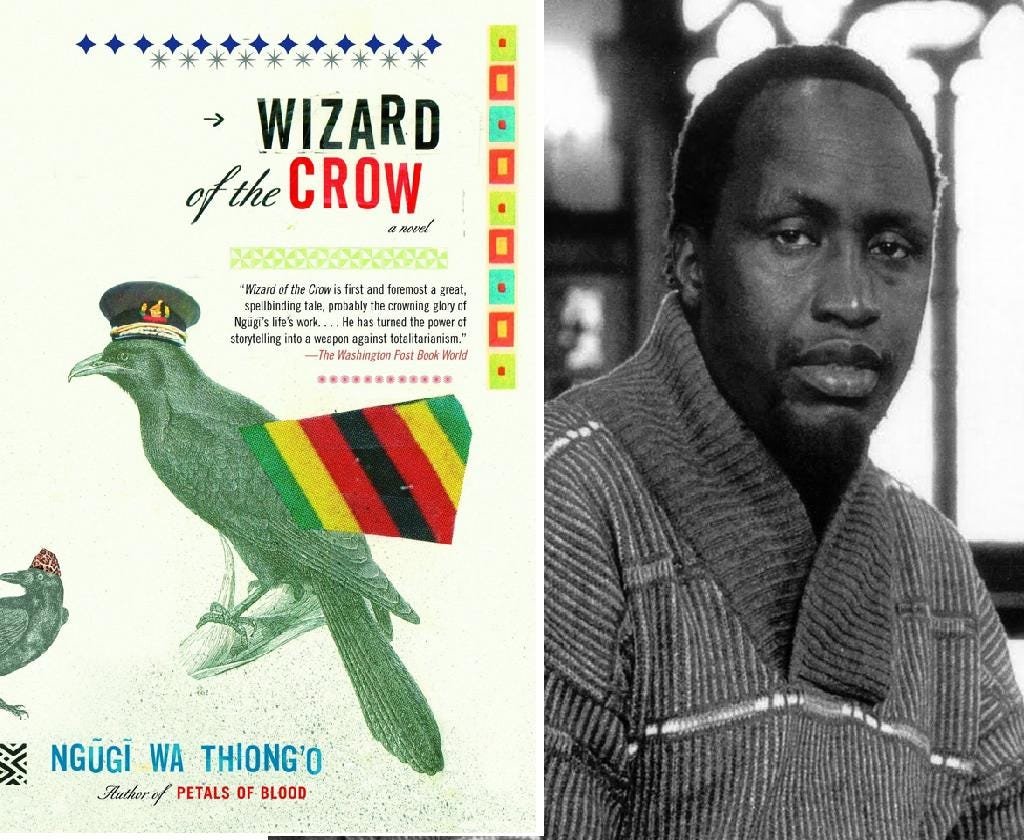
In this review, I invite you, my dear reader, to pick up Ngũgĩ wa Thiong’o’s magnum opus Wizard of the Crow, which stands as one of the most ambitious literary interrogations of postcolonial Africa.
Originally written in Gĩkũyũ as Mũrogi wa Kagoogo, Wizard of the Crow is not merely a story but an act of epistemic resistance—reclaiming narrative authority from colonial linguistic domination. To attempt a full account of this classic novel in a single review reminds me of the parable of the blind men describing an elephant: each grasp reveals something true, yet never the whole. My aim, therefore, is more modest—to illuminate a few key contours of the novel while provoking my reader to encounter it firsthand.
Set in the fictional Free Republic of Aburĩria, Ngũgĩ crafts a biting satire of postcolonial governance, where power operates as spectacle and excess. The Ruler’s fantastical project, Marching to Heaven (a subtle allusion to the biblical Tower of Babel), captures the delusions of grandeur that mark regimes sustained by vanity, foreign dependence, and internal repression. Here, independence appears hollow, its promises betrayed by the very elites entrusted with its realization.
What I love most in Wizard of the Crow is Ngũgĩ’s exposure of the anatomy of power as performance, where we encounter ministers competing in extravagant displays of loyalty, even to the point of bodily distortion. Clearly, sycophancy is not merely enacted; it is inscribed onto the body itself. Consider the story of Markus, the Minister for Foreign Affairs:
“The story goes that Markus used to be an ordinary member of Parliament… he entered a major London hospital not because he was ill but because he wanted to have his eyes enlarged… Enlarged to the size of electric bulbs, his eyes were now the most prominent feature of his face… The Ruler was so touched by his devotion… that… he had given him the Ministry of Foreign Affairs… And so Machokali he became…”
What we encounter here is caricature elevated into political theory. Markus’s grotesquely enlarged eyes dramatize a regime in which proximity to power is secured through exaggerated performances of vigilance and loyalty. The body becomes a site of political inscription, echoing what Achille Mbembe theorizes as the “aesthetics of vulgarity”—a domain where excess, obscenity, and spectacle are constitutive of authority itself.
This logic is further amplified in another character, Silver Sikiokuu. Listen to his story:
“He… sold his father’s plot… to buy himself… a hospital bed in Paris, where he had his ears enlarged… so that he would be able to hear better… His ears were larger than a rabbit’s… His devotion did not go unnoticed, and he was made Minister of State in charge of spying… And so Silver Sikiokuu he became…”
Here, surveillance becomes the currency of power. Sikiokuu’s monstrous ears signify not only his personal ambition but the expansion of the repressive state apparatus. In Fanonian terms, this is the degeneration of national consciousness into a machinery of control, where the postcolonial elite, rather than liberating the people, perfect the instruments of domination.
- Fare thee well, Ngugi wa Thiong’o: Author who was a needle in State’s flesh
- Architects of Freedom: Reflecting on the legacies of Ngũgĩ wa Thiong’o and Raila Odinga
Additionally, Ngũgĩ’s satire cuts deeper particularly in his choice of geography. London and Paris—metropolitan centres of former empire—become the sites where African elites seek bodily transformation. Ironically, the bodies that symbolize national authority are remade abroad. One is therefore compelled to ask: what does independence mean when power must travel elsewhere to see, to hear, and ultimately to govern?
Reading these episodes, the resonances with contemporary African realities are difficult to ignore. This is because, the recurring spectacle of political leaders seeking medical care abroad, even as domestic healthcare systems languish, mirrors Ngũgĩ’s fictional exaggeration with unsettling fidelity. What appears as absurdity in Aburĩria is, in many respects, a thinly veiled realism, rendering the novel’s “absurdities” disturbingly familiar.
In this way, Ngũgĩ’s use of caricature and satire does more than entertain; it unsettles. It forces the reader to confront the grotesque continuities of postcolonial power, where loyalty is performed, bodies are politicized, and sovereignty itself becomes a spectacle.
Read alongside Frantz Fanon’s reflections in The Wretched of the Earth, these episodes illuminate the tragic trajectory of postcolonial societies. Fanon’s warning about the “pitfalls of national consciousness” finds vivid expression in Aburĩria: a political elite that inherits the machinery of colonial domination only to redeploy it for self-enrichment and control. As such, sovereignty remains, but liberation recedes.
Gladly, Wizard of the Crow is not only a diagnosis of failure. Rather, it is also a meditation on resistance. Through characters such as Kamĩtĩ and Nyawĩra, Ngũgĩ imagines alternative modes of being that blend the political and the spiritual. Indeed, the interventions of these protagonists suggest that true liberation must occur not only in institutions but in consciousness itself.
Further, I need to point out that Ngũgĩ’s brilliance in this novel lies in its narrative method. Through magical realism and satire, he renders the absurdity of power visible. The enigmatic figure of Kamĩtĩ—who actually is the Wizard of the Crow—alongside Nyawĩra, becomes a site of resistance. Their “healing” practices expose the psychological and structural maladies of the state, suggesting that liberation must be both material and imaginative. In one striking episode, the Ruler’s mysterious illness—his body grotesquely expanding—becomes a metaphor for insatiable power, a condition that no conventional medicine can cure.
Another aspect worth mentioning is that language itself is central to the idea of resistance. This is because, by writing this novel originally in Gĩkũyũ, Ngũgĩ subverts the colonial hierarchy of knowledge production, affirming African languages as legitimate vehicles of complex thought.
Additionally, the allegorical landscape of Aburĩria allows us to read beyond the text into the lived realities of many African nation-states. The persistence of patronage networks, the theatrics of political legitimacy, and the entanglement with global capital all resonate within these geo-political settings. Thus, whether we call them “states” or “countries,” the distinction becomes secondary to the deeper crisis that Ngũgĩ exposes: the betrayal of the postcolonial promise.
Clearly, Wizard of the Crow is a prophetic text in the sense that it compels us to confront the unfinished project of liberation and to imagine alternative futures grounded in justice, accountability, and human dignity. In its fusion of satire, myth, and political critique, Ngũgĩ offers not only a searing indictment of power but also a profound meditation on the possibilities of resistance.
Ultimately, to read Wizard of the Crow is to encounter a mirror—one that reflects, distorts, and clarifies in equal measure. It is a novel that refuses complacency, demanding that we confront the unfinished project of decolonization in all its complexity.
Hence, this review can only gesture toward the novel’s depth. Like the blind men experiencing the elephant, I have merely traced a fragment of its vastness. The rest awaits you, my dear reader. For in entering Aburĩria, one does not simply read a story—one recognizes a world, unsettlingly familiar, and is left to ask: if this is satire, why does it feel so real?
Email your news TIPS to Editor@nairobilawmonthly.com, and to advertise with us, call +254715061658 anytime of the day
