

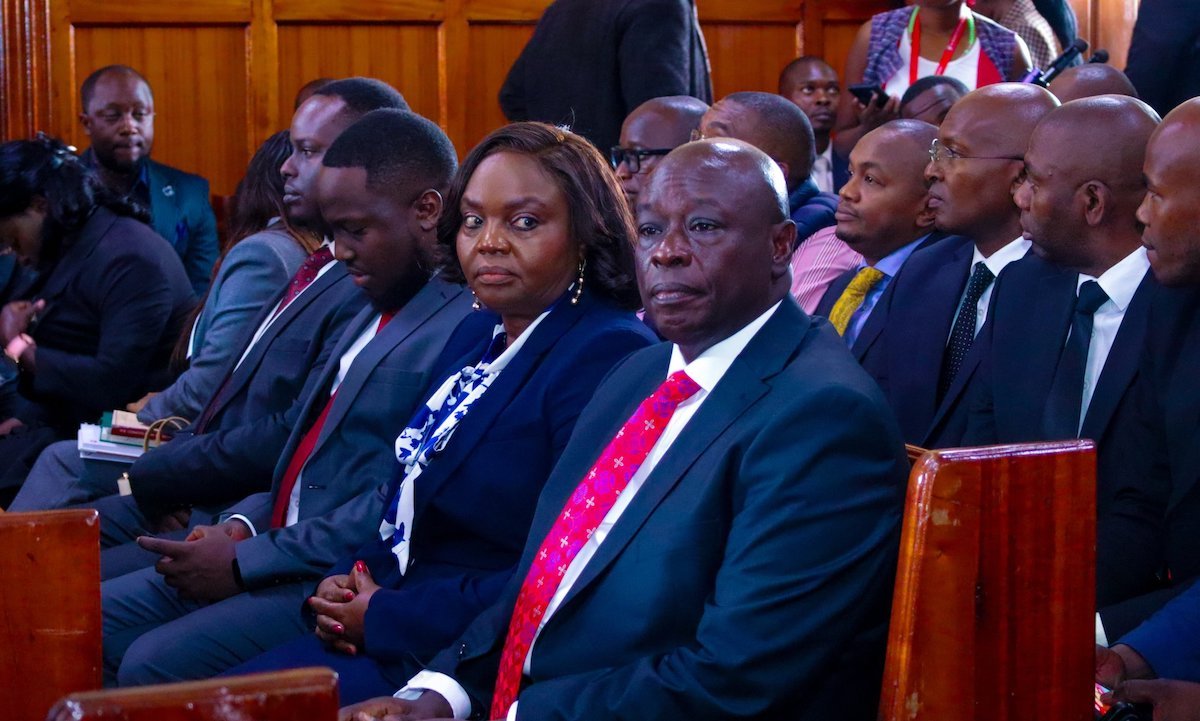
Lawyers representing former Deputy President Rigathi Gachagua have accused Parliament of orchestrating a “parliamentary coup” during the October 2024 impeachment process, arguing that constitutional procedures were ignored to settle political differences within the Kenya Kwanza administration.
During the second day of hearings before a three-judge bench comprising Justices Eric Ogola, Freda Mugambi and Antony Mrima, the court was told that the fallout between President William Ruto and Gachagua had triggered a politically motivated removal process disguised as constitutional accountability.
Counsel appearing for Gachagua, Kirinyaga Woman Representative Njeri Maina, Sheria Mtaani, Gema Watho and lawyer Ndegwa Njiru argued that Parliament abandoned its constitutional mandate and instead relied on its numerical advantage to force through the impeachment.
Lawyer Kibe Mungai told the court that plans to remove Gachagua had allegedly begun long before the political fallout became public, with Sirisia MP John Waluke initially considered to table the motion.
According to Mungai, by August 2024 it had become evident that President Ruto and his deputy were no longer politically aligned. He claimed there were indications the President intended to replace Gachagua ahead of the 2027 General Election, allegedly hinting during a Women’s Day event that his next deputy would be a woman.
The legal team maintained that the impeachment was not founded on criminal misconduct but rather on political disagreements played out publicly.
“Regrettably, it appears in retrospect that we might have celebrated too soon. The Constitution creates a powerful Parliament as the supreme political and law-making body. Yet Parliament has chosen to act as subservient, sheepish and sycophantic, reminiscent of the Sixth Parliament that existed between 1988 and 1992,” argued Kibe.
He further noted that it had never been anticipated that the Third Parliament under the 2010 Constitution would attract public protests, especially from young Kenyans demanding accountability and responsiveness.
Lawyer Ole Kamwaro described the impeachment as an abuse of parliamentary power, accusing legislators of using their majority to bypass constitutional safeguards.
“The impeachment characterises a textbook parliamentary coup. When plunder becomes a way of life, a legal system is fashioned to authorise it. This is not truly a case about impeachment. It is about the use of constitutional processes to legitimise a predetermined outcome,” he submitted.
Kamwaro also criticised lawmakers for allegedly condemning tribal politics publicly while practising the same through appointments and political mobilisation.
“Yet when it comes to political expediency, the same actors, the real tribalists, turn to accuse others while claiming moral authority,” he said.
Questions were also raised over the integrity of public participation during the impeachment proceedings.
Lawyer Andrew Muge argued that Parliament failed to meet constitutional thresholds for meaningful public engagement. He told the court that records showed only 125 comments, 19 shares and 203 online likes during the exercise.
Muge further challenged Parliament’s claim that 30,000 people physically participated in the process, arguing the numbers were unrealistic within the limited time allocated.
“Public participation ended at 5pm on both days. The information being presented is misleading. Even if each person took a minute, it would take 30,000 minutes. That is more than seven days. The figures are fictional,” he argued.
He also claimed the exercise became a mere procedural formality, adding that Parliament failed to adequately explain the issues under consideration to the public.
According to Muge, at least 20 constituencies changed participation venues on the day of the exercise, affecting transparency and accessibility.
Lawyer Shadrack Wambui, representing Sheria Mtaani, argued that impeachment proceedings are unique constitutional processes that require strict adherence to legal standards.
He claimed the Senate disregarded Article 145 of the Constitution by proceeding without establishing a special committee to investigate the allegations.
“In the absence of such a committee, it would be improper for the Senate to effectively investigate itself through a plenary sitting,” he said.
Lawyer Wanjiku Waithera challenged the appointment of Deputy President Kithure Kindiki, arguing that he was still serving as Interior Cabinet Secretary at the time and that the Independent Electoral and Boundaries Commission was not fully constituted.
Ndegwa Njiru submitted that impeachment should only be pursued as a final option after criminal proceedings have been exhausted. He argued that Gachagua enjoyed no constitutional immunity and should first have been charged and convicted before Parliament relied on the allegations against him.
Njiru maintained that lawmakers acted simultaneously as complainants, prosecutors, judges and jurors despite Gachagua never being found guilty of the accusations.
In response, the National Assembly and Senate defended the process, insisting that Gachagua was accorded a fair hearing before his removal on five grounds.
Among the accusations raised by legislators were claims that Gachagua made divisive remarks comparing government to a “dairy cow”, suggested preferential treatment for certain communities, contradicted President Ruto publicly, interfered with Nairobi City Market planning, and criticised Justice Esther Maina over the forfeiture of Sh200 million suspected to be proceeds of corruption.
The hearing continues today.
Email your news TIPS to Editor@nairobilawmonthly.com, and to advertise with us, call +254715061658 anytime of the day
