

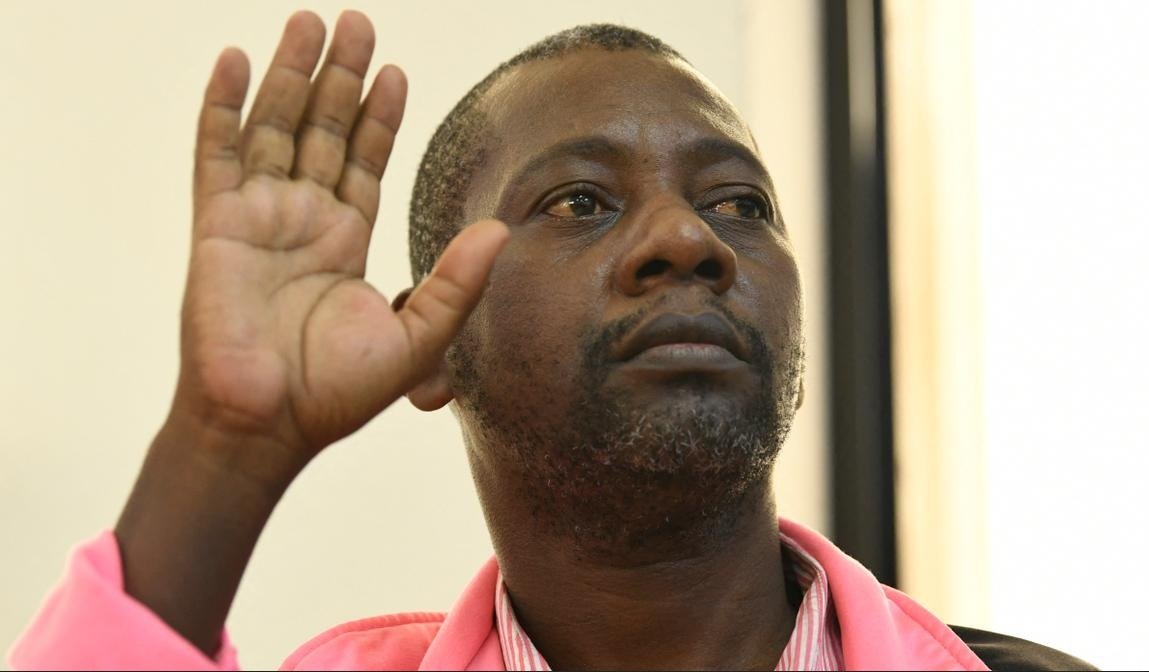
The High Court in Mombasa has convicted preacher Paul Nthenge Mackenzie and 28 of his followers of murdering 191 people in Shakahola Forest, Kilifi County, in a landmark judgment holding that religious belief cannot justify letting children die.
Delivering judgment on Monday, October 19, 2026, Justice Diana Kavedza-Mochache found that the prosecution had proved its case beyond reasonable doubt against all 29 accused in connection with the deaths of 190 children and one adult.

“I am satisfied that the prosecution has proved the case against all the 29 accused persons for the murder of 190 children and one adult, contrary to section 203 of the Penal Code,” she ruled.
“I accordingly find all 29 accused guilty as charged and convict each accused person individually and collectively under section 322 of the Criminal Procedure Code.”
The convicts will be sentenced on November 6, 2026.
At the heart of the judgment is the court’s rejection of the defence’s main argument: that the victims had chosen to fast.
“I reject the defence by the accused persons that the victims, who were all below the age of 16 years, voluntarily fasted to death,” the judge said.
She held that children cannot legally consent to being starved and that parental authority does not extend to fatal religious practices.
“A parent has no legal entitlement to determine that a child should die in pursuit of a religious belief,” the court held.
The judge also dismissed defence claims that gaps in the forensic investigation were fatal to the prosecution’s case.
Defence lawyer Lawrence Obonyo had argued that the lack of a forensic archaeologist during the exhumations, along with missing radiology, anthropology and odontology reports, meant the State could not prove what caused the deaths.
The court disagreed, ruling that the absence of a forensic archaeologist did not invalidate the evidence. It found that starvation caused 72 of the deaths and that, although 110 bodies were too decomposed for a cause of death to be established, starvation was the likely cause in those cases as well.
- Shakahola: How Paul Mackenzie runs deadly cult from prison
- Kilifi gives Shakahola victims’ families 21 days to claim remains
- DPP seeks 11-year hybrid sentence for Shakahola convict
The court went further and found that the conduct of Mackenzie’s Good News International Ministries met the definition of an extreme belief system under Section 12D of the Prevention of Terrorism Act.
The judge described the church as an apocalyptic cult that radicalised parents and children through crusades, seminars, television and YouTube before leading them onto 4,860 acres of land in Shakahola.
She found that Mackenzie indoctrinated followers, manipulated parents and coerced vulnerable members into submission.
Guards were posted to stop those who had committed to the fast from leaving. The judge noted that “Fasting was presented as a pathway to heaven” while “violence was deployed against children to ensure they complied with the directives on deprivation.”
Of the 31 people originally charged, two died while the trial was under way. Mackenzie and 27 others were convicted after a full trial, while Enos Amanya Ngala, alias Hallelujah, had earlier pleaded guilty to all 191 counts and admitted serving as a grave digger and enforcer.
The prosecution called 123 witnesses, while the defence called nine. The Office of the Director of Public Prosecutions welcomed the convictions as a significant step towards justice for the victims and their families.
The case arose from one of the deadliest religious tragedies in Kenya’s history. More than 400 bodies were exhumed from shallow graves in Shakahola after Mackenzie’s arrest in April 2023, and the court put the total death toll at 429.
Mackenzie still faces separate charges of manslaughter, terrorism and radicalisation, child cruelty and torture, as well as murder charges over 52 deaths at Kwa Binzaro, a breakaway cell he is accused of running from inside Shimo La Tewa Prison.
Email your news TIPS to Editor@nairobilawmonthly.com, and to advertise with us, call +254715061658 anytime of the day
