

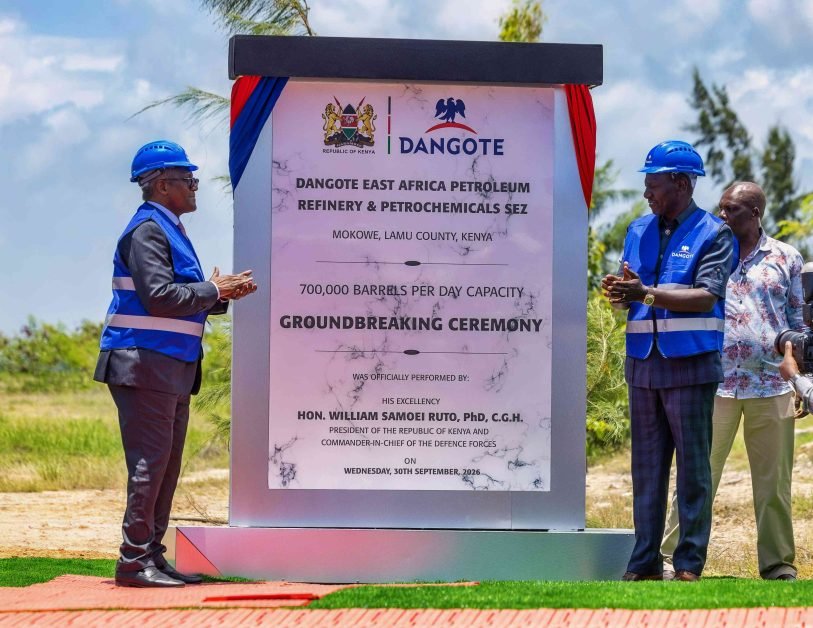
Six African leaders and senior government delegations gathered in Lamu on Wednesday, September 30, as President William Ruto, Nigerian billionaire Aliko Dangote and Uganda’s President Yoweri Museveni broke ground on the $16 billion Dangote East Africa Refinery.
Security was tight as guests arrived at Mokowe Jetty and proceeded to the Kililana port site, where the ceremony was held. Ruto, Museveni and Ethiopian Prime Minister Abiy Ahmed scooped soil with shovels to mark the start of construction. They were joined by Benin’s President Romuald Wadagni, Togo’s President Jean-Lucien Savi de Tove and former Nigerian President Olusegun Obasanjo.

In his address, Ruto described the project as the fulfilment of a commitment he made at the United Nations General Assembly in New York the previous week. “Africa’s resources must become the beginning of African industry, not the end of Africa’s contribution to global prosperity,” he said.
He described the refinery, designed to process up to 700,000 barrels of crude a day and generate as much as 1,000 megawatts of power, as an investment in “energy security, industrialisation, and regional integration.”
Ruto traced the project’s origins to a letter he wrote to Dangote following April’s Africa We Build Summit in Kenya, arguing that infrastructure should drive Africa’s industrialisation. He cited Afreximbank figures showing Africa produced roughly 6.8 million barrels of crude oil a day in 2024 against regional demand for about 4.5 million barrels of refined products daily.
He also noted that Kenya spent Sh530 billion importing petroleum products last year, saying the figure underscored the need for greater regional refining capacity.
Ruto described the refinery as a “Government-enabled, private sector-driven” project, with the state providing policy certainty and infrastructure while private capital carries the commercial risk. He said Kenya was pursuing a similar model through its new National Infrastructure Fund.
- Dangote selects Lamu for planned East African refinery
- Court declines to halt Dangote refinery launch over land dispute
Turning to local concerns, Ruto acknowledged questions over jobs, land, fishing and contracts. He promised that land matters would be “handled lawfully and fairly”, that environmental and social safeguards would be enforced, and that the roughly 60,000 direct and indirect jobs expected from the project would come with recruitment and training programmes prioritising young people from Lamu and surrounding counties.
Dangote said the Lamu project had progressed rapidly, describing it as the second-fastest project his company has delivered after the Gode Fertiliser Project in Ethiopia. He confirmed the refinery would create 60,000 jobs and generate up to 1,000 megawatts of power, with some of the electricity potentially supplied to the Kenyan grid.
He also urged residents not to rush to sell land near the project, saying land prices were likely to rise.
The groundbreaking went ahead despite an active legal dispute over land at the project site. A Kenyan court had issued an order linked to the disputed land, although it did not halt Wednesday’s ceremony. Dangote acknowledged that the dispute could affect some site activities.
Speaking a day later in Fulugani, Kwale County, Ruto criticised those challenging the project in court and said the refinery would not be derailed. Dangote has separately said he is prepared to address any challenges in court rather than delay construction.
Construction is expected to take three to four years, with completion targeted for around 2029 to 2030. For Lamu, the project represents a major industrial investment in a region that has historically lagged behind in industrial development, although its land, labour and environmental commitments will ultimately depend on how they are implemented.
Email your news TIPS to Editor@nairobilawmonthly.com, and to advertise with us, call +254715061658 anytime of the day
