

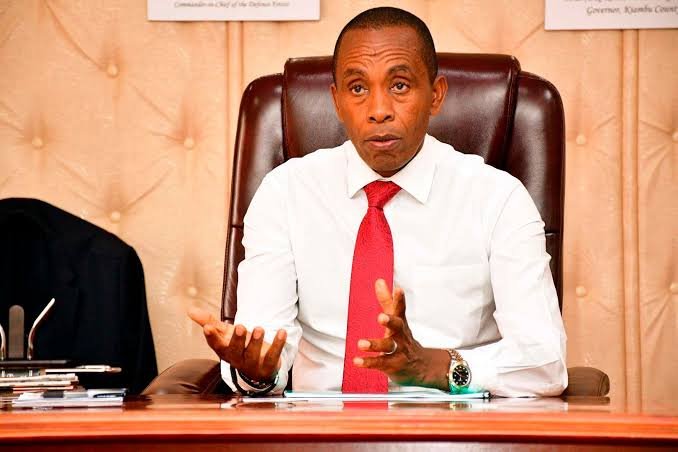
The High Court has dismissed an application by Kiambu Governor Kimani Wamatangi and several other defendants seeking to have an Ethics and Anti-Corruption Commission (EACC) asset recovery case involving Sh813.1 million struck out.
Justice Rose Ougo rejected the applications, allowing the civil suit seeking recovery and forfeiture of alleged proceeds of graft to proceed. The commission is seeking to recover Sh813,145,532.40 from Wamatangi and 13 other parties.
Wamatangi had argued that the case was sub judice because a separate constitutional petition involving him was already before the court and had resulted in conservatory orders.
However, Justice Ougo found that he had not demonstrated that the parties and issues in the constitutional petition were identical to those in the EACC recovery proceedings. The governor also failed to provide documentation showing that the two matters involved the same parties or raised the same issues.
EACC had opposed the application, arguing that the conservatory orders issued in the constitutional petition only prevented the Office of the Director of Public Prosecutions from charging Wamatangi. According to the commission, the orders did not bar it from pursuing a civil action to recover and forfeit assets allegedly acquired unlawfully.
The governor had further sought to rely on parliamentary privilege, arguing that the allegations against him related to his time as chairperson of the Senate Standing Committee on Roads, Transportation and Housing.
Justice Ougo rejected that argument, finding that parliamentary privilege did not extend to alleged unlawful conduct. She also held that the accusations by EACC did not relate to protected parliamentary proceedings or activities that would interfere with Parliament’s functioning.
The defendants had separately challenged the commission’s case, arguing that EACC had not established a cause of action against each of them individually.
They also contended that some of the companies named in the proceedings were separate legal entities and that their directors or associates should not automatically be held liable for the companies’ actions.
The court declined to strike out the defendants at this stage, holding that the allegations raised by EACC should be tested through evidence during a full hearing. The court therefore allowed the recovery proceedings to continue.
EACC alleges that the defendants were involved in fraud, misrepresentation and falsification of documents in connection with road construction tenders awarded by the Kenya National Highways Authority (KeNHA), Kenya Urban Roads Authority (KURA) and Kenya Rural Roads Authority (KeRRA).
According to the commission, the disputed contracts were awarded between the 2018/2019 and 2021/2022 financial years. EACC alleges that Wamatangi improperly influenced the award of tenders to companies associated with him and continued to act as a signatory to their bank accounts.
The commission’s case is that the payments made under the contracts amounted to proceeds of corruption that should be recovered. Earlier court documents showed that the companies linked to the case received a combined Sh726,483,442.40 from KeNHA and KURA and a further Sh86,662,090 from KeRRA, bringing the total to Sh813,145,532.40.
The allegations have not been proved in court, and Wamatangi and the other defendants have denied the claims. EACC has also asked the court to issue injunctions against the defendants and preserve existing orders freezing their bank accounts and other assets pending the determination of the case. The court has previously extended interim restrictions over the disputed assets as the recovery proceedings continue.
Justice Ougo directed that the application for injunctions be heard on November 12, 2026, and extended the existing interim orders until that hearing. Defence lawyers asked the court to expedite the proceedings, arguing that the frozen funds were being used to operate the companies and that continued restrictions were affecting their businesses.
The ruling allows EACC to proceed with its civil recovery case, but it does not determine whether Wamatangi or the other defendants are liable for the alleged graft. Those allegations will have to be established through evidence as the case proceeds.
Email your news TIPS to Editor@nairobilawmonthly.com, and to advertise with us, call +254715061658 anytime of the day
