

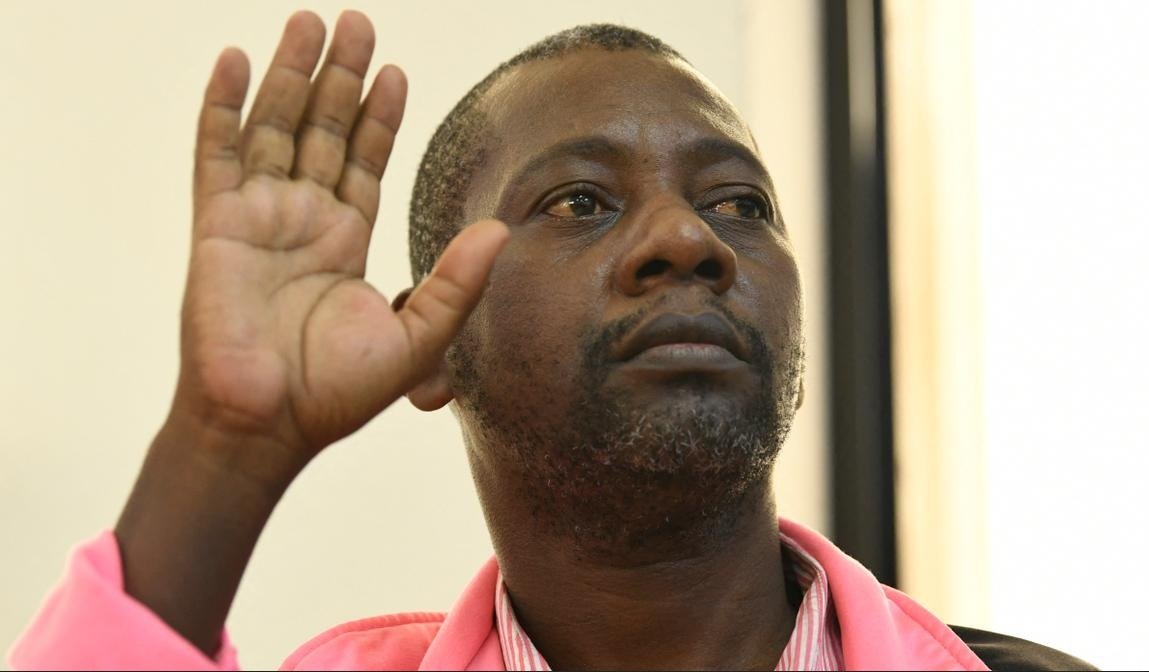
The High Court in Mombasa is set to deliver judgment on Monday, October 19, 2026, in the trial of controversial preacher Paul Nthenge Mackenzie, the leader of Good News International Ministries, who is accused of murdering 191 people in Shakahola Forest, Kilifi County.
Mackenzie and 30 of his followers are charged in connection with the deaths of 180 children and 11 adults, allegedly caused by extreme fasting that he directed his congregation to undertake between 2021 and 2023. The verdict follows a trial in which 121 witnesses testified, many of them giving harrowing accounts of life inside the cult.
One of the co-accused, Enos Amanya, alias Hallelujah, has already pleaded guilty to all 191 counts of murder, admitting that he served as a gravedigger and enforcer. He told the court that his own children also died.
A protected witness, identified only as J, told the court that he watched six of his children starve to death and said Mackenzie had ordered followers to deny the children their freedom. Another protected witness said he moved from Kitui to Shakahola with his wife and six children, and that all of them died. Other witnesses said the shallow graves dug in the forest were called “weddings” within the cult, while the bodies were referred to as “fertilizer.”
The prosecution argues that Mackenzie “initiated and directed” the deadly fasting through a “structured hierarchy of death.” Government pathologist Dr Richard Njoroge told the court that 110 of the bodies were so badly decomposed that the cause of death could not be determined.
- Shakahola: How Paul Mackenzie runs deadly cult from prison
- Kilifi gives Shakahola victims’ families 21 days to claim remains
- DPP seeks 11-year hybrid sentence for Shakahola convict
Of the remaining deaths, 31 were attributed to starvation and 41 showed features consistent with starvation. Four people died of asphyxia with signs of starvation, while two died of starvation with signs of asphyxia. One death resulted from manual compression of the neck and another from a traumatic head injury.
On Friday, Mackenzie and his co-accused made a final bid for acquittal through their lawyer, Lawrence Obonyo, asking Justice Kavedza Mochache to free them for lack of direct evidence. Obonyo argued that the prosecution had not proved beyond reasonable doubt that his clients caused the deaths.
“The evidence does not attain the high degree of cogency required and at best raises mere suspicion and conjecture. In such circumstances, the law is clear; any reasonable doubt must be resolved in favour of the accused, who are therefore entitled to an acquittal,” he said.
The defence argued that where the cause of death is unknown, the prosecution cannot establish whether the deaths resulted from an unlawful act or omission, natural causes or voluntary fasting.
“Where the cause of death is unknown, the prosecution cannot exclude the possibility that the deaths occurred from natural causes or preexisting medical conditions,” Obonyo said.
He dismissed the 31 starvation findings as observations rather than medical conclusions, arguing that they did not establish who was responsible. In his view, the post-mortem examinations could not show whether the children were denied food by their parents, refused to eat, or had food but chose not to eat. He also told the court that every person who fasted made a free, voluntary and informed decision, with access to food and the freedom to leave.
Obonyo further argued that the investigation lacked key forensic processes.
“The absence of key forensic processes, such as forensic archaeology, anthropology, radiology, and structured peer review, raises serious doubts as to the integrity, completeness, and reliability of the investigations,” he said.
Citing state witness Dr Kalsi, who described Shakahola as a complex forensic case involving mass graves and skeletal remains that required a coordinated, multidisciplinary approach, Obonyo said the lack of forensic archaeologists to oversee the exhumations was fatal to the prosecution’s case.
He also pointed to the absence of radiological procedures, including X-rays and CT scans, the lack of anthropology and odontology reports, uncertainty over DNA analysis and unmatched profiles, and poor photographic records. He said Dr Kalsi had conceded that his report relied on limited information that was insufficient for a conclusive evaluation.
“These deficiencies go directly to the issue of causation, which is central to the offence of murder. Without proper forensic handling, the prosecution cannot reliably establish the cause of death, the identity of the deceased, or any link between the accused and the deaths,” Obonyo said.
“The cumulative effect of inadequate investigations, missing expert evidence, gaps in forensic processes, and lack of scientific certainty is that the prosecution has failed to meet the threshold of proof beyond reasonable doubt.”
Mackenzie was arrested in April 2023 after a human rights group alerted authorities and some of his followers were rescued from the forest. Subsequent exhumations raised the death toll linked to Shakahola to well over 400, with the Kenya National Commission on Human Rights putting the figure at 429 in 2024. Some victims are yet to be identified.
The preacher also faces several other cases. These include manslaughter charges over the 191 deaths before the Mombasa Chief Magistrate’s Court, child cruelty and torture charges at the Tononoka Children’s Court, and terrorism and radicalisation charges at the Shanzu Law Courts.
At the Malindi High Court, he faces murder charges over the deaths of 52 people at Kwa Binzaro, a breakaway cell of Shakahola that he is accused of running from inside Shimo La Tewa Prison.
Email your news TIPS to Editor@nairobilawmonthly.com, and to advertise with us, call +254715061658 anytime of the day
