

 By Martin Minns
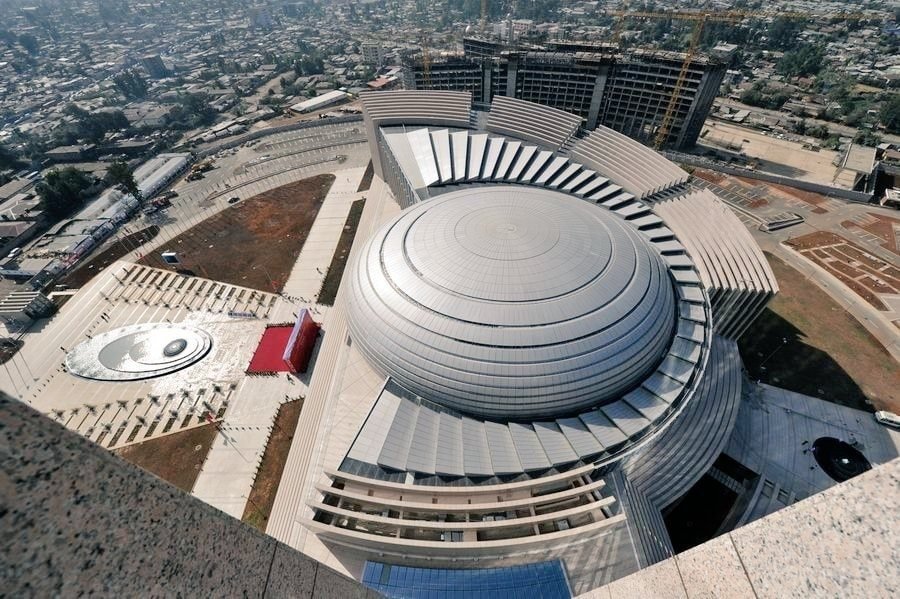
In 2018, a scandal erupted when the French newspaper Le Monde revealed that servers in the China-built African Union (AU) Conference Centre and Office Complex (AUCC) in Addis Ababa were transferring data to servers in Shanghai. It was alleged that this had been occurring nightly since the AUCC’s inauguration in 2012. Although Le Monde cited multiple sources, China reacted quickly, denying the allegations and rejecting the evidence.

This style of Chinese surveillance was characterised as a ‘Trojan Horse’ approach. The incident gave voice to a concern already quietly held by many officials in Africa about the potential security risks associated with allowing Chinese companies to construct and maintain official and parliamentary buildings. This incident also highlighted wider conversations about the surveillance risks of Chinese smart cities.
Fast forward to 2026: despite the AUCC controversy, China has now completed the construction of over 200 government buildings across Africa. These buildings, which contain much sensitive material, include a new foreign ministry in Ghana, a new annexe to the foreign ministry in Kenya and at least 15 African parliaments. A Chinese company was also entrusted to carry out the controversial revamp of Kenya’s State House in Nairobi.
In the heart of London, much has been made of China’s plans, which have now been approved, to build a new ‘mega embassy’ over critical communications cables. Construction of these sensitive buildings by Chinese firms is a potential vector for intrusive surveillance. Should we be worried, or should we be focusing on the benefits that Chinese finance and support have generated in Africa over the last 20 years?
There are multiple reasons why China would want to construct these buildings for African governments. To illustrate a key reason, a recent book by academic Dr Innocent Batsani-Ncube of Queen Mary University, London, titled China and African Parliaments, suggests that the Chinese government undertakes these constructions to ingratiate itself with the elite in that country.
Although there is no explicit quid pro quo in these construction deals, Batsani-Ncube says it is highly likely that China expects an informal return on its investment. This may be something simple, such as access to those in power. Crucially, he also mentions it provides access to those who will be in power, which underlines China’s long-term focus on these matters.
Doing this places China at the front of an informal queue when the conversation moves to deal-making. If other powers had the financial heft to undertake this sort of ‘soft hard-power’, they probably would.
There are multiple reasons, too, why African governments would accept these offers. In African countries limited by their financial resources, the construction of a new parliament is an attractive way to reallocate scarce funds elsewhere.
Accepting the construction of these buildings by China also helps the business of daily governance to be executed more efficiently, as it demonstrates progress and change to the electorate and can confer prestige on an administration. Risking some communication security in a Faustian bargain in return for a brand-new parliament building might seem worth it. In such cases, it might be tempting for a government to treat rumours of built-in surveillance capability as just that – rumour.
Though no state can admit it openly, all countries spy on each other. This has happened for centuries. General espionage by China in Africa is not the concern relating to Chinese-built government buildings. Rather, the concern is that the sheer scale of such government buildings, combined with the sophistication of China’s surveillance technology, as well as China’s track record of intentionally deploying it, for example, through ‘smart cities’, creates potential security threats for African governments.
The issue is also one of asymmetry. Everything about China and Africa’s relationship is asymmetrical. Africa, as a continent, is always looking up to the industrial might of China. This reduces the agency of African nations. If they wanted to, China could turn every building it constructs into a listening post. When these ‘gifts’ are built, they are to Chinese design.
After they are built, they are often China-maintained. This does not confirm that the Chinese Government is definitely listening, by any means, but it does make it much easier to do so than if domestic governments were responsible for their maintenance.
This again highlights the lack of leverage African nations have with China – if a host country accepts such a huge gift that is so hard to turn down from China, that country loses control of its planning, construction and maintenance, thus potentially ceding its own information sovereignty.
Given China’s deep entrenchment in the Continent’s political infrastructure, there is little African governments can do in response to the discovery of illicit surveillance by its gargantuan partner. China holds the keys to these buildings.
Africa needs China. It needs its technological and commercial might. China is an essential partner – it has built 70% of the continent’s 4G network through Huawei. It is also a critical provider of finance, logistics, transport and personal technology. Yet Africa also deserves respect from China.
Generous gifts of important buildings should be given because they are gifts, but there have to be assurances that they are free from the concern that they might be Trojan horses.
Martin Minns is Executive Producer of the Pan-Africa podcast, Panel 54
Email your news TIPS to Editor@nairobilawmonthly.com, and to advertise with us, call +254715061658 anytime of the day
