

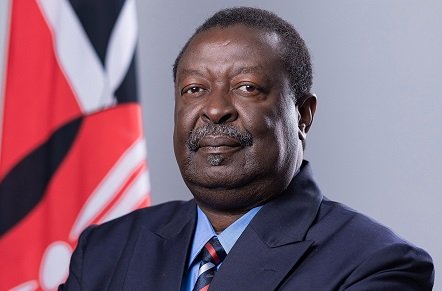
Podcaster Waweru Njoroge interviewed Prime Cabinet Secretary and Minister of Foreign and Diaspora Affairs, Musalia Mudavadi, on a wide range of public interest topics, including the war against corruption, job creation and the need for democratic governance.
Excerpts.
Question: You entered Parliament in 1989. What is the one thing you have had to unlearn in relation to leadership?”
Answer: One of the things that is completely different is the mode of communication. The scope and scale of that communication. Because when I entered politics, you literally had the dominance of one or two channels. The national broadcasting station, KBC. And then you had a few of the other emerging media houses.
Question: What problem would you most hate to leave to the next generation still unresolved?
Answer: I think the one thing I would hate to leave is corruption. I would hate to see a country that is consumed by institutions that don’t work and by corruption taking root and becoming a way of life. We must fight against it in every sense of the word, and it is a continuous process.
I’m sure you’ve heard of that famous story of several people cutting a tree. Who claims victory? The one who struck first? Or the one who struck last? If we look at corruption in that context, we will never win. We must look at it as a collective action where each stroke counts.
“So when I talk of each stroke, the Judiciary, police, citizens, politicians, private sector, everybody. We must collectively pull together to deal with it.
Question: What is the one thing you would be proud to leave to the next generation?
Answer: What I would like to see is an economy that creates enough meaningful and gainful jobs for its people, for its young, for its citizens who are able to work. That would be the biggest legacy.
Question: You played rugby as a winger for Mean Machine. A winger typically spends quite a lot of time reading the space, waiting for the right moment, and then suddenly committing. Has Kenyan politics rewarded that instinct?
Answer: It’s a metaphor that speaks to politics. First of all, politics is rough. So you’ve got to appreciate that. And politics requires tact. It requires proper timing. It requires skill. Reading the game.
My experience in rugby helped cultivate some of my traits in the political arena. There are times you have to sidestep. There are times you have to tackle low; depending on the challenge, you tackle the issues. And then there are times you have to face things head-on. There are times you’re also tackled.”
Question: Kenya’s revised foreign policy framework places the citizen much closer to the centre of diplomacy. Where should foreign policy become visible in the life of everyday people?”
Answer: There are many aspects to this; it is a great question. When I came to the Ministry of Foreign Affairs, one of the things I decided to do was to take diplomacy from an elitist window to a more citizen-facing window.
“It is the first time in the history of Kenya that we are laying bare Kenya’s diplomatic policy and what we intend to achieve…we are basically demystifying this space.”
Question: Africa is constantly told that its population, resources, and future markets actually make it strategically important. Being important to somebody else’s strategy is not the same as having power of your own. What does Africa need to control for itself before its demographic weight becomes bargaining power?
Answer: We must sort out our politics. We must strengthen institutions in our individual countries. We must consolidate democratic practises and principles in all our affairs. That’s how we’re going to prepare ourselves better for this engagement with the rest of the world.”
We need to have the right environment here. We must stop coups d’état. We must stop trying to get into leadership through undemocratic means as a continent.
Question: Kenya is a major non-NATO ally of the United States, within a relationship that stretches well beyond security. Kenya has become strategically more valuable to Washington. What should Kenya be getting in return?
Answer: I think the geopolitical situation is mutating rapidly. Friendships and partnerships are being reshaped. The principles of engagement are changing. In some instances, they’re becoming very transactional. We’re also seeing overseas development assistance dwindling.
We are now seeing a push to have the economic agenda take the front banner; therefore, transactionalism and the growth of the private sector is becoming prominent in the diplomatic space.
We look for foreign direct investment so jobs can be created for young Kenyans. These parameters will define our engagement, among others. For instance, we are in a conversation with the US for a free trade agreement.
Question: What is the US expecting from us now that they did not before?
Answer: One of the things is they want enhanced cooperation; they want better security partnerships in the region.
They are also looking at ways of us providing better opportunities or more opportunities for the American private sector to invest in Kenya. You may have seen we are having more intense dialogue with the American Chamber of Commerce about how to step up investment in the country.
Question: Kenya’s first strategic neighbour remains Africa, which brings us to an idea we invoke perhaps more often than we actually test. Pan-Africanism. If Pan-Africanism were working, what one thing should ordinary Africans be able to do more easily?
Answer: That is a very important question. It is a work in progress. We have 54 nations, 54 currencies, 54 central banks. So, one of the things that we have to look at is: what are the steps that need to be taken to get to a better position in terms of actual Pan-African ideals?
The first positive thing is that we have the African Union. Then, we have the regional blocs. COMESA, East African Community, SADAC, ECOWAS. These are important. Within this framework, we are seeing systematic graduation.
For instance, we have seen the East African Community, SADAC, and COMESA coming together to create the tripartite. So, systematically, the economic blocs are beginning to coalesce. The ultimate is the African Continental Free Trade Area. So aspects of Pan-Africanism are actually taking place.
Question: The AU is often criticised for lacking authority, but institutions cannot exercise power that their members are not willing to give. What power are African governments asking the AU to exercise that they themselves are not willing to surrender to the AU?
I think the biggest challenge maybe is not necessarily political. Slowly, systematically, we are becoming more Pan-African. The principles of the African Union are important: respect sovereignty, respect the individual States, and then build the institutions through consensus. It’s essential. You cannot try to force these things.
The challenges that the African Union is experiencing are not different from the challenges that the UN is experiencing today. In reality, there’s a clawback on multilateralism by some countries.
Question: Your Excellency, please complete this sentence…Kenya will know its diplomacy is working when…
Answer: Kenya will know that its diplomacy is working when we can boast of peace and stability, when we can boast of investment, when we can boast of job creation, people waking up in the morning, taking their children to school, waking up in the morning and going to work, when Kenyans can feed themselves because the right environment is in place. And we have good relations with our partners, within the continent and beyond.
Email your news TIPS to Editor@nairobilawmonthly.com, and to advertise with us, call +254715061658 anytime of the day
