

By Dr Samuel Ndogo
In this article, I share with you a childhood journey through music, memory, imagination, faith and the enduring magic of Dolly Parton, who passed on at the age of 80 on 25 August 2026.

Beneath the nostalgia her music brings, I offer you, my dear reader, a deeper reflection on fatherhood, childhood, cultural transmission, family memory, artistic legacy and the mysterious ways in which seemingly ordinary experiences become formative narratives in our lives.
There are some musicians we deliberately discover, perhaps through recommendation from a friend, a record we happen to encounter in a music shop, a concert we attend, or a song that suddenly captures our imagination when it comes through the radio. There are others, however, whom we seem to inherit, almost as though they enter our lives through the quiet and mysterious channels of family, childhood and memory.
Their voices become part of the soundscape of our growing up, mingling with the voices of our parents, the clatter of everyday life, the crackling sound of an old radio and the countless ordinary moments that we scarcely notice while they are happening. It is only many years later, when a familiar melody unexpectedly transports us backwards in time, that we begin to realise that some of those apparently insignificant moments were quietly helping to construct the architecture of our memories.
For me, one of those voices has always been Dolly Parton. I first encountered Dolly not through an album cover or a concert, nor through the sophisticated digital music platforms that have now made virtually every musician in the world accessible at the touch of a screen. Rather, I encountered her in the most wonderfully old-fashioned way imaginable: through my father’s radio.
That radio was, in many ways, our window into a world that stretched far beyond our immediate surroundings, and through its sometimes crackling sound, especially when my father tuned to the famous VOA, the Voice of America. From a distance, I would look in awe as my father struggled with the dial on short wave mode to receive news from this American media house.
From this radio I heard voices, melodies and stories from places that could only exist in my boyhood imagination. Among those voices was the unmistakable voice of Dolly Parton, a woman who would eventually become one of the most recognisable figures in country music and popular culture.
But there was a little complication. I did not initially know that her name was Dolly Parton. To me, she was Dolly Patron. And I believed, with all the confidence that belongs to childhood, that this must have been her real name. Looking back now, I find the memory both amusing and strangely beautiful because my misunderstanding was not entirely without logic.
The word Patron seemed to make sense to me. If she was such a celebrated country musician, then surely, she must have been some kind of patron of country music, a distinguished figure who had earned the title because of her contribution to the music I had come to love. I had constructed my own little explanation around a name I had not quite heard correctly, and for a long time that explanation was perfectly satisfactory to me.
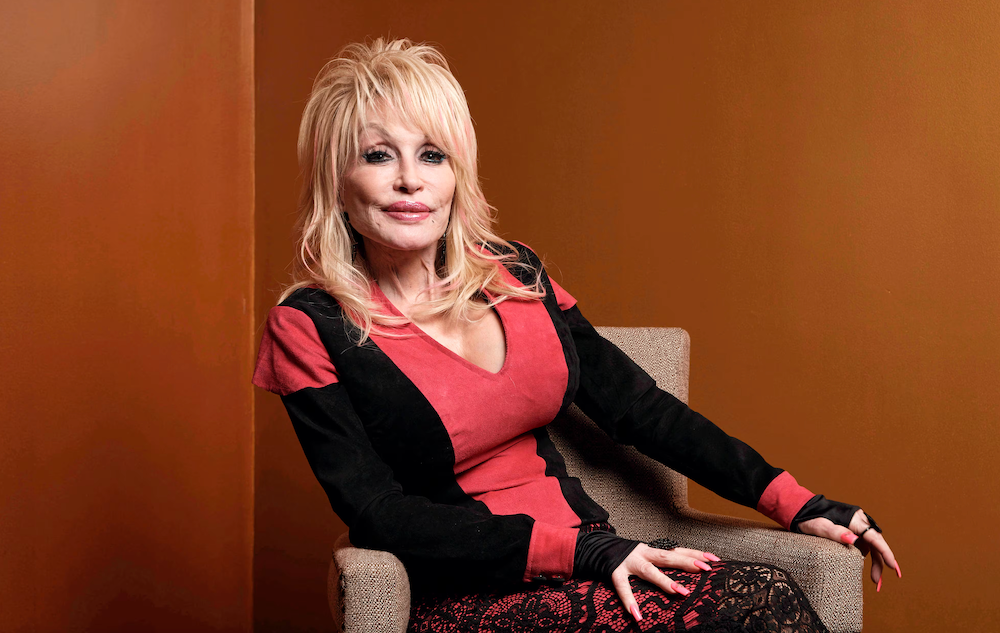
There was, however, another dimension to my understanding of Dolly, and this one had less to do with the sound of her name and more to do with what I imagined when I saw her. She truly looked like a doll. As a child, I would sometimes encounter photographs of Dolly Parton in magazines, and there was something about her appearance that fascinated me.
To my young eyes, she looked almost unreal, as though she had stepped out of a picture book or a glossy magazine and entered the world of music. Her blonde hair, carefully styled appearance and unmistakable sense of glamour seemed to me to resemble the beautiful dolls that my father occasionally brought home from the city for my sisters.
Those dolls mesmerised me. I would look at them with the fascination of a child trying to understand how something so beautiful could have been manufactured, dressed and presented so perfectly. They seemed almost too immaculate to be ordinary toys, and somehow my young imagination connected them with the photographs I had seen of Dolly Parton.
The connection was not rational in the way an adult might demand rationality from an explanation, but childhood has its own logic, and that logic is often governed by association, wonder and imagination rather than by the rigid categories with which adulthood eventually trains us to think.
To me, therefore, the name Dolly seemed perfectly appropriate because she looked like a doll, and the dolls looked, in my childish imagination, like miniature, picture-perfect imitations of my favourite musician. At the same time, my sisters called their girlish toys Dolly. Furthermore, the woman whose voice came through my father’s radio, the beautiful Dolly that appeared in the pages of magazines, and in the dolls in my sisters’ hands gradually became part of one imaginative universe.
I suppose that is one of the fascinating things about childhood. A child does not always distinguish sharply between reality and imagination; instead, the child creates bridges between things that adults might regard as completely unrelated. A photograph in a magazine, a blonde toy sitting in my sisters’ hands, a voice coming through my father’s radio and a name that I had misheard could all belong to the same imaginative universe. That notwithstanding, the child does not need to explain the connections. This is because those connections simply exist. Period.
As such, Dolly Parton became, in my childhood imagination, Dolly Patron—the beautiful Dolly who seemed to me to be the patron of the music I loved. Only much later did I learn that I had got the name wrong. But as I look back across the decades, I sometimes wonder whether my mistake was not, in its own peculiar way, prophetic. This is because if a patron is someone who supports, nurtures, advances or preserves something precious, then Dolly Parton has certainly become a patron of much more than music.
Through her extraordinary career, she has championed storytelling, creativity, education, generosity, entrepreneurship and the dignity of people who come from humble beginnings. Her official biography records a career that has stretched across music, film, television, business, philanthropy and literature, while her music has reached generations of listeners around the world.
The little boy who called her Dolly Patron knew none of that. He simply knew that he loved her music. There was something deeply formative about growing up around music that came to us through the radio rather than through today’s carefully curated playlists. You did not necessarily choose what you were going to hear next. You did not have the luxury of selecting an artist, searching for an album and skipping immediately to a favourite track.
Sometimes the music simply arrived, carried through the invisible waves of radio transmission, and you either welcomed it into your world or allowed it to pass you by. That is how I welcomed Dolly Parton. Closely related, I also welcomed Kenny Rogers. That way, I welcomed the rich musical world of country music that accompanied their voices.
Among the songs that became part of my childhood musical memory was Islands in the Stream, Dolly’s unforgettable duet with Kenny Rogers. The song, recorded in 1983, became a remarkable crossover success, reaching audiences well beyond the boundaries of country music.
Yet when I think about the song today, I do not think first about its chart position or its commercial success. I think about a young boy listening to a radio and singing along to two voices that had travelled across the Atlantic and somehow found their way into a home, in a small dusty village in central Kenya.
That, to me, is one of the great mysteries and miracles of music in the sense that, music has a remarkable capacity to cross geographical, cultural and linguistic boundaries. A song can travel from one continent to another without requiring a passport, settle into an unfamiliar home, acquire new listeners and eventually become part of the memories of people who live thousands of kilometres away from the place where it was created.
Dolly and Kenny were singing from a cultural world very different from mine, yet their voices became familiar to me. I did not need to understand every cultural reference in their music to feel its emotional force. I did not need to know the history of Nashville, which I encountered later as an undergraduate in my Literature lectures, to recognise a beautiful melody. I did not need to understand the mechanics of a duet to know that these two voices belonged together.
I simply listened and sang along. That is how cultural encounters sometimes begin—not in classrooms, libraries or formal institutions, but in the seemingly ordinary circumstances of everyday life. As such, the radio becomes a classroom; a song becomes a cultural text; a foreign voice becomes strangely familiar. Through that, a child in Kenya discovers that the world is considerably larger than the geographical boundaries of his immediate surroundings.
Perhaps one of the most beautiful things about a musical inheritance is that we sometimes pass it on without deliberately deciding to do so. Why do I say this? Years after the songs had entered my childhood through my father’s radio, I found myself playing those same songs on my own car radio as I travelled with my family on road trips. There is something profoundly moving about that realisation because it suddenly reveals that the music has survived not merely as sound but as memory, and that memory has itself travelled from one generation to another.
Clearly, my father provided the soundtrack to my childhood. Years later, I was providing a soundtrack to the childhood of my own children. Over the years, as we travel along the Kenyan roads, sometimes through long stretches of our beautiful countryside and sometimes through the bustle of our towns and cities, the voices of Dolly Parton and Kenny Rogers have occasionally filled the car.
My children may not have understood the significance of those songs in quite the same way that I did, but something has nevertheless been happening as that music plays. I have been handing over a musical inheritance whose meaning has accumulated in our family over several decades.
In that sense, I have been unconsciously passing a baton from one generation to another. I have been doing, in my own small way, what my father had done for me many years ago. However, he did not sit me down and announced that he was introducing me to an important cultural tradition. No. He simply played his music which I listened from a distance and absorbed it all. This is music that I grew up listening from the radio. And now, without any formal ceremony, I have been doing the same with my children.
Perhaps this is how cultural memory survives. It does not always survive through formal instruction or deliberate preservation. Sometimes it survives through repetition, affection and shared experience. A father plays a song that his child comes to love; that child grows older, becomes a parent and plays the same song for his own children; and somewhere along that invisible chain, music ceases to be merely entertainment and becomes heritage. That is what Dolly Parton’s music has become in my family. Her songs have become part of our family memory.
Then there is Coat of Many Colors, perhaps Dolly Parton song that touches a particularly deep place in my memory. The song is rooted in Dolly’s own childhood experience. Her mother, Avie Lee Parton, made a coat for her from pieces of fabric that were available to the family, and Dolly later transformed that experience into one of her most enduring songs.
The story is deceptively simple, but its emotional power lies precisely in the way it transforms material poverty into a profound reflection on love, dignity, family and belonging. Whenever I hear the song, however, another story immediately comes to my mind: Joseph, the young man of the Old Testament whose father Jacob gave him a distinctive coat, traditionally rendered in many English translations as a coat of many colours.
The two stories are obviously not the same, and Dolly Parton’s song is not a retelling of Joseph’s story. Yet the phrase creates an unexpected bridge in my imagination, connecting the Tennessee childhood of a country music legend with the ancient biblical story of a young man whose distinctive garment became part of the narrative of his identity.
Perhaps this is one of the gifts of literature and music: they allow seemingly distant stories to speak to one another across time and culture. A song written in the Appalachian tradition can unexpectedly open a door into an ancient biblical narrative. A childhood memory can become a literary meditation. A garment can become a metaphor through which we begin to think about identity, dignity, love and belonging.
Whereas Dolly’s coat was made from pieces of fabric, Joseph’s coat became a sign of his father’s particular affection. Nevertheless, in both stories, the garment carries a meaning greater than the material from which it was made. It becomes memory made visible, a sign of identity and belonging, and part of a story that the wearer carries into the future.
What moves me most about Dolly’s song is the way she refuses to allow poverty to have the final word. What might otherwise have remained in her memory as an embarrassing reminder of material deprivation is transformed, through the alchemy of art, into a tender testimony of love, dignity and belonging. The coat may have been made from scraps, but Dolly’s memory of it is not a memory of lack.
It is a memory of abundance, because what the family could not afford to provide in material wealth, her mother provided in love. This is aptly captured with remarkable simplicity in the chorus when Dolly remembers the coat her mother made for her from rags and declares that, although the family had no money, she was “rich as I could be.” That seemingly simple contrast between material poverty and emotional richness lies at the very heart of the song and, perhaps, helps to explain why this song has continued to resonate so deeply across generations. Here are the classic words from the chorus, in which Dolly captures this paradox with remarkable simplicity and emotional power:
My coat of many colours that my Mama made for me
Made only from rags but I wore it so proudly
Although we had no money, I was rich as I could be…
Thus, what Dolly accomplishes in Coat of Many Colors is much more profound than simply telling us about a childhood garment. She takes an ordinary and potentially painful memory and transforms it into art, allowing the coat to become a visible testament to the invisible wealth of a mother’s love. In her hands, the scraps of fabric acquire a meaning far greater than their material value; they become threads in a larger story about family, dignity, memory and the human capacity to find beauty even in circumstances marked by scarcity.
In that sense, Dolly does not erase the poverty of her childhood, nor does she romanticise it. Instead, she changes the way we look at it. She returns to the landscape of childhood with the imaginative eyes of an artist and discovers meanings that may not have been fully visible to the child who first wore that coat. The child experienced the coat; the artist later understood its significance and gave that experience a language through which millions of other people like me could enter her memory.
That, perhaps, is one of the distinguishing marks of a great storyteller. A great storyteller does not merely preserve the past by remembering what happened; the storyteller revisits the past and enables us to see it anew. Dolly takes what could have been remembered as a story of having less and reveals within it a story of having more than money could ever buy.
The coat was fashioned from rags, but the memory it carries is woven from love, and it is that deeper meaning that has allowed the song to outlive the circumstances that gave birth to it. In transforming her childhood memory into music, Dolly reminds us that the value of a life is not always measured by what we possess, but also by the love with which what little we have was given, received and remembered. Incidentally, just like I have enjoyed listening to her songs while travelling, this song was composed in 1969 while Dolly was travelling in a tour bus together with her music mentor Porter Wagoner.
The Queen of Country Music
It would be impossible for me to write a tribute on Dolly Parton without acknowledging the extraordinary stature she has attained within country music and the wider history of popular culture. For me, she is not merely one of the great country musicians; she is one of the defining voices through which country music has announced its emotional, narrative and cultural possibilities to the world.
There is good reason why she has been celebrated as the queen of country music. Dolly’s achievement is not simply that she has recorded popular songs. She has written songs that have become part of the cultural vocabulary of several generations, performed across genres and collaborated with artists from remarkably different musical traditions. Her songwriting has produced works such as Jolene, Coat of Many Colors, 9 to 5, Silver and Gold, Eagle When She Flies, Tomorrow is Forever, Just When I Needed You Most, Here You Come Again, Daddy Was an Old Time Preacher Man, Hello God, and I Will Always Love You, songs that have survived beyond their original contexts and have repeatedly found new audiences through reinterpretation and performance.
Her distinction is also visible in the extraordinary catalogue of honours that has accompanied her career. The Recording Academy currently lists Dolly Parton with ten Grammy wins and fifty-five nominations, while her Grammy history includes victories in country, bluegrass, contemporary Christian and other categories. She was also honoured with the Recording Academy’s Lifetime Achievement Award in 2011, an acknowledgement of the lasting artistic significance of her contribution to recorded music.
Her influence has also crossed the boundaries of music into television and film. In 2021, Dolly Parton’s Christmas on the Square, on which she served as executive producer, won the Emmy for Outstanding Television Movie, while the production also won Outstanding Choreography for Scripted Programming. Her wider career has placed her among the rare artists who have received nominations from all four major American entertainment award organisations—the Emmy, GRAMMY, Oscar and Tony.
These accolades matter because they provide a public record of artistic achievement, but they do not fully explain why Dolly Parton has remained so beloved. After all, even though awards can measure recognition, they cannot adequately measure affection.
Undoubtedly, they can only tell us that an artist has been honoured by institutions, but they cannot entirely explain why a particular voice becomes woven into the private memories of ordinary people thousands of kilometres away from the place where that voice originated.
For me, therefore, the significance of Dolly Parton lies beyond the trophies. The awards tell us what the institutions saw, but my own memories tell me what Dolly Parton’s music has become.
The Faith Behind the Music
There is another dimension of Dolly Parton’s story that I find especially compelling, and that is her faith in God. Beneath the rhinestones, the wigs, the glamour, the humour, the business empire and the extraordinary public persona, there has been a spiritual dimension to her life that she has spoken about repeatedly over the years which I have greatly admired.
Dolly grew up in a deeply faith-shaped family in Tennessee, and she has often spoken about how the beliefs of her childhood remained with her throughout her life. In a recent reflection on her faith, she recalled the childhood conviction that she had been taught that through God all things are possible, explaining that those words remained deeply embedded in her heart and consciousness. She has also spoken about prayer as an everyday practice and about her dependence upon God for guidance, strength and direction.
One of the statements attributed to her captures this dependence particularly beautifully: “I really lean on God for everything. There’s a line that I heard when I was little in church that through God all things are possible and I believe that.”
I find these words striking because they offer another way of reading Dolly Parton’s extraordinary journey. As such, we can interpret her life through the categories of talent, discipline, ambition, entrepreneurship, creativity and perseverance, and all of those categories are undoubtedly relevant. Yet Dolly herself has repeatedly insisted that there is another dimension to her story, one that she understands through faith.
She does not appear to regard success merely as the consequence of personal ability. Instead, she has often spoken about her gifts as something entrusted to her and about her responsibility to use them for good. In a 2019 interview, she described praying for God to lead her, remove the wrong things as well as wrong people from her life, bring the right ones, and enable her to glorify Him and uplift humanity.
That understanding of giftedness as stewardship is particularly significant to me. It suggests that talent, however extraordinary, is not necessarily an end in itself. A gift becomes meaningful when it is placed in the service of something larger than the gifted individual. In Dolly’s case, music became a vehicle not only for entertainment but also for storytelling, generosity, encouragement and giving back. Her faith seems to have provided a moral and spiritual framework within which she could understand both her success and her responsibility.
There is something deeply attractive about that understanding of vocation. It allows us to see the artist not merely as a celebrity seeking applause but as a person wrestling with the question of what to do with the gifts entrusted to them. Dolly’s faith has also been remarkably practical. She has spoken about prayer, about talking to God, about seeking divine guidance and about keeping herself grounded. She has described her spiritual life as rich and has repeatedly connected her faith with the strength and hope she has needed to navigate life.
For someone who has lived so much of her life under the unrelenting gaze of the public, that grounding is deeply significant. This is because, fame can easily become an alternative religion in which applause gradually becomes a measure of worth, success becomes a measure of identity, and public admiration begins to take the place of the inner stability that comes from knowing who we are and what ultimately gives our lives meaning. The world of celebrity can be intoxicating precisely because it constantly feeds the human desire to be seen, affirmed and celebrated, yet the applause of the crowd is often too fragile a foundation upon which to build a life.
Clearly, Dolly’s testimony suggests a different centre of gravity. Whatever the world may say about her achievements, whatever accolades may come her way and whatever admiration may surround her name, she continues to locate her deepest confidence in something beyond herself. Her faith appears to have provided her with an anchor that fame cannot simply supply and a source of strength that does not depend upon the changing verdict of public opinion.
Reflecting on the secret of holding herself together despite the extraordinary pressures that have accompanied her life in the public eye, Dolly puts it with characteristic simplicity: “I really think that the key to my success as far as holding myself together is that I believe in something greater than myself.” She goes on to explain, “I believe in God and I believe that strength comes from that. And I will always believe it and I will always be hanging on to that.” There is something profoundly revealing in that confession because it places her remarkable career within a framework that is larger than talent, ambition or celebrity.
That same spiritual dependence finds a striking expression in her song Hello God, where Dolly turns to God with the simple but profoundly searching words, “Hello God, we really need you, we can’t make it without you.” The words seem almost like a prayer emerging from the heart of a troubled humanity, but they also offer a revealing window into Dolly herself: beneath the glitter of celebrity and the extraordinary achievements of her career lies a deep conviction that human beings ultimately need God.
In this sense, spirituality is not merely a footnote to Dolly Parton’s story; rather it appears to be one of the deeper threads running through it, reminding us that behind the public persona and the celebrated artist is a woman who continues to acknowledge her dependence upon the God whom she believes is greater than herself.
For Dolly therefore, the strength to remain grounded does not ultimately come from the size of the audience, the number of awards on the shelf or the recognition attached to her name; it comes from her conviction that there is Someone greater than herself upon whom she can continually depend. In that sense, her faith is not merely an aspect of her public identity but a source of orientation, stability and meaning, enabling her to navigate the extraordinary heights of fame without allowing fame itself to become the centre of her life.
Perhaps that is another reason why the story of the little girl from the Tennessee mountains has remained so compelling. She became famous without allowing fame to become the whole story.
She became wealthy without forgetting poverty. She became globally recognised without severing herself from her beginnings. And she became extraordinarily successful while continuing to speak about dependence upon God. That, to me, makes her story much richer than the conventional narrative of a country singer who made it big.
Eighty Years of Dolly
This year in January, Dolly Parton reached the remarkable milestone of eighty years of life. Eighty. There is something almost surreal about writing these words about the woman whose voice still sounds so vividly alive in my memory. Perhaps, that is why her music makes me so nostalgic.
Nostalgia is a strange emotion because it is not simply happiness about the past. It is the simultaneous experience of remembering what once was and recognising that it can never quite be recovered in the form in which we first experienced it.
When I hear Dolly Parton today, I hear more than Dolly. I hear my father. I hear the radio. I see the world of my childhood. I remember the fascination of those blonde dolls my father brought home for my sisters. I remember the photographs of Dolly that made her look almost like a living doll to my young eyes. I remember singing along to Islands in the Stream. I remember Coat of Many Colors. And now, when I play these songs in my car with my own family, I hear something else as well: the passage of time.
The little boy who once listened to Dolly through his father’s radio has become the father who plays Dolly through his own car radio. That is what music does. It does not merely remind us of where we have been. Sometimes it reveals how far we have travelled.
The Woman Behind the Music
It would be easy to celebrate Dolly Parton merely because she has written great songs, sold millions of records and entertained generations of listeners. Those achievements are remarkable in themselves, but they do not, in my view, fully explain her enduring appeal. What fascinates me more is the story behind the success.
Dolly came from humble beginnings in the Smoky Mountains of Tennessee, growing up in a large family with limited material resources but a rich musical and faith environment. Her journey from those beginnings to international fame is one of the great stories of determination and creative persistence in modern popular culture. Her career expanded far beyond music into acting, business, philanthropy, literature and other forms of cultural influence, while her connection to the world from which she emerged remained remarkably visible.
There is something deeply instructive about that. Success can sometimes tempt people to distance themselves from their beginnings, as though the achievement of greatness requires the rejection of the ordinary world from which they emerged. Dolly, however, seems to have followed a different trajectory. She always carried her beginnings with her and she did not need to pretend that she had never known poverty in order to celebrate success. Instead, she turned the memory of humble beginnings into part of her artistic identity.
That is one reason Coat of Many Colors resonates so powerfully with me. The song tells us that where you begin does not have to determine where you end. The scraps from which the coat was made did not prevent the child who wore it from dreaming. The hills of Tennessee did not become the boundaries of Dolly Parton’s imagination. And the little girl who grew up listening to music in a modest home eventually became a voice heard around the world.
There is an important lesson here, especially for anyone who has ever been tempted to think that their beginnings are too small to accommodate their dreams. Clearly, Dolly’s story reminds us that humble beginnings are not necessarily limitations; sometimes they become the soil from which imagination, resilience and creativity grow.
When Music Becomes Memory
Perhaps this is ultimately what Dolly Parton means to me. She represents a particular kind of musical memory—a memory that has travelled with me from childhood into adulthood, from my father’s home into my own family, from an old radio into the modern car, and from one generation into another.
Her music reminds me that our lives are not constructed only from major events. They are also constructed from seemingly insignificant moments: a song playing on the radio, a father’s musical preference, a child’s mispronunciation, a sister’s doll, a family road trip, a familiar voice coming through the speakers while the landscape passes outside the car window.
We often discover the importance of such moments only in retrospect. At the time, we are simply living, but years later, we realise that we were collecting memories. And Dolly Parton has become one of the custodians of some of mine. That is perhaps the deeper meaning of music.
A song does not remain confined to the moment in which it was first written or recorded. Once it enters the life of a listener, it begins another journey. It acquires new associations, new memories and new meanings. It becomes attached to people, places and seasons of life that the songwriter may never have imagined.
In the long run, country songs written in Tennessee, USA have become part of my Kenyan childhood. A voice heard through a father’s radio has eventually become part of a family’s intergenerational memory. Interestingly, a childhood misunderstanding of a surname has become, decades later, the central metaphor of a tribute. And a country music singer has become, in the private world of one listener, a companion through the journey of life.
So, Thank You, Dolly Parton, My Dolly Patron
And so, Dolly Parton, my Dolly Patron, allow me to offer you this tribute from a rather unlikely corner of the world.
Thank you for the music that travelled across oceans and found its way into my childhood through my father’s radio. Thank you for the stories, the melodies, the humour, the tenderness and the unmistakable voice that became part of the soundtrack of my growing up.
Thank you for Islands in the Stream, which gave me and countless others the joy of hearing two extraordinary voices become one unforgettable musical conversation. Thank you for Coat of Many Colors, which taught me, even before I fully understood its deeper meaning, that something made from scraps can still carry immeasurable value when it is stitched together with love.
Thank you for giving me a song that, in my own imagination, reaches all the way back to the biblical Joseph and his coat of many colours, reminding me that stories separated by centuries and continents can still find surprising ways of speaking to one another.
Thank you, too, for demonstrating what can happen when talent is combined with discipline, imagination, resilience and a willingness to remain connected to one’s beginnings. Your journey from the Tennessee mountains to the heights of international recognition has become a story of what it means to transform personal gifts into a life of extraordinary creative influence.
And thank you for the example of a woman who has never been afraid to speak about God. In a world in which success can easily become an occasion for self-glorification, your willingness to acknowledge divine help offers another way of understanding achievement. Your words about leaning on God for everything, and about carrying with you the childhood conviction that through God all things are possible, provide a spiritual lens through which your extraordinary journey can be read.
Perhaps that is why my childhood misunderstanding of your name now makes me smile even more than it once did. I believed you were Dolly Patron. I believed you were the patron of country music. I was wrong about your surname. But perhaps I was not entirely wrong about the title. This is because, for many generations of listeners, you have indeed become a kind of a saint; a kind of a patron of music, storytelling, creativity, generosity and hope. You have shown that humble beginnings do not have to produce small dreams, that poverty does not have to erase dignity, that success does not require us to forget where we came from, and that a person can travel a very long way without becoming ashamed of the road from which they emerged.
And so, as I continue to play your songs on my car radio while travelling with my own family, I realise that something rather beautiful has happened. The music my father introduced to me has become music I have introduced to my own children. The radio has changed. The journey has changed. The generation has changed. But the songs remain the same. And perhaps that is the most beautiful tribute I can offer you.
Your music has not simply been heard in my family. It has been remembered. It has been lived. And now, without my even realising it, it has become part of another generation’s story. So, Dolly Parton, my childhood Dolly Patron, thank you for being part of the soundtrack of my life. Thank you for the music that found its way into a Kenyan home through my father’s old radio and somehow remained there long enough to travel into another generation.
Thank you for reminding me that sometimes the most enduring journeys begin with something as simple as a voice coming through a father’s radio. Some songs entertain us, some accompany us through particular seasons of our lives, and a very special few become so deeply woven into our memories that separating the music from the person we have become is almost impossible. Dolly, for me, your songs belong to that last category. You did not merely sing into my childhood. You lived there.
And somewhere, in the warm and mysterious country of memory, Dolly Patron—the beautiful woman I once imagined to be the patron of country music—will probably always be sitting beside my father’s old radio, singing.
Email your news TIPS to Editor@nairobilawmonthly.com, and to advertise with us, call +254715061658 anytime of the day
