

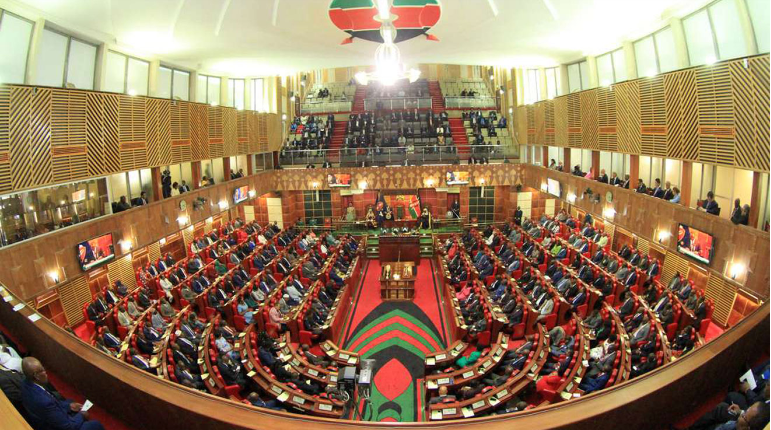
The National Assembly has passed the Public Participation Bill, 2025 (National Assembly Bill No. 44 of 2025), setting out for the first time a clear legal framework for how public participation should be conducted across Kenya’s government institutions.
The Bill was approved by the House on Wednesday, August 12, and now awaits presidential assent before it can take effect as law. If signed, the law will spell out how public participation exercises are to be carried out going forward, placing the responsibility for organising them on various public entities rather than centralising the process, in a bid to avoid over-legislating the details.

The Bill was considered by the National Assembly’s Departmental Committee on Justice and Legal Affairs (JLAC), which set out proposed principles and general guidelines for conducting public participation and identified the authorities responsible for organising it.
It also seeks to define “public participation” itself, a term the Constitution uses repeatedly, including as one of the national values and principles of governance, without ever defining it.
The law’s provisions will bind responsible authorities and the general public in matters of public participation, but will not extend to private individuals or entities that do not make or implement public policy, a carve-out intended to protect their privacy and autonomy. Its scope covers the full spectrum of governance, from budget-making to the formulation and implementation of government projects and programmes.
The JLAC report is emphatic that participation should not be bought.
“Similar to participation in elections, public participation is a civic responsibility which helps sustain and expand our democracy. Therefore, any form of financial facilitation for attendance of members of the public is discouraged because it may undermine genuine participation, result in skewed outcomes and create inequality,” the report states.
Authorities planning participation exercises are also expected to observe the principles of public finance, including the prudent use of resources.
The Bill sets out how such exercises should actually be run.
“A responsible authority undertaking a public participation exercise under this Act shall be guided by the principles that The Public Participation Bill, 2025 espouses. Public participation may be conducted through written submissions, oral hearings, online forums or any other method deemed appropriate to the context,” it states.
- Parliament allocates Sh2.5bn for public participation initiatives
- MPs extend public participation on Gachagua impeachment motion after High Court ruling
It further requires that the public be given a reasonable opportunity to express their views, that the scope, depth and duration of any exercise match the complexity and significance of the matter at hand, and that public resources be used responsibly throughout.
The legislation also designates who counts as a “responsible authority” for each arm of government: the Clerk of the relevant House for Parliament, the Chief Registrar of the Judiciary for the Judiciary, the Attorney-General’s Office, the Director of Public Prosecutions for the ODPP, and the relevant Principal Secretary for State departments.
Constitutional commissions and independent offices are represented by their Secretary or Chief Executive Officer, State corporations by their Executive Officer, county assemblies by their Clerk, and county executives by the governor.
Before finalising its report, JLAC carried out extensive public participation of its own, including stakeholder consultations and nationwide public hearings, giving Kenyans the chance to submit views and recommendations on the proposed law. JLAC chairperson and Tharaka MP Gitonga Murugara said the Bill would help bring order to how public participation is handled across government institutions.
“To avoid over legislation, we as a House have given the mandate on public participation to the various government institutions; and it is now up to them to study this Bill once it is assented to and to come up with the specific regulations as guided,” he said.
The Bill arrives amid mounting debate over how well institutions such as Parliament, county assemblies, constitutional commissions and other public bodies are actually engaging citizens. It was co-sponsored by Rarieda MP Otiende Amollo and his Ainabkoi counterpart Samuel Chepkong’a, who set out to give the country a clear legal framework for public participation in governance and decision-making.
Deputy Leader of Majority Owen Baya said Kenya has long needed such a law, noting that in its absence, disputes over public participation have often ended up being settled by the courts rather than through clear statutory guidance. He argued that the lack of legislation has cost the country dearly over the years.
“We have lost quite a lot as a country since 2010. Parliament never gave a law since the Constitution was enacted. Therefore, there was arbitrary abuse of the issues of public participation. Any small thing, if you disagree with anything, people will just rush to court to get orders to stop anything on the basis of public participation,” Baya said.
Email your news TIPS to Editor@nairobilawmonthly.com, and to advertise with us, call +254715061658 anytime of the day
