

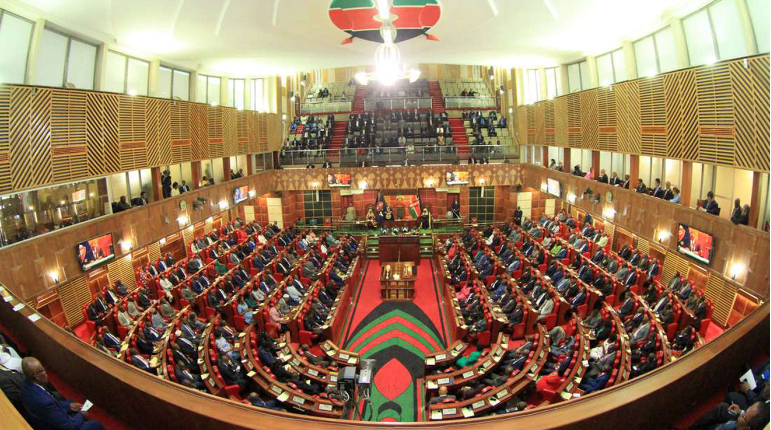
The National Assembly has dropped a proposal that would have required people nominated to county assemblies to be registered voters in the counties they represent, leaving political parties free to pick nominees from anywhere in the country.
The change was made in the Elections (Amendment) (No. 2) Bill, 2024, which the House passed with amendments on Thursday, October 22, 2026. The Bill now goes back to the Senate, where it originated, for consideration of the amendments.

The proposal came from the report of the National Dialogue Committee (Nadco), which Parliament adopted. It was intended to ensure that nominated Members of County Assembly (MCAs) had a direct link to the areas they serve.
The MPs voted to delete Clause 19 of the Bill. That clause would have added a new subsection 8A to Section 34 of the Elections Act, stating: “A person shall not be nominated by a political party unless the person is, on the date of submission of the party list by the political party, a registered voter in any of the wards in the county in which the person is nominated.”
Wajir East MP Aden Mohamed, who moved the amendment, said parties should keep control over their nomination lists. “The justification is that we want to maintain the autonomy of political parties with respect to party lists,” he said. The House also removed a proposal requiring parties to ensure fair representation of all wards in a county on their nomination lists.
Minority Leader Junet Mohamed, the Suna East MP and ODM’s director of elections, supported the move, saying parties should be left to decide who they nominate. He also argued that such a rule would be hard to enforce. “Even if you legislate here, political parties will find a way to circumvent it. I am a party operative and I know what I am talking about. Do not waste your time. You can legislate, but they will find a way around it. I assure you,” he said.
Funyula MP Wilberforce Oundo was among the few lawmakers who backed the proposal, saying it would stop parties from imposing nominees who have no ties to the communities they are supposed to serve. “This is meant to prevent abuse by political parties and cure all mischief,” he said.
“In Busia, you will find that the nominated MCAs are individuals nobody has ever seen. They do not live there. They merely come, and some of them actually reside in America.”
Some observers worry that without the ward rule, party leaders could favour areas that support them and overlook those seen as hostile. City lawyer David Ochami said the vote showed how hard it is to regulate party nominations.
“The MPs’ actions confirm what insiders have long known: that any attempt to legally restrict party nominations is practically dead on arrival,” he said.
Nominated MCAs fill special seats created under Article 177(1)(b) of the Constitution, which ensures that no more than two-thirds of the members of any county assembly are of the same gender.
The 770 nomination slots across the 47 counties also cater for marginalised groups, including young people, persons with disabilities and ethnic and religious minorities.
The Independent Electoral and Boundaries Commission (IEBC) shares out the slots among parties according to the number of elected seats each wins in a county. The nominees sit alongside 1,450 elected MCAs.
Under the current law, anyone who is a member of the nominating party when it submits its list qualifies for nomination, and Section 35 of the Elections Act requires parties to hand in their lists to the IEBC at least 45 days before a General Election.
Email your news TIPS to Editor@nairobilawmonthly.com, and to advertise with us, call +254715061658 anytime of the day
