


“I have not failed,” the great American inventor, Thomas Edison, once famously said. “I’ve found 10,000 ways that won’t work.”
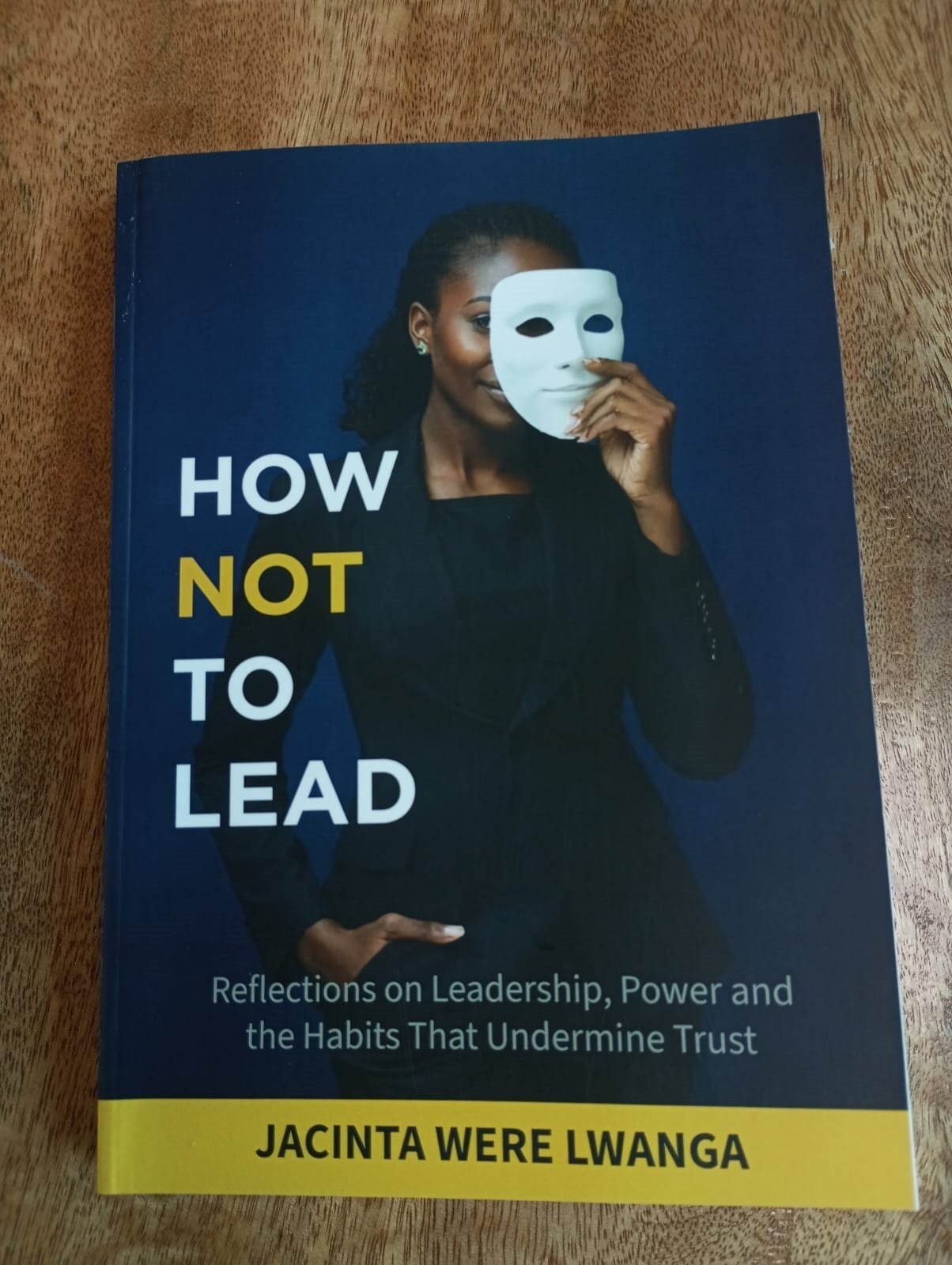
This is the wisdom that Human Resource expert Jacinta Were Lwanga invites corporate and public service leaders to contemplate in her new book, How Not to Lead. In it, she summarises her over 23 years of corporate experience and offers some of the critical lessons she has learned on leadership, power and the habits that undermine trust.
She argues that leadership is one of the most powerful and influential forces in any organisation or institution and determines whether such an institution will rise or fall and what this would mean for the people who follow — or work under — team leaders who fail to live up to the principles of good leadership.
Leadership, she says, “determines the direction, shapes culture, and influences lives across workplaces, communities, and institutions”, hence its centrality in measuring group success or determining while such groups fail. However, she does not just end at examining the 18 attributes of poor leadership that adversely affects organizational performance, she also offers a glimpse, at the end of the book, on what constitutes excellent leadership and how toxic leaders can mend their ways and become transformational.
One of the challenges that holds back leaders — and pulls down their teams — is competence, which, the author warns, can arise from incompetence, poor judgement, limited expertise or technical knowledge, unwillingness to learn or a combination of these individual shortcomings.
“When examined closely,” she says, “incompetence in leadership is often not accidental.” It can arise from a cocktail of factors, including mistaking loyalty or length of service for capability especially when promoting a person to a position of authority.
To avoid such pitfalls, Human Resource practitioners are urged to first ask themselves if the employee they are considering for promotion is ready and willing to lead. Failure to do so, often triggers a predictable cycle of operational inefficiency, low staff morale and the resultant decline in team performance and productivity.
At every point, the author proposes solutions that can help to turn below average leaders into competent ones, arguing that acknowledging one’s shortcomings is an important first step in this journey of self-transformation.
She examines weaknesses such as insecurity among leaders, dishonesty, egotism, jealousy, manipulation, and other negative personal attributes and how these lead to bad leadership and the attendant spiral effects that precipitate organisational decline. And at every step, and without being didactic, she explores ways in which these can be corrected for the good of the people working for — or under — the affected leader as well as for their team or organisation.
She also proposes practical exercises and reflective questions that can help all the stakeholders involved to evaluate themselves and chart a future that is beneficial for all.
“I have read this work with deep interest and concern,” Florence Wanguku-Kaira, the Deputy Director, Human Resources, at the Kenya School of Government, writes in the book’s forward. “It confronts leaders, aspiring leaders, and institutions with an uncomfortable but necessary truth.”
Part of that all-important truth, in the reviewer’s view, is that even when leadership is broken, it can be fixed through what the author describes as “the insight to rebuild with intention and integrity”. To achieve this, however, leaders must cultivate the moral courage to pause and reflect, unlearn harmful habits and choose the hard road of accountability over comfort. They must also go out of their way to lead in ways that build trust, and leave their followers better than when the leaders first take over the reins of authority.
Negative cultures of gossip
For instance, they must crack down the negative cultures of gossip, character assassination and favouritism among others mentioned in the book, all of which are meant to undermine their victims, damage their credibility and integrity and give an unfair advantage to those who perpetuate this corporate-killer vices.
“Leaders who avoid character assassination model integrity, fairness, and human dignity,” the author counsels, calling for cultivation of emotional intelligence to navigate such challenges, and deliberately taking steps to publicly acknowledge those who have been unfairly targeted.
Jacinta, a human Resource & Leadership Consultant, who in the past worked as Head of HR at Consolidated Bank of Kenya Limited, Group HR Manager at CMC Holdings Limited and a Communications Officer at Lutheran World Relief, counsels leaders and potential leaders that their calling demands discipline, self-awareness, integrity and most importantly moral courage.
“Excellent leadership,” she observes, “is not defined by charisma, authority, or titles. It is defined by impact. Specifically, the kind of impact that strengthens people, clarifies purpose and leaves organisations healthier.”
These are just some of the numerous insightful gems of wisdom that the author has learned from her long years of corporate experience and which she joyfully shares with the aim of influencing positive leadership in the various spheres of corporate and social life. The book is now available at Nuria Bookstore and Kibanga Bookshop Nairobi. It can also be ordered and delivered by the author through mobile Number +254 711132978. A copy is retailing at Sh1,500, a price that is worth every penny. The book is also available on Amazon for readers in and outside Kenya.
Jacinta’s is a book that every worker, present and future leader, should read to prepare themselves for the reality of navigating the complex dynamics of organisational management and leadership even at the political level. Published by Ssali Publishing House in collaboration with UNISA press, this handbook comes highly recommended for its simplicity, clarity and applicability.
Email your news TIPS to Editor@nairobilawmonthly.com, and to advertise with us, call +254715061658 anytime of the day
