

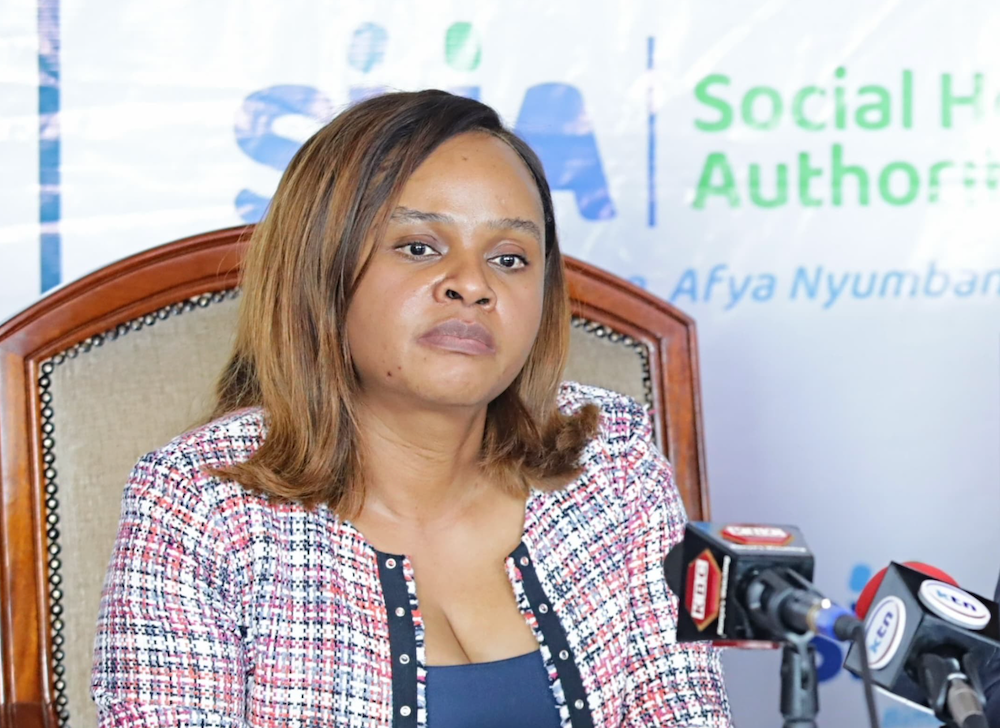
The Social Health Authority (SHA) has warned health facilities that have not migrated from the old provider portal to certified Health Management Information Systems (HMIS) that they risk losing their contracts after the current extension period ends.
SHA CEO Dr Mercy Mwangangi noted that the transition applies to all providers, whether or not they are contracted by SHA. She said no facility had been caught off guard, noting that the transition process began six months ago and involved extensive sensitisation and training of registered facilities. The warning comes as the government assures Kenyans that no one will be denied hospital care during the transition from the SHA provider portal to HMIS.

“No Kenyan will lack care because of a system. We have engaged all providers in the last six months and walked them through the journey and what it means to transition,” said Dr Mwangangi.
She noted that while a significant number of facilities at levels 2 to 4 had completed the transition, some higher-level public hospitals, as well as private and faith-based facilities, still had work to do.
Approximately 523 faith-based facilities have contracts with SHA. These organisations are transitioning with the support of the Ministry of Health through a government-to-government (G-to-G) programme with the United States (US). The US is providing equipment, training and selected HMIS solutions, where applicable, to these facilities.
According to Digital Health Agency (DHA) CEO Anthony Lenaiyara, lower-level faith-based and public facilities at levels 2 to 4 that cannot afford to purchase their own HMIS solutions will be provided with a basic HMIS package at no cost. The main requirement for these facilities is training.
“We only need to train them. It is a decision they have to make. Apart from insurance, HMIS manages the processes and operations of hospitals. We will give them the basic system to help them transition,” he explained.
The transition process is in line with the Digital Health Act, 2023, and forms part of Kenya’s broader digital health agenda, Taifa Care. The new systems will allow facilities to choose their vendors freely, provided the solutions are certified by the DHA for interoperability.
Most private hospitals already have HMIS solutions and only need to have them certified to connect to the national digital health platform. Certification costs vary depending on the level of the facility.
The certified HMIS solutions will be used to submit electronic claims, verify patients and share relevant information with SHA’s e-health platform in real time. The information will be stored in a sovereign cloud managed by the DHA, with end-to-end encryption and access controls.
“Accessing that data will be role-based since it has heavy encryption, and it is managed by the Digital Health Agency with strict guidelines on who can access it, how it can be accessed and even audits of why it was accessed,” Dr Mwangangi explained.
In addition to submitting insurance claims, the new digital health ecosystem is expected to provide SHA and the Ministry of Health with more data on individual patients. This includes information on who arrives at a facility, the procedures they undergo, as approved by a licensed professional, the medications administered and when they are discharged.
The system is expected to enhance disease surveillance, reduce duplication of services and standardise the International Classification of Diseases (ICD) across the health sector. This will facilitate the production of standardised health statistics while reducing the need for separate health surveys.
“We are building a robust Electronic Medical Records System that now has patient-disaggregated data. Each patient interacting with a hospital will be visible to the authority and to the ministry,” Dr Mwangangi said.
According to Dr Mwangangi, the new system will provide “quality surveillance activation”, enabling the development of appropriate policies for social health insurance.
This will include resource allocation and targeting areas with deficiencies in the management of specific illnesses, such as malaria and cancer.
A transition committee was formed after private hospitals requested additional time to prepare. Consequently, the government has extended the transition period for all remaining facilities to October 30, 2026.
The transition will not affect the financing arrangements for social health insurance. It is, however, expected to ease operations by reducing administrative procedures and promoting accountability.
“There is no change in how we finance insurance. We are trying to make systems in hospitals seamless. To improve patient care, we need to collect enough information and reduce duplication and administrative work. We just want to talk to your systems directly,” said DHA CEO Anthony Lenaiyara.
During the extension period, SHA and DHA will continue to provide technical assistance to facilities that have not yet completed the transition, while reminding them that failure to comply with the regulations could result in contract termination.
– By John Murunga
Email your news TIPS to Editor@nairobilawmonthly.com, and to advertise with us, call +254715061658 anytime of the day
